Kathalaya Impact Series

Your career journey?
I started working as a pre-primary teacher. I worked in pre-primary for 33 years. I worked as a coordinator for the pre-primary sector. That is when I thought that storytelling is an important aspect for pre-primary sector. I contacted Kathalaya and invited Geeta Ma’am for a workshop. At that time, I thought that when I quit my job and retire, I will be a storyteller. This was the inspiration I had that day to be a storyteller.
After I quit my job, I took storytelling as a profession. That is when I called Deiva and she asked if I could do storytelling through schools. I started working on storytelling for schools through Kathalaya. I have also done the diploma in storytelling through Kathalaya.
Could you talk about the certifications in storytelling you completed at Kathalaya?
I did an online beginner’s course during Covid. Since I had decided I work as a storyteller, it worked well. After that I did my diploma at fireflies. The Kathalaya beginner’s course covered how a story should be told. With the diploma we covered the deeper nuances of storytelling – the importance of voice, voice modulation, movements, body language, and the role puppets play in storytelling. For the diploma we interviewed a few folktale tellers and made a booklet with fairytales, folktales etc. We documented all this.
Could you talk about your interest in using puppets for storytelling?
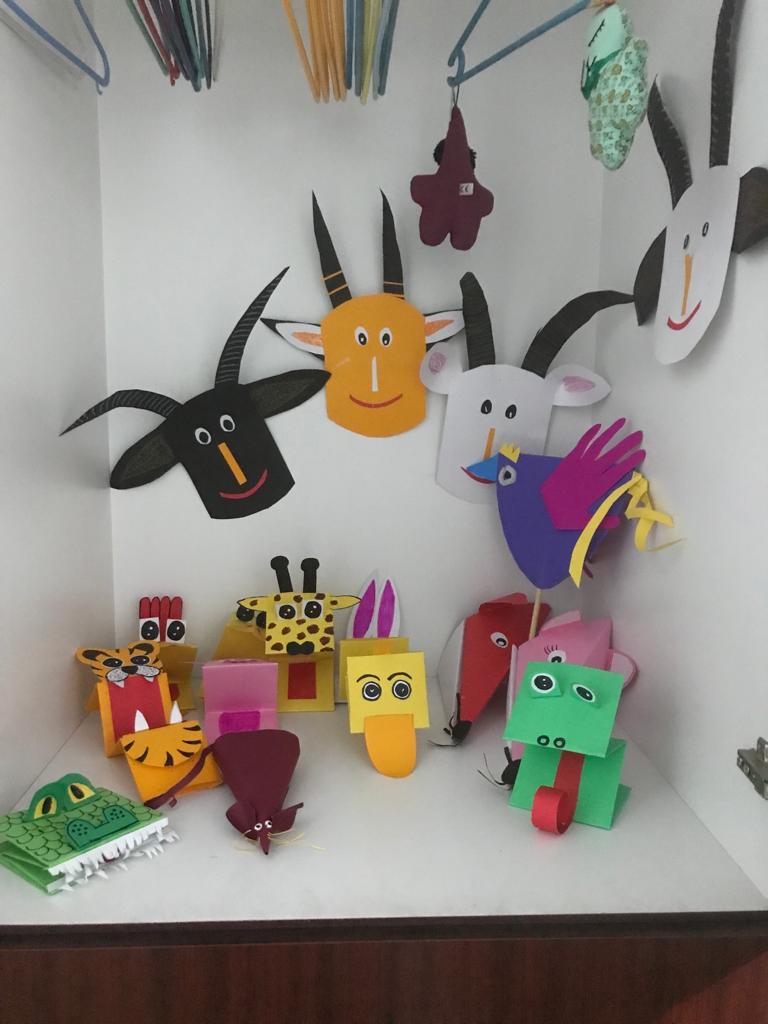
When you do the diploma in storytelling, you know who your audience is. Mine is storytelling for pre-primary children. For others it has been storytelling for adults, storytelling for senior citizens, storytelling for special children etc. Since I am interested in doing storytelling for pre-primary children or smaller children I knew that puppets will be relevant. I make my own colorful and attractive puppets. I make hand puppets and stick puppets. I have a whole box of puppets.
Could you talk about the role of sounds and voice modulation in storytelling?
When we are enacting animals, each has a characteristic sound. We use a different voice for each animal. For instance, the lion has a gruffer voice, and the mouse has a softer voice.
During storytelling sessions, voice modulations for different animals is done.
Is there a need to research ecology for storytelling?
A lot of study is needed while preparing for a storytelling session. We need to read a lot of information on nature, plants, animals, birds etc. For instance, if you are working on a story on hornbill, then you need to know if the bird migrates, if it can fly etc. You need a lot of information and facts to tell the story of an animal or bird.
Can you talk about your experience as a story narrator?
Every platform, I perform in is a different experience. Even storytelling in one school to another school is a different experience. The storytelling experience varies from when your audience has only children or when it has less children.
Could you talk about spontaneity in storytelling?
The same story can be told to a two-year-old and to a ten-year-old. You can elaborate on different points of the same story to help different audiences connect. The way you tell a story to younger children requires much more voice modulation than a story told to older children.
Could you talk about movement in storytelling?
I start my story with an icebreaker with movement. Movement helps the audience connect to the story and the teller. Through getting the audience to enact movements during the story they are able to pay better attention to the story.
How has storytelling positively impacted you?
Once I got into the profession of storytelling and stopped working in schools my perception towards life itself changed. I was able to read more. I have been meeting different types of people. My knowledge has increased. It has changed my perspective of life.
On your plans as a storyteller?
I would like to reach out to more schools, more children and do more storytelling.
The favourite story you like telling?
The story of the lion and mosquito.
Once there was a lion. The lion thought that he was the King of Jungle. He really thought that.
The lion growled.
The mosquito was trying to sleep. The lion was making so much noise that the mosquito could not sleep.
The mosquito asked the lion to be quiet.
The lion said, “I am the King of the Jungle and can do anything I want.”
The mosquito said, “I don’t think you are the King of the Jungle.”
The lion said, “I am the King of the Jungle.”
The mosquito said, “I don’t think you are the King of the Jungle.”
Then the mosquito, entered the lion’ nose.
The lion cried, “Leave me please.”
The mosquito bit the lion hard.
The lion said, “Leave me alone.”
The mosquito asked the lion, “Who is the King of the Jungle?”
The mosquito then said, “Now, I am the King of the Jungle.”
And that is how the mosquito became the King of the Jungle.
Could you talk about the use of dialogues in the story?
The more you talk in dialogues during a narration the more the children will be able to assimilate. Their language also improves. I use Kannada and associate it with English. I do storytelling at the Sharadha Mutt and I do it in Kannada and English.
Could you talk about other influences to your storytelling?
I am a trained dancer. I have been training since the age of five and have been performing till the time of marriage. This has helped in storytelling with expressions and voice modulation. I am trained in Bharatnatyam, Mohiniattam and Kathakali.
Could you talk about how Kathalaya has impacted you?
After I left school I told Geeta Maam, about joining as a storyteller and she knew what my strengths were. She knew I had been associated with schools. She suggested I do storytelling for schools for Kathalaya. We are also working on building a story curriculum.
 Learn Curve for Girls
Leave a comment