On your journey?
I have written for 15 years. I wrote for the media (newspapers and magazines) and the IT corporate set-up. I started my own website and web magazine. Here, I worked on a blog with features on the conscious space, with all things conscious like practicing Veganism, Climate Conservation etc. I also ran an online store which sold five – six products like soy candles, body butter etc. to fund my writing. I had registered this manufacturing, and it was done inhouse.
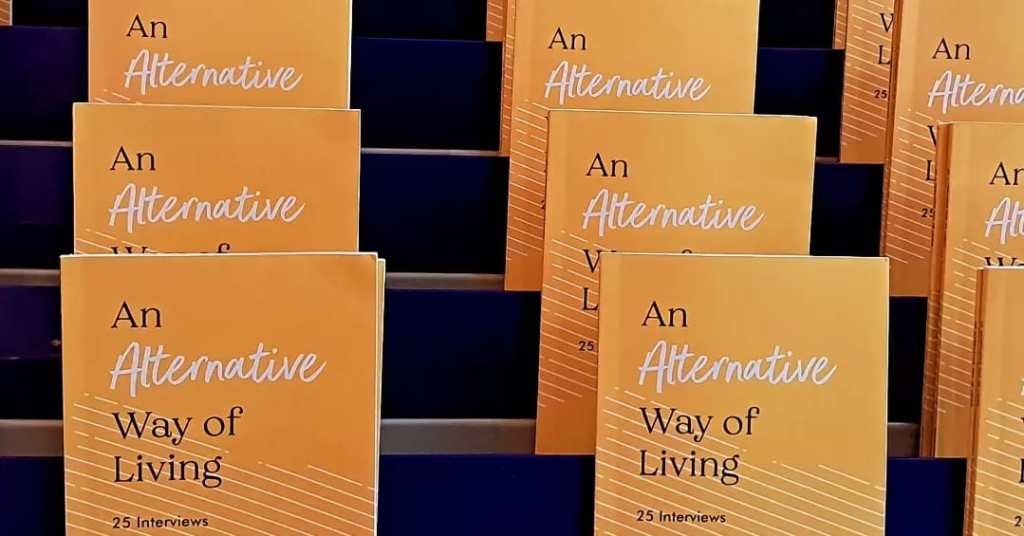
In 2018, I said goodbye to my 9-5 job. I went for a Vipassana retreat in Jaipur. Ten days of Vipassana has transformed me. As a consequence of this transformation, I realised I did not need so many things in my life. I was practicing Vipassana and gym. Because of the 10-day Vipassana meditation, my complete lifestyle changed. In my web magazine I started featuring people who practiced conscious lifestyles. And out of these interviews a published book emerged – An Alternative Way of Living: 25 Interviews.
The field of Positive Psychology talks about the importance of Positive Journalism. Do you see your work as Positive Journalism?
I wanted to document the little practices that made people feel good. I could see these practices as an alternative way of living. I wanted to focus on lifestyle practices that helped. The positive side of life is something that newspapers need to talk about. Newspapers are filled with news on criminals and scandals. Not of it makes much of a difference to the life of reader. Say there is news on a scandal in some remote part of the world how is it going to change my life or that or the reader. It is a scandal and cannot have a positive impact on my life. Now instead if I write about wearing cotton fabric it is a lifestyle practice that can fundamentally alter someone’s life. News on a criminal in Tihar Jail will not help me improve my life. People need to understand this. I met a family friend and gave him my book of interviews. I asked him to give it to his dad who is in the 70s. This friend said that his father won’t read such light stuff because was interested in serious things. Yes, knowing about the suffering and strategy of the government brings empathy and expands the mind, but so does reading a book like this.
Could you talk about the Vipassana meditation that transformed your life and set you on the journey to write this book?
I have attended 10 retreats after the first retreat. It has been six years of tremendous transformation. I can now clearly see how an alternative way of living is the direct pathway to such transformation. This is what I have explored in my book. It is the little practices that can make a huge impact. I was a big fan of milk tea. I interviewed people following veganism and saw it as an important alternative practice. I could see after the interview how we are depriving cows of milk and not giving calves their full share. I have written on cotton fabric. We resort to synthetic fabric because it is easy to maintain. But is it good for us? After Vipassana, my view of things has changed. I have a wider view and a clearer view.
How have these practices impacted your writing?
I have started to write better and with more clarity. My thoughts flow in a straight line. I have a wider view of being a human being. A lot of my stories revolve around the themes of impermanence and acceptance – these are practices from Buddhism. I wrote one story about a girl who gets a million gifts for Christmas. Initially these gifts are very exciting for her. But in time she realises the problems – like how they slow her down. I don’t subscribe to what the world asks you to think. I have an independent school of thought.
Could you talk about the ‘little practices’ covered in your book?
The book lists around 20 practices. One interviewer has been wearing natural fabric for 25 years. When you wear natural fabric the body feels better. Traditionally fabrics of India were made from natural material. Two of the interviewees are working on garbage management which is very important for a country like India where there is no understanding that garbage needs to be managed. A Bollywood actress talks about how children need to be graded not just for knowing things in textbooks but for their understanding of plants. We need these alternative practices in today’s India which is full of European brands and style aspirations. We are forgetting good practices. The idea is not to hurt oneself, others and nature around us.
When talk about not hurting do you mean Ahimsa?
Ahimsa is a strong word; it has connections with violence. By not hurting I mean not causing them pain even in little ways.
Could you talk about mindfulness in connection with conscious living?
I see mindfulness and conscious living as synonyms to each other. A lot of people associate mindfulness as being only present in the present moment, but I see it as same conscious living. Being mindful about how you are talking, how your actions are affecting the other person, being mindful about what you eat, what you wear – these are some aspects of mindfulness.
How do you define conscious living?
Living in way that does not hurt me, hurt you or hurt the nature around.
How has writing this book changed and influenced you?
I have adopted a lot of the practices I have written about. I have turned 80% vegan. My wardrobe has 85% natural fabric. I have become mindful of the fabric I am wearing. I learnt about a new practice called permaculture, so I learnt something new. I turned into a minimalist. In 2023, I didn’t buy anything. I realised had so much already. In Delhi, known for its small shops I shopped for all of Rs. 5000 for one year.
Could you talk about the book?
I have written about eating mindfully, sleeping mindfully and behaving mindfully. The book launched on July 18th. A lady told me during the launch that the book is very good and different. A friend of mine Niveditha started writing with Morning Pages, a practice documented in the book. In a sustainability event, all participants were given a copy of the book. A book like this can impact the collective consciousness.
Your future plans?
I am writing an autobiography on being on the conscious path. I am also working on a book of interviews on Vipassana practitioners and how the practice has helped them transform.
 Learn Curve for Girls
Leave a comment