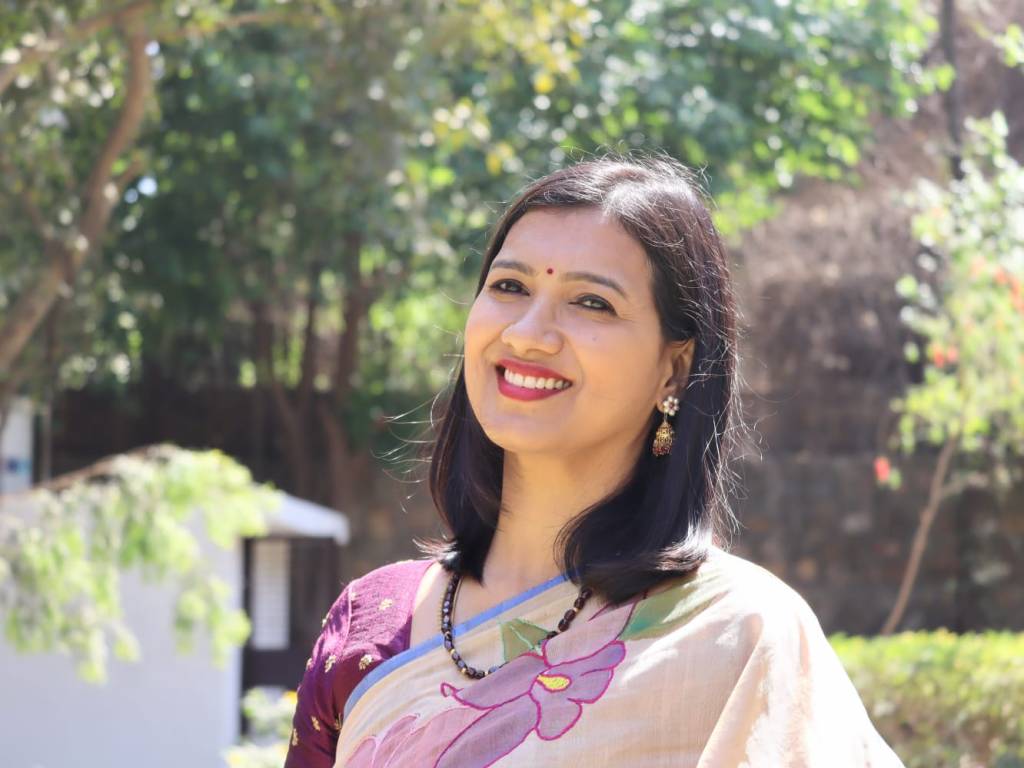
About your background?
My background in education is a Masters in English Literature. Before that I did a Bachelors in Nutrition. Since 2000, I have been in the field of English Language Teaching. I have been teaching English in different schools. And I started using stories and storytelling for English Language Teaching. My background to storytelling is that I am trained in Bharatnatyam, Kuchipudi and in Rabinder Sangeet. I have worked in the All India Radio. I was a part of an oration club in Secunderabad. I learnt the flute and the violin. My parents put me in Chinmaya Mission at an early age and here I learnt to chant the Bhagvat Geeta. There was an environment and culture of stories, music and dance here. Formally I started telling stories to my students in 2000.
I grew up living in 13 states in the country. Everyone in my family speaks 4 to 5 languages, extended family included. I have had a multilingual and multicultural upbringing.
On your journey as a storyteller?
I loved telling stories. In 2000, as an English teacher I realised that narrating stories was very useful for schools and children. I had done stories before in the All India Radio. I had recorded Alice in Wonderland as a series there. But this was chosen by my boss. But in 2000, I chose to tell stories in the classroom because I thought it was beneficial. Children could relate to the stories better, be more enthusiastic about the language, talk in English and turn in homework. In 2005, I studied teaching English in the English and Foreign Languages University. I could connect the dots back. I could see what I was doing with storytelling in the classroom was working. And I could connect the dots forward. What I did at EFLU I could use as a teller and in the classroom.
Another milestone was, in 2010 I started singing songs in my stories. In 2011, I got a project for Dasaavatram for children of NRI. I sat with my Kuchipudi teacher and composed the story in English and also with Sanskrit and in other Indian languages. The performance included narrating the story with music and dance – a style I continued since then.
In 2017, I founded the Story Arts Foundation as a trust to work with the Government and NGOs. Starting 2016, I started travelling internationally for my work to do stories from the Indian culture and perform them for a global audience. My focus has been on stories found in the Indian culture.
Your favourite story?
This was one that my father told me. He was my first storyteller at home. He would often narrate the story of Yellaam Nanmaikku. There was King and he had a trusted minister and he would keep saying Yellaam Nanmaikku Yellaam Nanmaikku. The king would find this irritating some times to hear Yellaam Nanmaikku – everything was good. One day the King ate a lot of Brinjal and got a little ill. Physicians were called in. And still all the Minister could say was ‘Yellaam Nanmaikku’. The King was furious and threw the Minster in jail. Still all the Minister could say was ‘Yellaam Nanmaikku’. The next day the King and his troop went on a trip to the jungle. A thorn pierced the King’s hand and he ended up with a bandage. Meanwhile, without the minister, the King and his band got lost in the jungle. They reach a place where there are jungle dwellers who are going to make a sacrifice. The King realised he was going to be sacrificed. The drum rolls started for the sacrificial ceremony. But the sacrificers soon realised that the King was an imperfect sacrifice as his hand was bandaged. The king was released and he and his troop reach the palace safely and realised that Yellaam Nanmaikku, all was good. The King had his minster released. The Minster was still in a cheerful state of mind. The King asked how come the Minister said Yellaam Nanmaikku to being thrown in jail. The minster said, ‘They didn’t sacrifice you because your hand was bandaged but if I had joint the troop and they would seen I have no bandage and sacrificed me. The King agreed – Yellaam Nanmaikku.
I had heard this story from my father and narrated it frequently to my children. Once when I was disappointed with something my younger son said Yellaam Nanmaikku. So, the story came back to me. My father, me, my children and from my child to me – that’s how the story travelled.
Your favourite Indian story collection?
Stories from the folklore of India and our Itihasa Puranas. I feel deeply connected to stories of our land. It has something to do with my style of narration – which is very Indian. I like narrating stories from the Ramayana for children. For myself, i like reading the Upanishadic stories.
Any world geographies, whose stories you enjoy?
I enjoy listening to all narratives – Norwegian stories, African Stories, Australian Aboriginal stories. I find that stories from Africa have a lot of music and are extremely lyrical. They have a special quality of language and orality in them. When I had been invited by the University of South Africa to visit six schools in the municipality I realised that reciting African poetry was a part of the African culture and tradition. This was apparent as child after child recited African poetry in a particular manner. They have a tradition of oral poetry recitation. Even if you don’t understand the language, you will feel the power of the cadence.
How would describe your connection to storytelling?
Just like some people like cooking and specifically cooking for others. Storytelling for me is like that. I like to cook a story and share it with others. With storytelling, we sit down, share a story and listen to it together.
You use a lot of rare musical instruments in your narrations, could you talk about these?
I look for instruments whenever I travel. They are not new in my life. I started playing a palm sized piano when I was 10 years old. I learnt the flute for one year. I learnt musical instruments at Bal Vihar and Bal Vikas, the majeeram, harmonium, cynabal are all used in Indian bhajans. I have a very interesting musical collection. Many of my musical instruments are from distant and far off places. This bird made from clay is hollow inside. You have to fill this water inside. With the water, the bird will make a chirping sound. I got the Xutuli from Assam.
From the Haridasus, who are Harikatha performers in the state of Andra Pradesh, i got this musical instrument the Alandu. My friend came from Australia and was attending a Haridasu performance and got this for me from them. These are not available commercially in shops.
I got the Dapu from Malayasia, it is made from monitor lizard skin. I soundscape my stories. I am a storyteller and not a musician. While narrating stories my focus is on the storytelling not a musical or dance performance.
I used a rattle in the Banyan and the Sparrow story. Rattles are common for children and are available everywhere. My focus is in getting the right music for the storytelling. I have the damaru. It is played with the rope, not the hand or the stick. I got this Shaker from Pondicherry. It is made of dried seeds. All cultures have such musical instruments. I got cymbals from Dharmashala with typical Tibetan patterns embossed on them. From Bengal, I got the Duitara – which has two strings. Baul storytellers use this instrument. I got this from Baul singers when I was attending a children’s writing residency in Bholpur, Shantineketan. In Nepal I got a meditation bowl that has a nice resonance. In Kolkata, I got the ocean drum, which creates sounds of water. From Northeast Thailand, I got the flute. I was visiting a music department of University where I had been invited. The flute has to be rotated to create the sound – a sense of sadness or happiness depending on what you want for the story.
 Learn Curve for Girls
Leave a comment