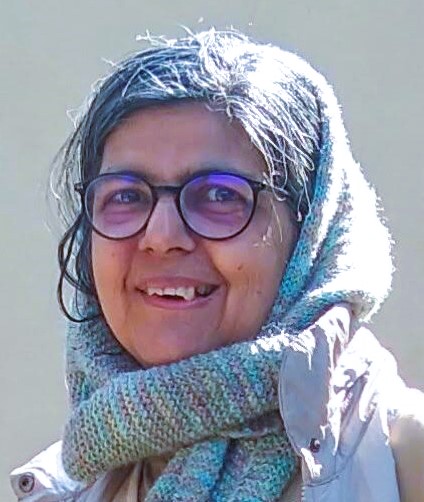
Your career journey?
Because of street theatre, and related activism, which I got introduced to when I was 17-18, I didn’t follow the set career path I could have, like being in full-time teaching or journalism. I did not want to join set institutions.
Writing has been my mainstay in terms of meaningful work. I write in English and Hindi, and have written a number of books. In 2003 I wrote a book on single mothers – Home Truths: Stories of Single Mothers. These are narratives of women who have a child or children outside the structures of patriarchy – adoptive mothers, divorced women, widowed women, women who never married etc. The inspiration came for this from myself being a single mother — I brought up my daughter on my own, and the book came out of my own experience, because I needed to know such stories, to help me and other women also. There are these common beliefs that I wanted to challenge, such as ‘Divorce leads to broken homes.’ There’s a space that opens up – the freedom that comes from being single, taking the decisions. We are different, which need not be a problem.
I was able to interview many other single mothers in this research project. I had won a MacArthur Foundation grant to do this 2 year research project. The book was published by Penguin. I wrote the Hindi book also – Ekal Maa: Maut bhi tum se haari hai (Single Mothers—You triumph even over death).
My next book was on Nautanki – a folk theatre form, very popular in India for 100 years till the 1960s-70s. It was an operatic theatre form with music, dance, dialogue, stories, and initially done only by men. I wrote the book on Gulab Bai who was reputed to be the first woman actor in Nautanki. I did the book Gulab Bai: the queen of Nautanki Theatre. Gulab Bai was from the Bedia caste–a dalit caste. They were on the margins of respectable society, completely on the periphery. Gulab Bai was awarded the Padma Shri, for her singing. These women were actors, singers, directors, experts in everything they did. This book was also published by Penguin. It is a biography of Gulab Bai, as well as a social history of the Nautanki genre.
My third book was different – it was on Peace Activist Irom Sharmila. The story of her life and the story of Manipur. There have been women’s struggles in Manipur, as a part of anti-colonial struggles. These women’s wars of the 20th century were known as Nupilan – Nupi being the word for women in Manipuri. Well known for struggles, this is the community of women Irom Sharmila came from. She was protesting state extra-judicial killings by armed forces. Under the Armed Forces Special Powers Act, rapes and killings took place which were state-sponsored violence. In 2004, elderly women protested the rape of a 34 year old woman. The elderly women protested and disrobed in public, expressing their rage. In these contexts, Irom Sharmila was protesting. She went on a hunger strike, demanding the withdrawal of the Armed Forces Special Powers Act. Irom Sharmila was sent to jail and force-fed through a nasal tube. I met her both in jail and in the hospital. This is a book about Irom Sharmila and the Manipuri people’s struggle for peace. I have also written the book in Hindi and it has also been published.
I have written on Jaggi Devi, a Dalit freedom fighter who was born in 1918. I met her in the 1980s and she died in the 1990s.
I was also writing for magazines, journals and newspapers. Thereafter, I wrote a book called Her Stories: Indian Women down the ages – Thinkers, Writers, Rebels, Queens. Some of them are women we know while some are known only in their local areas. It covers a span of 3000 years. It is interesting to retell the stories of women, to write with historical authenticity without the limitations of biased historical writing.
I have also been a teacher. I completed a PhD in political science, a BA in Economics, and an MA in Philosophy, all from Delhi University. When I was around 40, I began teaching in Lady Shri Ram College in DU. Though I did not take it up full-time job, sometimes I had up to 18 classes a week. I taught in the Education department and the Journalism department. I provided Social Sciences inputs into these two departments, both of which are career focussed – education and journalism. I brought in my life experiences to connect with young people. I taught briefly in the Tata Institute of Social Sciences, Mumbai. And in Dayalbagh Educational Institute, a university in Agra. There I designed several courses in the Social Science Faculty and taught across B.A., M.A and research scholars. It was a different cohort of students there, very different from Delhi or Mumbai. They all had to wear a staid white uniform, in college!
Apart from this, I took up a number of consultancies. I was a consultant on social issues for UN agencies, Action Aid, National Foundation of India, Aga Khan Foundation etc. This too was an interesting career for me. I went to remote parts of the country, to evaluate, document or advise them on projects.
Could you talk about the biases in history writing especially in writing women’s histories?
All the books I wrote were concerned with social organisation and patriarchy. All are concerned with gender. I grew up as a very quiet and frightened child. My own experiences and feelings, very personal, made me sensitive to biases in society. One has to have an eye for this. I could see an opening in street theatre. In the theatre workshops we would talk about our experiences – about sexual harassment, our mother’s pain, our overworked mothers. My mother would wake up at 3:00 every morning, to cook, then go to work. She was so creative, but she burnt herself out. I learnt storytelling from my mother.
When I look at books and search for women in history, women are just not there in the books. There are queens in books – but these queens were seldom in power. What we read about women in royal households, are daughters, wives and royal mothers. When we read these accounts we don’t see the agency and possibilities of women. The history writers often don’t know about these aspects of women’s lives and don’t mention important things, like the overwork. We talk in terms of ‘father of science’, ‘father of sociology’ – but women pioneers in the same areas were ignored. Women in history books are stereotyped nonentities. Androcentric biases exist in every discipline, and feminist scholars are countering this. The figure of women in history books must be made more full and perceptible with information about their identity, thoughts, public and personal life, strengths and frailties.
My joy has been to stand in the way of patriarchies, challenge their stereotypes, and to look and see the hidden aspects, the invisible histories, what has been happening with human beings, with society, all around. There have been so many voices in history and so many versions, histories and her-stories. Even very powerful women had to fight many different types of social systems. There were the Begums of Bhopal who were excellent administrators, and very concerned about girls’ education. The Buddhist nuns of the 6th century composed the first ever women’s poetry known in the world. The stories of these women are available in Buddhist literature, as little more than sketches. When I thought of this book – ‘Her Stories: Indian Women Down the Ages…’, it was to re-imagine women’s lives by standing in their shoes, as it were. In 56 short chapters, I retold stories of many women, each more interesting than the other. I wanted to write about women with their own voice and their own energy.
Even the women mystics revered in India – Andal, Karaikkal Ammaiyar, Meerbai… — their stories need to be brought to life through feminist perspectives. On Meerabai there is this familiar story that she merged with the idol of Krishna. But there’s also an another story, of how the king sent a group of Brahmins to drag her back to Chittorgarh, because she was bringing bad repute to the Rajput kingdom. She was to be carried forcefully, but instead of submitting to this fate, she chose to end her life, by walking into the sea. This story honours her resistance, her her agency. We can rewrite these stories, based on oral histories, fragments of documents, similar to stories we ourselves have seen, understood. We have to ask these questions of women in history – ‘What was her life like?’ ‘What was her story?’ ‘What did she want?’ ‘What did she do?’
There is so much to learn, beyond biases of gender, caste, class etc. Nangeli was a Dalit woman who cut off one breast as a form of protest, because she had to pay tribute to the upper castes, in Travancore. They would not let the Dalit women wear upper body clothing. News of her protest spread, and the rules finally had to change.
Could you talk about your work in Feminist Street Theatre?
The street theatre book I wanted to do since years, the motivation came from my involvement in feminist street theatre during 1980s-90s. Feminist street theatre involved – such a transformation, such an energy – I wanted to communicate the memory, the emotions, the solidarity and the joy of friendships.
The theatre was held in public spaces. We were women-predominant groups with performances of plays like Om Swaha. The plays were anti-dowry and anti-domestic violence. These were important plays. Street theatre performance was in streets, markets, parks, resettlement colonies, in colleges and homes. slum. Actors were across class, college students, working-class women, and we made friends – close friends.
Theatre workshops were the basis of creating most of the plays. There was a common political urgency, a need to communicate certain messages. The plays were collectively produced, sometimes there was no written script.
We were working on our fraught systems – working on how patriarchal institutions, like marriage, are moulded. Plays like Om Swaha expressed these concerns and more. We were fighting for certain ways of thinking. We were fighting for a freer life. We were doing all this in Ehsaas. This play showed gender socialisation, sexual harassment, household roles, all in a very familiar manner. We were a women students’ group. We were footloose, independent-minded young women, wearing colourful clothes, ordinary salwar-kurtas. Audiences asked questions during post-performance discussions, about social change, and a lot of ground was covered. We performed in many places in Delhi, Lucknow, Aligarh and in Bhopal at a big theatre festival. We were an involved group. We believed in the power of street theatre. We refused to accept unequal social systems and would talk about everything – difficult lives, personal choices, lack of respect for women.
Street theatre performances could be viewed by all. They were performed as forms of protest and agitation. It was agitprop without the propaganda (prop). It was quality theatre, with wonderful directors like Rati Bartholomew, Maya Rao, Anuradha Kapoor, Tripurari Sharma, Madhushree Dutta, Jyoti Mhapsekar. Actors were mostly amateurs. The whole essence of the women’s movement was enacted through street theatre. We just connected organically to each other as a part of the street theatre experience.
In Om Swaha Kanchan asks the audience, “What should I do?” She was being badly abused by her husband and in-laws. Should she continue to adjust, or should she leave? It was based on a real story. People in the audience said – Kanchan should leave rather than suffer and die. The play brought about a change in their mindset.
The movement faded after the 1990s due to many reasons. It is hard to find today feminist street theatre groups of that sort. It was then a women-led and women-predominant group. Women actors often find it difficult to continue, given their multiple responsibilities, at work, at home.
It was my keen desire to document feminist street theatre as it existed in India of the 80s. I wanted to write the histories of feminist street theatre, to answer questions like – “Why did the women create feminist street theatre?”, “Who were the women in feminist street theatre?”
If I had not been able to do the book, probably such a book would never have been written. In 2014, I started writing the book. It took time to get scripts, photos, conduct interviews, and get inputs of people involved in the plays. Half of the work involved sourcing the plays, reading, translating, selecting excerpts, doing interviews, making transcripts. The other half was writing, analysis, putting it all together. I was also working on other things. The book took ten years to complete.
Working on the street theatre built many types of skills – of speaking, listening, interacting with large audiences. People went on to work as teachers, lawyers, human rights activists, writers and journalists. There is a continuous teaching and learning in street theatre. We articulated feelings, issues, because we could do it collectively. It built us as individuals and we could continue to work in activism and education in many ways after the theatre.
The streets of India were not crowded with traffic then. We did plays in parks, outside police stations, at protests, in houses — courtyards (angans). There were many public venues where we performed. Later the streets changed, and also performances are banned in many public venues. There was globalisation, there was rise of social media — all that impacted the street theatre.
The project of the book was to hear and record different voices and campaigns that constituted feminist street theatre in India. The women’s movement was strong and there was a lot of street theatre by women, I have been able to cover some of it, in Delhi, Maharashtra, Bengal, Chhatisgarh, UP etc but of course not all of it. Plays took up issues of violence, also communal violence.
Street theatre is done in places where people congregate. We would go anywhere and perform, we would find the audiences. We would create a circle, and the audience would sit or stand all around. There was eye contact with the audience. We would just let people gather, and participate. There was no backstage, it was all very spontaneous.
It was all very focussed on bringing about change in the minds of the audience. So many possibilities arose. Sometimes the plays were done in small gatherings. The plays were very engaging with a lot of symbols and images. Plays were open-ended, with a lot of urgency and issues. The street theatre was full of the power of feminism. There was a great deal of singing, popular songs like – “Babul ki duayein leti jaa” as well as specially created songs.
Most people in the audience would stay and watch the whole play. Therein lay the power of this performance art form.
Could you talk about the possible revival of the feminist street theatre tradition?
It is hard to find street theatre now in the traffic filled streets of Delhi. But in UP, in Bundelkhand women’s groups still create and perform plays. In rural areas, street theatre of this kind remains a possibility. Vanangana, the women’s organisation in Bundelkhand, makes plays based on real events, like we did. It is a very powerful way of talking about and understanding issues, leading to participation and social change.
In urban areas, feminist street theatre can never come back to what it was – there is too much traffic, policing of areas, a clamping down on street performances and protests. All this means revival of that particular form of street theatre is not possible. But feminists are engaged in many experiments, in theatre, art, music, and cultural activism continues to be an important way to raise issues.
 Learn Curve for Girls
Leave a comment