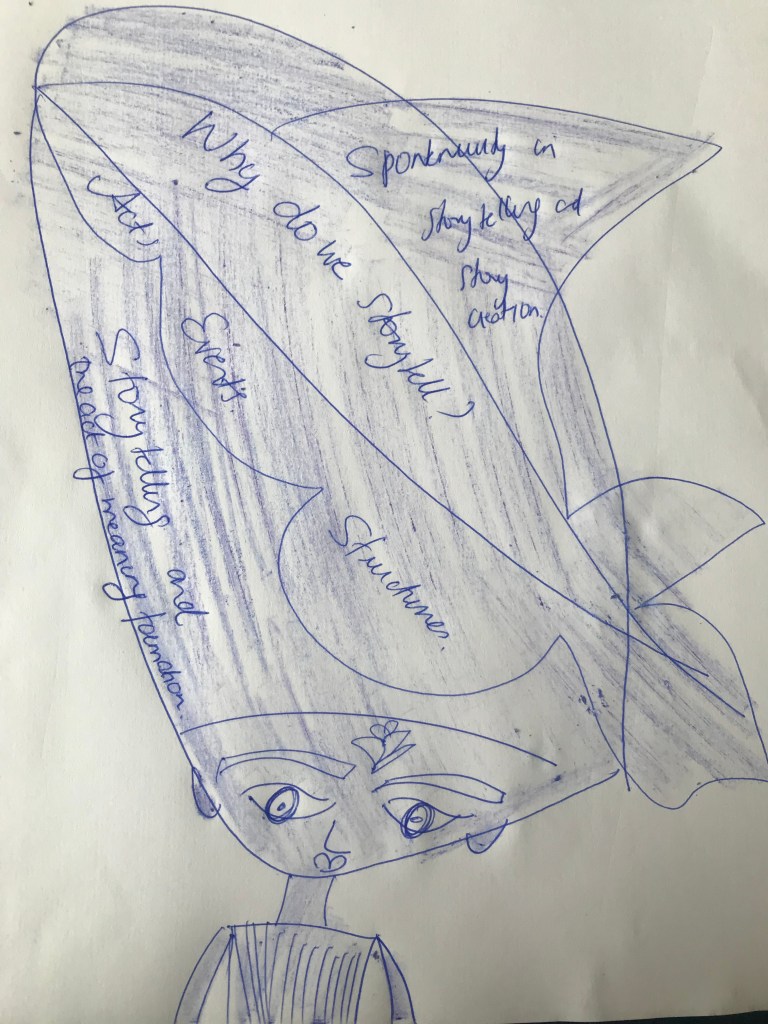
Why do we storytell? – Art
School Story Curriculum
Subject: Space
Topic – Triangulum Galaxy
Anika built a space travel machine. With this she travelled to the Triangulum Galaxy which was 2.7 million light years from Earth. In this galaxy, she observed one thing. She could see Earth with her eye. Subsequently she returned to Earth and noticed that she could see the Triangulaum Galaxy – one of the most distant objects visible with the eye – from Earth too.
Subject – Mathematics
Concept – Area of a rectangle
Definition – Area of a rectangle = length * breath
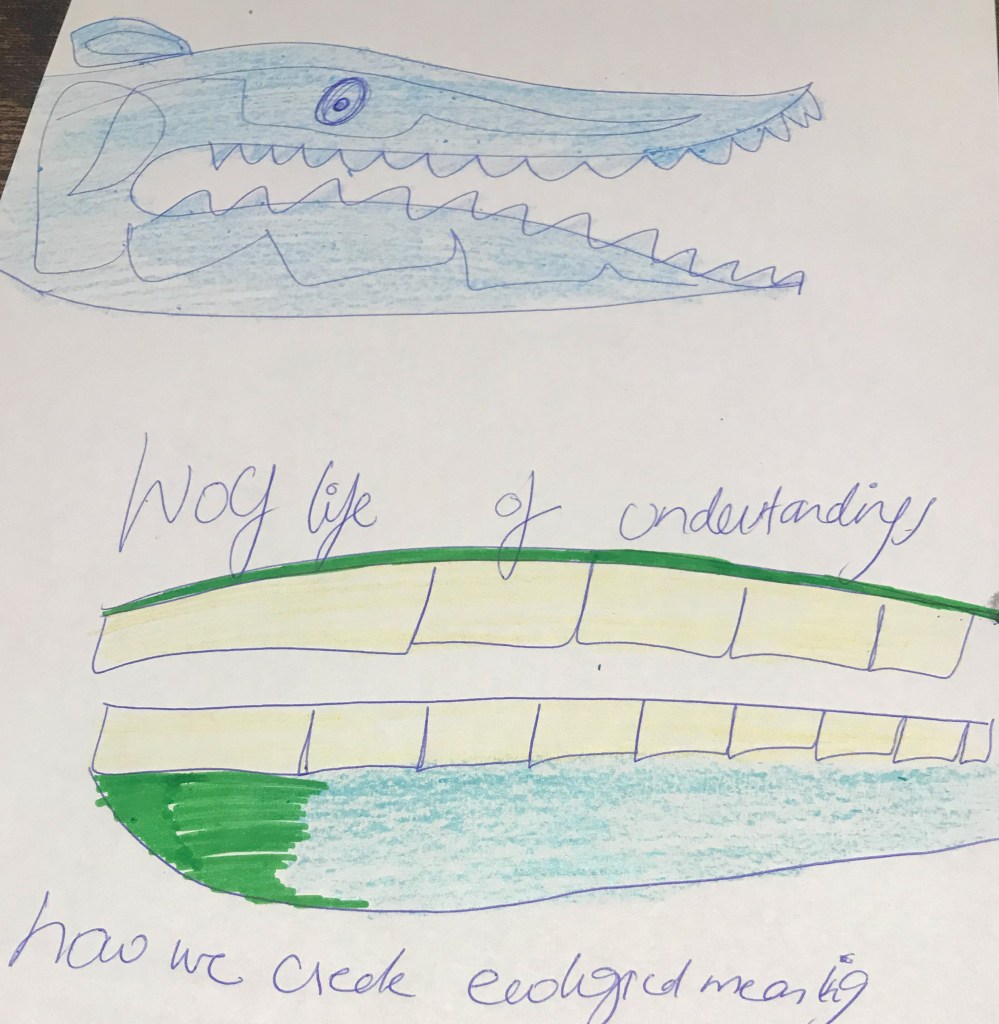
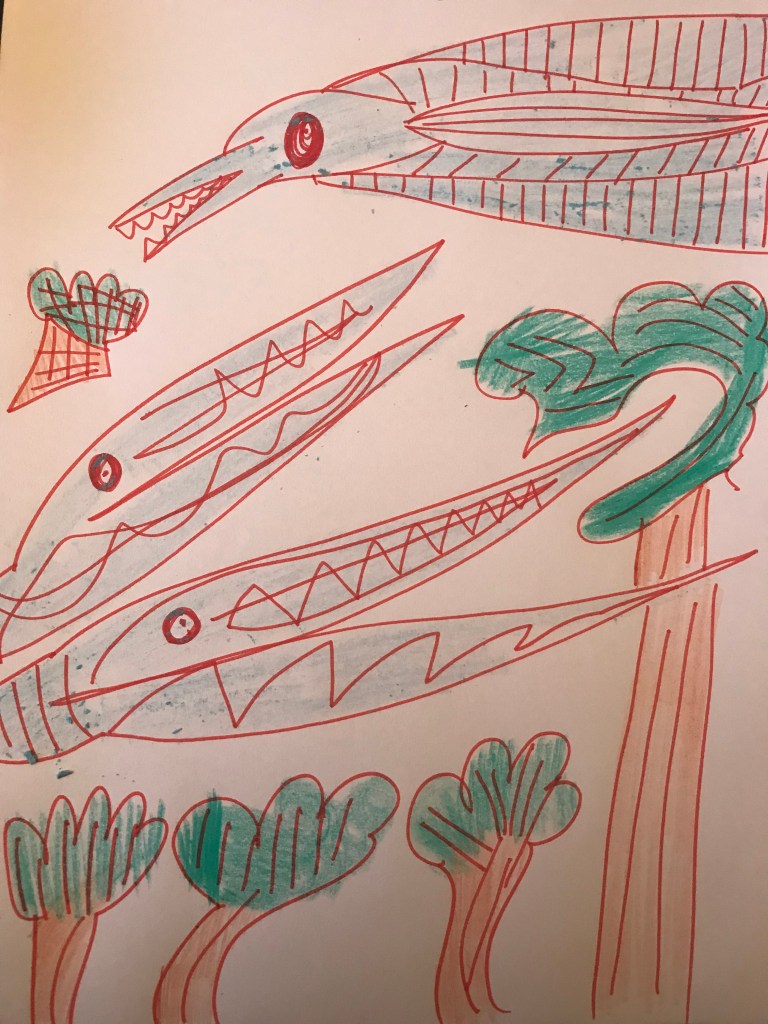
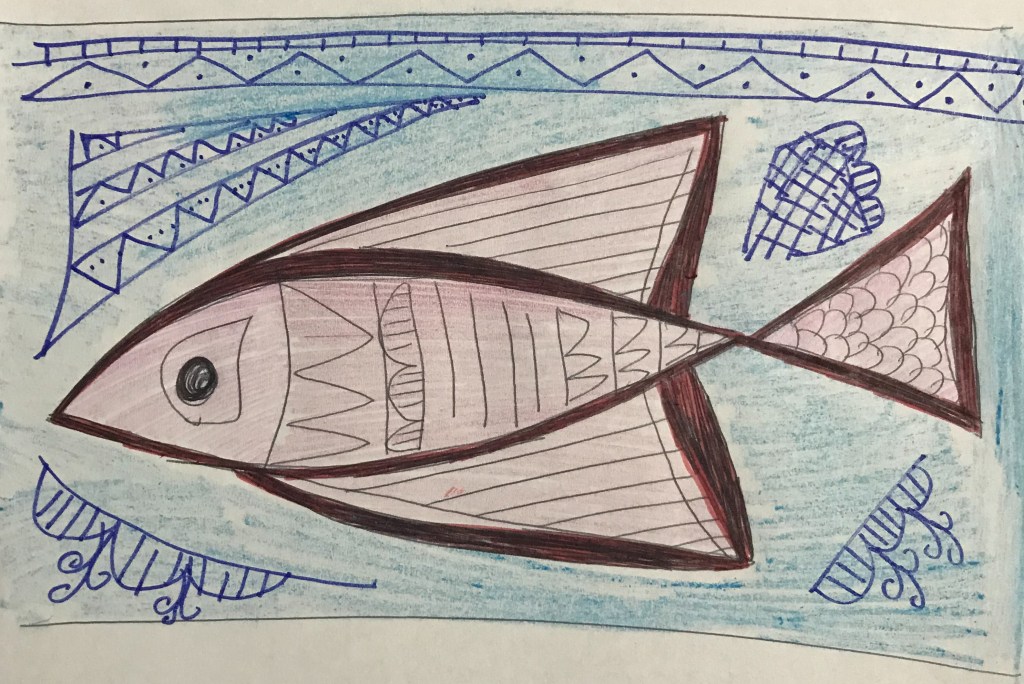
Once a fish was swimming in a pool of water filled with pink lotuses. These lotuses would not fade as they were ever pink lotuses. They were magical lotuses. The magical lotuses would
radiate a particular vibratory force with the mantra om hum. Bees would buzz near the lotuses. One day, a prince drew a rectangular piece of paper. The fish wanted to know the area of that rectangle. And it swam up to the lotuses for help knowing they were very wise.
The lotuses said, “The longer side of the rectangle is called length and the shorter side of the rectangle is called breath. The length into breath of the rectangle is called the area of the rectangle. The bees buzzed with joy on hearing this formula. The fish swam in circles in joy.
Book Review: Walking Out, Speaking up – Feminist Street Theatre in India by Deepti Priya Mehrotra

A book on theatre and dissent, Walking Out Speaking up – Feminist Street Theatre in India by Deepti Priya Mehrotra is a book which is at once academic and rooted in social reality. Walking Out Speaking up – Feminist Street Theatre in India is a book made of fragments, fragmented as our lives are by dowry and social lies. The fragments comprising this book are quotes from interviews, extracts from plays in Hindi and English, photo documentation, news excerpts, feminist activism as a lived experience etc.
The book is a study and a very very meticulous study of the methods and formulations of the street theatre in North India that started with a wish to stop dowry deaths and other crimes against women. Om Swaha is a play on a dowry death, made personal and immediate through the commitment and agency of the method of street theatre.
Ehsas, a feeling and a street play, can be sensed so clearly and evocatively through the means of this book. The book almost takes us through a video journey of brilliantly apt images that bring Ehsas to life.
Images stark and real, images of death and murder, images colourful and on the dangerous invocations of fire in India today that would have made our ancestors from the prehistoric era who discovered the many positive uses of fire shudder, images of that which can be understood and images of that which has to be explained – images of feminist street theatre in India.
Feminist street theatre in India is an important part of the woman’s movement in India. Delineating the structure of the same is this book, a ready manual of intense writing which is at once self-aware and socially conscious. Feminist Street Theatre in India is both a subject of deliberations and actions.
Feminist Street Theatre can be understood as a grassroots movement lead by scholars and academics – central to our understanding of how to respond and react to that which is the content of our daily newspapers.
Feminist Street Theatre in India is a collective and movement lead by the chance and often lifechanging meetings of actors, feminists, activists, directors, scriptwriters, theatre coordinators over the outrageous and enraging contents of daily news. News – short and impersonal, hardly evocative and image based but full of reality as we never want to know it forms the basis of feminist street theatre in India.
News and journalism if the backbone of a society and culture, then theatre especially feminist street theatre is its secret mystical kundalini or serpent power – magical and powerful at once.
Watch the news and experience its horror and discover solutions for the realities it photographs and who better to help in this than feminist street theatre – a magical portal of learning and democratic processes?
Your career journey?
Because of street theatre, and related activism, which I got introduced to when I was 17-18, I didn’t follow the set career path I could have, like being in full-time teaching or journalism. I did not want to join set institutions.
Writing has been my mainstay in terms of meaningful work. I write in English and Hindi, and have written a number of books. In 2003 I wrote a book on single mothers – Home Truths: Stories of Single Mothers. These are narratives of women who have a child or children outside the structures of patriarchy – adoptive mothers, divorced women, widowed women, women who never married etc. The inspiration came for this from myself being a single mother — I brought up my daughter on my own, and the book came out of my own experience, because I needed to know such stories, to help me and other women also. There are these common beliefs that I wanted to challenge, such as ‘Divorce leads to broken homes.’ There’s a space that opens up – the freedom that comes from being single, taking the decisions. We are different, which need not be a problem.
I was able to interview many other single mothers in this research project. I had won a MacArthur Foundation grant to do this 2 year research project. The book was published by Penguin. I wrote the Hindi book also – Ekal Maa: Maut bhi tum se haari hai (Single Mothers—You triumph even over death).
My next book was on Nautanki – a folk theatre form, very popular in India for 100 years till the 1960s-70s. It was an operatic theatre form with music, dance, dialogue, stories, and initially done only by men. I wrote the book on Gulab Bai who was reputed to be the first woman actor in Nautanki. I did the book Gulab Bai: the queen of Nautanki Theatre. Gulab Bai was from the Bedia caste–a dalit caste. They were on the margins of respectable society, completely on the periphery. Gulab Bai was awarded the Padma Shri, for her singing. These women were actors, singers, directors, experts in everything they did. This book was also published by Penguin. It is a biography of Gulab Bai, as well as a social history of the Nautanki genre.
My third book was different – it was on Peace Activist Irom Sharmila. The story of her life and the story of Manipur. There have been women’s struggles in Manipur, as a part of anti-colonial struggles. These women’s wars of the 20th century were known as Nupilan – Nupi being the word for women in Manipuri. Well known for struggles, this is the community of women Irom Sharmila came from. She was protesting state extra-judicial killings by armed forces. Under the Armed Forces Special Powers Act, rapes and killings took place which were state-sponsored violence. In 2004, elderly women protested the rape of a 34 year old woman. The elderly women protested and disrobed in public, expressing their rage. In these contexts, Irom Sharmila was protesting. She went on a hunger strike, demanding the withdrawal of the Armed Forces Special Powers Act. Irom Sharmila was sent to jail and force-fed through a nasal tube. I met her both in jail and in the hospital. This is a book about Irom Sharmila and the Manipuri people’s struggle for peace. I have also written the book in Hindi and it has also been published.
I have written on Jaggi Devi, a Dalit freedom fighter who was born in 1918. I met her in the 1980s and she died in the 1990s.
I was also writing for magazines, journals and newspapers. Thereafter, I wrote a book called Her Stories: Indian Women down the ages – Thinkers, Writers, Rebels, Queens. Some of them are women we know while some are known only in their local areas. It covers a span of 3000 years. It is interesting to retell the stories of women, to write with historical authenticity without the limitations of biased historical writing.
I have also been a teacher. I completed a PhD in political science, a BA in Economics, and an MA in Philosophy, all from Delhi University. When I was around 40, I began teaching in Lady Shri Ram College in DU. Though I did not take it up full-time job, sometimes I had up to 18 classes a week. I taught in the Education department and the Journalism department. I provided Social Sciences inputs into these two departments, both of which are career focussed – education and journalism. I brought in my life experiences to connect with young people. I taught briefly in the Tata Institute of Social Sciences, Mumbai. And in Dayalbagh Educational Institute, a university in Agra. There I designed several courses in the Social Science Faculty and taught across B.A., M.A and research scholars. It was a different cohort of students there, very different from Delhi or Mumbai. They all had to wear a staid white uniform, in college!
Apart from this, I took up a number of consultancies. I was a consultant on social issues for UN agencies, Action Aid, National Foundation of India, Aga Khan Foundation etc. This too was an interesting career for me. I went to remote parts of the country, to evaluate, document or advise them on projects.
Could you talk about the biases in history writing especially in writing women’s histories?
All the books I wrote were concerned with social organisation and patriarchy. All are concerned with gender. I grew up as a very quiet and frightened child. My own experiences and feelings, very personal, made me sensitive to biases in society. One has to have an eye for this. I could see an opening in street theatre. In the theatre workshops we would talk about our experiences – about sexual harassment, our mother’s pain, our overworked mothers. My mother would wake up at 3:00 every morning, to cook, then go to work. She was so creative, but she burnt herself out. I learnt storytelling from my mother.
When I look at books and search for women in history, women are just not there in the books. There are queens in books – but these queens were seldom in power. What we read about women in royal households, are daughters, wives and royal mothers. When we read these accounts we don’t see the agency and possibilities of women. The history writers often don’t know about these aspects of women’s lives and don’t mention important things, like the overwork. We talk in terms of ‘father of science’, ‘father of sociology’ – but women pioneers in the same areas were ignored. Women in history books are stereotyped nonentities. Androcentric biases exist in every discipline, and feminist scholars are countering this. The figure of women in history books must be made more full and perceptible with information about their identity, thoughts, public and personal life, strengths and frailties.
My joy has been to stand in the way of patriarchies, challenge their stereotypes, and to look and see the hidden aspects, the invisible histories, what has been happening with human beings, with society, all around. There have been so many voices in history and so many versions, histories and her-stories. Even very powerful women had to fight many different types of social systems. There were the Begums of Bhopal who were excellent administrators, and very concerned about girls’ education. The Buddhist nuns of the 6th century composed the first ever women’s poetry known in the world. The stories of these women are available in Buddhist literature, as little more than sketches. When I thought of this book – ‘Her Stories: Indian Women Down the Ages…’, it was to re-imagine women’s lives by standing in their shoes, as it were. In 56 short chapters, I retold stories of many women, each more interesting than the other. I wanted to write about women with their own voice and their own energy.
Even the women mystics revered in India – Andal, Karaikkal Ammaiyar, Meerbai… — their stories need to be brought to life through feminist perspectives. On Meerabai there is this familiar story that she merged with the idol of Krishna. But there’s also an another story, of how the king sent a group of Brahmins to drag her back to Chittorgarh, because she was bringing bad repute to the Rajput kingdom. She was to be carried forcefully, but instead of submitting to this fate, she chose to end her life, by walking into the sea. This story honours her resistance, her her agency. We can rewrite these stories, based on oral histories, fragments of documents, similar to stories we ourselves have seen, understood. We have to ask these questions of women in history – ‘What was her life like?’ ‘What was her story?’ ‘What did she want?’ ‘What did she do?’
There is so much to learn, beyond biases of gender, caste, class etc. Nangeli was a Dalit woman who cut off one breast as a form of protest, because she had to pay tribute to the upper castes, in Travancore. They would not let the Dalit women wear upper body clothing. News of her protest spread, and the rules finally had to change.
Could you talk about your work in Feminist Street Theatre?
The street theatre book I wanted to do since years, the motivation came from my involvement in feminist street theatre during 1980s-90s. Feminist street theatre involved – such a transformation, such an energy – I wanted to communicate the memory, the emotions, the solidarity and the joy of friendships.
The theatre was held in public spaces. We were women-predominant groups with performances of plays like Om Swaha. The plays were anti-dowry and anti-domestic violence. These were important plays. Street theatre performance was in streets, markets, parks, resettlement colonies, in colleges and homes. slum. Actors were across class, college students, working-class women, and we made friends – close friends.
Theatre workshops were the basis of creating most of the plays. There was a common political urgency, a need to communicate certain messages. The plays were collectively produced, sometimes there was no written script.
We were working on our fraught systems – working on how patriarchal institutions, like marriage, are moulded. Plays like Om Swaha expressed these concerns and more. We were fighting for certain ways of thinking. We were fighting for a freer life. We were doing all this in Ehsaas. This play showed gender socialisation, sexual harassment, household roles, all in a very familiar manner. We were a women students’ group. We were footloose, independent-minded young women, wearing colourful clothes, ordinary salwar-kurtas. Audiences asked questions during post-performance discussions, about social change, and a lot of ground was covered. We performed in many places in Delhi, Lucknow, Aligarh and in Bhopal at a big theatre festival. We were an involved group. We believed in the power of street theatre. We refused to accept unequal social systems and would talk about everything – difficult lives, personal choices, lack of respect for women.
Street theatre performances could be viewed by all. They were performed as forms of protest and agitation. It was agitprop without the propaganda (prop). It was quality theatre, with wonderful directors like Rati Bartholomew, Maya Rao, Anuradha Kapoor, Tripurari Sharma, Madhushree Dutta, Jyoti Mhapsekar. Actors were mostly amateurs. The whole essence of the women’s movement was enacted through street theatre. We just connected organically to each other as a part of the street theatre experience.
In Om Swaha Kanchan asks the audience, “What should I do?” She was being badly abused by her husband and in-laws. Should she continue to adjust, or should she leave? It was based on a real story. People in the audience said – Kanchan should leave rather than suffer and die. The play brought about a change in their mindset.
The movement faded after the 1990s due to many reasons. It is hard to find today feminist street theatre groups of that sort. It was then a women-led and women-predominant group. Women actors often find it difficult to continue, given their multiple responsibilities, at work, at home.
It was my keen desire to document feminist street theatre as it existed in India of the 80s. I wanted to write the histories of feminist street theatre, to answer questions like – “Why did the women create feminist street theatre?”, “Who were the women in feminist street theatre?”
If I had not been able to do the book, probably such a book would never have been written. In 2014, I started writing the book. It took time to get scripts, photos, conduct interviews, and get inputs of people involved in the plays. Half of the work involved sourcing the plays, reading, translating, selecting excerpts, doing interviews, making transcripts. The other half was writing, analysis, putting it all together. I was also working on other things. The book took ten years to complete.
Working on the street theatre built many types of skills – of speaking, listening, interacting with large audiences. People went on to work as teachers, lawyers, human rights activists, writers and journalists. There is a continuous teaching and learning in street theatre. We articulated feelings, issues, because we could do it collectively. It built us as individuals and we could continue to work in activism and education in many ways after the theatre.
The streets of India were not crowded with traffic then. We did plays in parks, outside police stations, at protests, in houses — courtyards (angans). There were many public venues where we performed. Later the streets changed, and also performances are banned in many public venues. There was globalisation, there was rise of social media — all that impacted the street theatre.
The project of the book was to hear and record different voices and campaigns that constituted feminist street theatre in India. The women’s movement was strong and there was a lot of street theatre by women, I have been able to cover some of it, in Delhi, Maharashtra, Bengal, Chhatisgarh, UP etc but of course not all of it. Plays took up issues of violence, also communal violence.
Street theatre is done in places where people congregate. We would go anywhere and perform, we would find the audiences. We would create a circle, and the audience would sit or stand all around. There was eye contact with the audience. We would just let people gather, and participate. There was no backstage, it was all very spontaneous.
It was all very focussed on bringing about change in the minds of the audience. So many possibilities arose. Sometimes the plays were done in small gatherings. The plays were very engaging with a lot of symbols and images. Plays were open-ended, with a lot of urgency and issues. The street theatre was full of the power of feminism. There was a great deal of singing, popular songs like – “Babul ki duayein leti jaa” as well as specially created songs.
Most people in the audience would stay and watch the whole play. Therein lay the power of this performance art form.
Could you talk about the possible revival of the feminist street theatre tradition?
It is hard to find street theatre now in the traffic filled streets of Delhi. But in UP, in Bundelkhand women’s groups still create and perform plays. In rural areas, street theatre of this kind remains a possibility. Vanangana, the women’s organisation in Bundelkhand, makes plays based on real events, like we did. It is a very powerful way of talking about and understanding issues, leading to participation and social change.
In urban areas, feminist street theatre can never come back to what it was – there is too much traffic, policing of areas, a clamping down on street performances and protests. All this means revival of that particular form of street theatre is not possible. But feminists are engaged in many experiments, in theatre, art, music, and cultural activism continues to be an important way to raise issues.

Could you talk about your career journey?
My career began when I started my masters in Cultural Studies. I did English Literature in my bachelors. Studying English literature was a launch into the questions of selfhood. When I was younger, I had read Hindu Philosophy. English Literature felt like it could be a way of enquiring into ourselves. There is a joy in studying the social sciences and humanities and focussing on culture.
The kinds of questions cultural studies answered didn’t satisfy me.
As I was doing my PhD, it occurred to me that cultural studies answered the how question (how things are done?) rather than the why question (why they occur in the first place?) I wanted the why question answered. Knowledge quests are in a very fundamental way asking about the why question. I started getting answer to the Why question through Hindu studies. I was studying Akka Mahadevi. I was studying an array of religious studies.
I read over 200 books in feminism. I do identify as a feminist. I have read a lot from the discipline of religious studies. In the United States, I did a lot of religious studies research. It is an interesting engagement. I love some scholars and don’t love some of them.
Could you talk about your reading?
The academic reading is read in order understand ideas, draw comparisons, etc. Culture Studies reading helps gain a different impression of history and culture. It is a different experience. Reading fiction is an altogether different experience. It allows to experience in images, in full colour and sensory details. I have read 200 odd novels. It has been a joyous experience. I have read English literature, Kannada and regional books in translation. Amit Chowdary is one of my favourite writers and ‘Strange and Sublime Address’ is one of my favourite books. I love the way he writes. Shashi Deshpande and Arundhati Roy are two of my favourite writers. The impulse to write a novel or a poem next follows me.
Could you talk about history writing from India?
Until 1970s, history writing in India was conducted bias free. Since the 1970s, very left leaning ideologies have taken over history writing in India. There are two very different things – one looks white and one looks black.
Could you talk about women’s history writing in India?
Women’s history in India can’t be understood unless we understand StreeDharma. In a Jain scripture we get glimpses of women performing rituals and yagnas. The Upanishads are known for the Brahmavadinis – independent women who are independent scholars. In the Upanishads we get small glimpses of how women lived. Who were the foreigners who altered us? Hindu warrior code was clear that you should not fight a woman. The warrior code of the other side seems barbaric now and they did fight women. Streedharma, which looks very regressive, was set up in these circumstances. Women are restricted to their home. Uma Bharati, Andal – the stories of these women give us a glimpse of lives of women in ancient India.
There are two tasks that hindered the history writing process in India – extreme tolerance for the project and extreme hatred for the project.
Hindu Dharma did offer women compensations. If women due to family commitments could not participate in spirituality – equalities and substitutes were offered. Hindu dharma did offer that. That is kind of feminist.
What about the unique place of Goddesses in Indian history?
Celebrating Goddesses in a country where women can’t still be what they want to be in society fully, is showing futility. Women in India should be like Goddesses in real life. We retain the ancient goddess tradition in India. We once had women who were brahmavadinis – that is the goal.
Could you talk about the Dus Mahavidyas in this context?
If you tap into these energies – you will never be disappointed. For me however, this is an academic endeavour and an active research process that gives the answers.
Could you talk about your research topic and Bhakti in particular?
Bhakti opened a way for women out of StreeDharma. To pursue knowledge is a bhakti search in medieval India. Wherever there were hostile external circumstances some women became bhaktas – living within and living detached. They lived in society but in a detached manner. Times can be very difficult in an unsafe society and society still feels unsafe. That needs to change.
Akka Mahadevi is addressing a deep quest within. As far as time immemorial in India there has been a quest for the self, a philosophical quest. She is a part of this ancient tradition. It has been there for men and women. The quest for the self within remains in India. The interesting this about Akka Mahadevi is that she does not deny StreeDharma and recommends it for women in general. Akka Mahadevi was a part of the Veerashaivaite movement. Her Ista devta was Shiva as Mallikarjuna. Veerashaivism had a tantric understanding of Shiva and Shakti. Here we can clearly see the connection between tantra and bhakti. Scholarship tends to look at literary aspects of bhakti writing without understanding their experiences.
Story knowledge systems of India
Could you talk about how and in what form you encountered the stories of India?
My maternal grandfather used to tell stories at night during vacations. The school curriculum included stories in both Hindi and English. Starting from classes 2nd and 3rd, the English teacher would narrate stories to us. She would narrate it like a storytelling performance with voice modulation. I used to like listening to her so much. I used to read also – Cinderella, Rapunzel, Puss in the Boots. I especially liked folktales.
Could talk about how listening and stories as a child had influenced you?
Indic Stories influenced me tremendously, as also did stories like Snow White. They all had an imprint on me. In the 9th standard there was a speech from the Bhagvat Geeta, a speech given by Krishna to Arjuna before the war. The speech goes, “If you lose your mental composure, you will lose completely.” In my adult life, I always went back to this Bhagvat Geeta speech when I needed some clarification or guidance. I was deeply influenced by the Ramayana. Lord Rama is an obedient son, so I wanted to be obedient like him.
“In Celebration of Being Alive,” the Dr. Christiaan Barnard story taught me about the lesson of celebrating life.
They make me thoughtful and in my adult life, the stories I have heard as a child, have played on my subconscious mind.
The stories existed before there was writing on paper or TV. Indian stories are numerous. I watch the Ramayana every time there is new version.
What can children learn from our stories?
Much can be learnt from stories. There is a deep focus on family life in Indian stories. The Ramayana is all about standing for your blood.
How are Indian stories different from western ones?
The landscape is very different. Snow-white is played out on a vastly different climate zone. Cinderella too. The landscapes itself create a deep difference in the storytelling styles. Culture gets transferred through stories – any culture. If you look at Krishna stories – they advocate community living. In all Indic stories there is a great emphasis on community living.
In Indian stories you get a good sense of the grandeur of Indian lifestyles.
Any message on Indic stories?
In India, people take the stories as sacred and very seriously. They could just let stories be stories.
 Learn Curve for Girls