Story Knowledge Systems of Mothers and Grandmothers of India
How does Indian culture get transmitted through its stories?
Indian Culture through its stories makes a distinction between the good and bad. These stories give a strong foundation to children. These stories encapsulate the values we pass on to the younger generation. These stories are an introduction for every child to the world of morality. Storytelling strengthens our culture in a sure way. Stories teach us about righting wrongs. The Ramayana makes an important point about respecting women. Stories can make the point much clear.
Can you talk about Indian stories in the context of world stories?
Other cultures will have their folklore and folk stories. The aim behind such storytelling in all societies is to create a good society. Other cultures will have their stories where the broad guidelines to have a peaceful and content life are defined. Indian cultural stories are as relevant today as they were in the past. In the Mahabharata, we when we read it, we can see the stories are still happening today. The learnings from the epic can be still implemented in today’s climate and scenario. When we look at the stories around us and hear stories of disrespecting of women, we can see that Mahabharata is as relevant today as it was earlier.
The basic moral stories can relevant even today. The story where the crow puts in stones to get a level water teaches us still about patience and logical thinking.
Could you talk about Indian tales?
I read the Panchatantra in the 1st and 2nd standard. These stories cover basic values. Akbar and Birbal stories show how intelligent and quick thinking can solve any problem in a witty way. In our culture, mythological stories become the very foundation of our culture.
Stories come into play at a very young age. We hear them from our parents and it comes before we go to school and before we learn to read. It is our first introduction to the world.
Story Knowledge Systems of Mothers and Grandmothers of India
Could you talk about the traditional stories of India that you heard as a child?
Most of the stories were like mythological stories like reincarnations of Vishnu, Ram, Krishna and Narasimha. These have been very close to me. These are certain moral stories. There was this story of a Shepard who would scream everyday, “The lion has come to eat me, the lion has come to eat me,” He used to say this for fun. And the villagers stopped believing him. One day a lion actually appears, and the Shepard is unable to get the help of the villagers to protect him against it. What we learn from this is that you shouldn’t lie to others. You should be jolly in certain matters. You should be simple and straightforward with other people. Another similar story is the crow and the water. It teaches about patience. You need to have patience. In Indian mythology, the stories show the difference between the truth and the untruth. These stories show that truth always wins. The stories always show the contrast between good and evil.
What is your favourite story?
Narasimha Avatar is my favourite story. This incarnation of Vishnu shows the victory of good over evil. It’s now how you have faith. It reflects on different aspects of human life. The story is about having huge faith. This faith gives the power to overcome obstacles. Prahlad has immense faith in Lord Narasimha. Because of faith he feels nothing can happen to him. His is open to things that come to harm him. His faith is such that when he feels immense powers acting against him still nothing could happen to him. The story also teaches that if you get power also it should not be misused. You shouldn’t have the ego or the arrogance that comes with the power. Prahlad has immense faith such that he is able to overcome all obstacles. This story helped me realise how important faith is. To have faith is important. When i was growing up. This was the story I could connect with the most.
In what format did you first encounter the stories of India?
These stories were told by our grandfather. Later we understood the stories had a moral compass. The mythological stories were our first understanding of God. You hold on to the good qualities of God to inculcate those good qualities in us. Mythological stories depict a clash between good and evil. In the Ramayana the contrast is clear – between Ram and Ravan. These stories were first told by our grandfather, we saw it on television and when we became a little older, we started reading about them.
You had a vision for India as teenager and that is what motivated you to become a journalist. Could you talk about your experiences of meeting people with a vision for India?
I have a worked on a series of profiles of scientists who won awards. Some have done very interesting projects. Some of them have done projects you don’t even understand. When you present a story, it should be understood by a 12-year-old too. TV is a very visual medium. It’s difficult to explain physics and maths developments in a way that they are easy to understand. I remember interviewing a social scientist who did work in rural Karnataka. We spoke to people whose lives were dedicated to serving India. I interviewed a doctor who worked in the tribal belt. He spoke of his challenges and recollected instances with tribal women, who would refuse to believe in the medical system. They would mix leaves from trees and say that this would cure them. They would avoid treatment. But he also spoke about how in time understood that tribal wisdom needed to integrated with medical wisdom. Lot of people want to change the world. You would think it is so difficult to change the world. Call it fate – but I have seen a lot of people who do come your way because they have seen and appreciated some work you have done. All this fills you with hope.
Could you talk about the role of journalism in bringing about change in society?
I have covered a lot of social issues and social problems. In 2020, we discovered there were a large number of child brides in rural Karnataka. In 2018, through a child helpline we uncovered a child rape case where the perpetrator was a relative. The girl was 13 and had a child. She gave birth to the child and we got a lot of help from the Anganwadi. She was really scared. The parents were waiting for the perpetuator to be released. They wanted their daughter to be married to him as they could see no other way. In 2019, we went through a local NGO and found 17-18 year olds who had children as old as one year. To access the health system to which they needed access – local workers got them to change their age. They were able to access the health system this way, which was a priority. Yes, they were in a child marriage, but now the priority was to take care of their young children and also their health. None of them was confident. It was difficult for them to get access to healthcare. When you are in a system you work within the system. No one will fend for the mother and child. We have to address such issues with awareness. We need to be more aware – that is the only way to understand in such situations. There are ethical issues we come across.
You spoke about awareness, could you elaborate on this?
There was a science event for children I was covering – a rocket making competition. They were in the fields. Every rocket went 1 foot one alone went 10 feet high. I wanted to interview the boy who made it. He was very shy and didn’t want to talk in front of the camera. He asked if he will have to speak in English. He said in Kannada, I can’t speak very well in English. He told me he had just come from a village and had started attending the city school. He was in the 7th grade, 12 years old. “I can’t talk Akka,” he told me. I told him that many scientists in ISRO studied in Tamil, Telugu and Kannada medium. He called me three days after that and said, “Thank you Akka.”
What is your understanding of awareness?
Awareness is very important. People know what lens they are coming from. It is important to be kind and sympathetic. Empathy matters. People tend to become judgemental very often. Let’s accept people as they are. It’s important not to judge. Empathy really matters.
Deepa Balakrishnan has been an award-winning journalist in Bengaluru for nearly two decades. In that short stint, she has had the privilege of covering a host of subjects from politics and rocket science to tsunamis and riots. She has spent most of her professional life as a broadcast journalist, though she also wrote for newspapers and websites. She is also an author, having published two books for children based on real-life news experiences. Her journey, authoring, started when she ended her long days at work to return home and her then-four-year-old wanted bedtime stories. She then started storifying her some of the real-life events she had covered, and found that the little one loved those. While on a career break, she published some of these stories to reach more children.
On your career as a journalist and writer?
I wanted to be a journalist since I was 15-16. I took journalism courses all through college. It was not for the glamour or the fame or the money, since there was not much money in journalism. But I wanted to be involved in societal change. It was a thing of identity. I would think of the utopian world. I wanted to contribute to a utopian world. I started my journalism journey in a publication – beats I covered were education, science and urban governance. I had so much to write about. Then I had the TV interview. I was asked, “Do you write for the news per week? What kind of deadlines do write to? Can you do one story or two per day? I was at that time doing 11 stories.” But TV is different. It may be one story, but you are still doing one story per day are the challenges can be navigating traffic, getting the right sound admist the noise etc. So, I was not putting up 11 stories in given day. One thing about journalism in any form is that the goals are the same. We are telling stories. I was at home and telling my son a story. My son loved it so much that he heard it again and again for a week. What I wanted to do was tell news stories in a way in which children could understand. As a journalist you tell a story that everyone in a village can understand, the whole nation can understand. I would tell my kid stories and that’s how the storytelling started.
Could you talk about your children’s books? How did they come about?
One was a story about a news event that had happened in Brazil. A sealion that had got lost in city traffic – I made a story out of it. The other story was about stone quarrying, illegal stone quarrying at that. We went to do the shoot in the forest and we took a video of the quarrying. The impact it had on villages. In the book, I wanted to talk about what we are doing to protect our forests. So many trees, so many animals – how does this quarrying impact them. A year after the incident there were so many news reports of animals leaving the forest and getting lost in villages. A leopard that comes from the protected forest area and enters the village is in the news. As a result of telling such stories we can get our children to read the news. How do you get your child hooked to reading the news? My son opens the physical newspaper and reads it.
Could you talk about the importance of truth and authenticity in your work?
All these are lived experiences. Authenticity is very important in any story. There is no room for plagiarism. You are here and the stories are about what you see. Journalism is all about how anyone anywhere can understand what you have to say. Even a younger child can relate to these things. Questions to ask are – whether I am making a difference to society? Whatever I am writing – whether I am making a difference in terms of awareness?
Is this not pioneering work, in terms of presenting the news as children’s books?
Maybe. That is hard to say. As journalists, we are all storytellers. There are lot of children’s writers these days doing the same thing. Sudha Murthy banks on her own childhood experiences. She writes about what she has known. She is a storyteller who draws from her lived experiences.
Could you talk about your experience of storytelling – in Print Journalism, Broadcast Journalism, and as children’s writer – the entire expanse of storytelling?
Storytelling is what we do as journalists. How it changed and remained the same across mediums. The story should have people and anecdotes, case studies and experiences. Once we were doing a documentary on The Chandrayan and spent 23 days on it – shooting and editing. It was the experiences people shared with us that made the story real. We were talking to one of the scientists behind the exhibition. He was from Pollachi and never left his district till he finished his collage. The story of a scientist from a small town can be a source of a lot of personal inspiration. To a news story, the personal experiences make all the difference.
I have done an MBA full time and then did an MA in English Literature by distance mode. I was more into science or physics. So, the MBA appealed to my analytical side. I could not adjust in the corporate world and I did the MA in English and a career in literature looked appealing to me. I started sending my writing to people. I gathered a lot of feedback. I worked with Artoonsinn and Writer’s Workout. Now I am a published writer.
What genres do you prefer?
I read a lot of mysteries. I try writing mysteries. I enjoy writing horror. I like writing the strange pace of events in horror. I like the supernatural and the paranormal. I enjoy magic realism too. This collection Forests and Fairies was a collection for children and is middle grade stories.
Your writing has a lot of references to the world of folklore and fairy tales, could you talk about this?
I have a soft corner for fairies. I look for inspiration in the Panchatantra Tales and Jataka Tales. I like weaving stories around forests. We all as children read the folk tales and fairytales and this becomes a part of you since its a part of our childhood. Many of my stories find inspiration in fairytales and folklore. I used really like the Little Mermaid as a child, though it was a sad story. I think my love for fairies goes to barbie movies. Mariposa and barbies became an inspiration for my fairy worlds. I associate the barbie movies and also fairies with a sense of safety. You can rely on fairies when things go wrong. The fairies try to help you and even you can’t see them.
Your journey of writing Forests and Faeries?
I have been writing the different stories in this collection for children over four to five years. The writing was done for different publications. But the editing was what took attention. When we decided to publish the collection, I had a chance to read a lot of middle grade fiction and children’s books. In this book, there are a lot of pagan people and people who are close to nature. The stories retain a sense of globalness. The stories can be retold in any other context – African or South American.
Could you talk about your interest in sustainability?
Forests have been central to my writing. I create spaces with the presence of trees, animals, calmness, a brook on the side etc. It makes me carefree. Another location I like setting my story is in the ruins of a temple. In Shared Roots I had set my story in the ruins of a temple.
Could you talk about motifs in your writing?
I see forests as a safe place. I see them as a non-venomous space. These forests are home, and they are where I believe magic happens. Forests have everything I ask for as a home. Another motif in my writing is Faeries – the little helpers, guardian angels, giving us help and hope. We all need help and hope. We are always stepping on shadows. Fairies give us hope. As a writer, I also have characters in the story who read books and like books. This is a given.
Could you talk about your idea of magic?
Being a Hindu, magic is a part of our lives. The Ramayana, the Mahabharata with Sita Haran or War Scenes. There are different types of arrows, causing rain, using fire. The ties are close by. As a child you read a lot of folktales and fairytales – it becomes a part of who you are. I see magic as a kind of help when you need it. When you need help and get it – it is form of magic. It comes in varied forms. It depends on how much magic we want to believe in. The flower turning into fruit – there is magic in science. As a child, I believed in magic.
Could you talk about writing as a dialogue?
When I write the first draft. I write for myself. I don’t think of the reader. Then there is dialogue with me and what I have read so far. When I start editing that’s when I have a dialogue with the audience. Some of the stories had to be edited to make them suitable for children. The story Perfect Paradise has a hopeful ending for instance.
Living in Goa for the past 43 years, 72 years old Rajeswari Iyer, is a freelance journalist. She has to her credit many articles, features stories , interviews published in leading English dailies. A few popular Tamil magazines featured her articles in Tamil too.
Rajeswari is one among the 8 senior citizen authors who have written two stories each in 15 books over a span of just one year published by Pachyderm Tales . These authors including Rajeswari were recognized and awarded by All India Book of Records.
Her 16th book, Ragamalika is a compilation of all her stories from the 15 books written in Tamil of which ‘Musings from my balcony’ is the English version. Rajeswari is the only woman writer from Goa to receive lifetime achievement award and medal and a certificate from All India Book of records. She is also a recipient of best innovative story writer from Pachyderm Tales.
Could you talk about your writing background?
My journalism background was many decades back. For ten years, from 1990 – 2000, I have been writing feature stories, interviews including celebrity interviews of people who are well known in their field. I wrote the middle of 400-500 words for a Goan newspaper. Goa Today has featured me. I was a businesswoman. Writing was a passion. I did special features. I wrote for Deccan Herald, Bangalore and Deccan Chronicle Hyderabad. I joined a Tamil writing group. I refreshed my Tamil. We were writing in the same Tamil group when Uma spotted me. I joined the Ashtalaksmi group of Pachyderm Tales.
You have written about the Kumbi dance of Goa. Could you talk about this art form?
The Kunbis or Gawdas are one of the ‘Adivasi’ communities of Goa, an indigenous tribal community engaged in the farming sector. Due to the Portuguese influence, the Kunbi dance is performed by the women folk to the beats of local instruments like dhol, tashe and ghumot which are played by the men. The beat is a mix of local and western. In spite of the fast pace, the women sway with grace and elegance. The attire of the Kunbi women is the red chequered cotton saree which is now popularly called the Kunbi saree. This six-yard Adivasi saree is locally referred to as the ‘Kapod’. As the women work in the fields, for their comfort and convenience they tie the saree at the waist with pleats, stretching just below the knees. What would normally be the pallu is drawn across the chest and back over the right shoulder to form a knot locally called a ‘dethali’. Traditionally, no blouse was worn with this sari.
Could you talk about the Chikal Kalo festival of Goa?
There is a temple dedicated to Lord Krishna and Devaki in a town called Marcel in Goa. It is called Devaki Krishna Temple. In Garbha Griha (sanctum sanctorum) we see that Devaki is in a standing position holding the infant Lord Krishna known as Balakrishna, in her arms.
Devaki also requested Lord Krishna to grant herself that privilege of Krishna’s childhood antics. Lord Krishna obliged, and he came to earth along with Devaki to fulfil her wish. They chose an Island called “Sudan” in Goa. The Portuguese changed the name of Sudan Island to Chorao Island. Goans hid the idol of Devaki and Bala Krishna near a waterbody called Mayem Lake. The mud festival or the Chikal Kalo festival demonstrates the divine play of Balakrishna for his mother Devaki.
Could you talk about the legends associated with Govapuri?
According to ancient Indian mythology is said that Goa was reclaimed from the sea. It is believed that Sixth Avatar of Vishnu Sage, Parshuram created the Sahyadri range and struck an arrow into the western seas. The arrow is said to have sent the seas rolling back to create Gomantak or Goa. Govapuri, also known as Gopakapattana, was a prosperous port city in ancient Goa. It was the capital of the Kadamba dynasty for 300 years. The Sanskrit name for Goa is “Govapuri.” The name “Govapuri” is derived from the combination of two Sanskrit words: “Go” meaning “cow” and “Puri” meaning “town” or “city.” In ancient times, Goa was known for its cattle and agriculture, hence the association with cows in its Sanskrit name.
Could you talk about Goan “susegad” lifestyle
Goan “susegad” lifestyle. ‘Susegad’ is a concept associated with Goan culture. It is derived from the Portuguese word ‘sossegado’ (peace). It is often about living life in a relaxed, calm, peaceful, and laid-back manner. In short, enjoying life to the fullest.
I have written for 15 years. I wrote for the media (newspapers and magazines) and the IT corporate set-up. I started my own website and web magazine. Here, I worked on a blog with features on the conscious space, with all things conscious like practicing Veganism, Climate Conservation etc. I also ran an online store which sold five – six products like soy candles, body butter etc. to fund my writing. I had registered this manufacturing, and it was done inhouse.
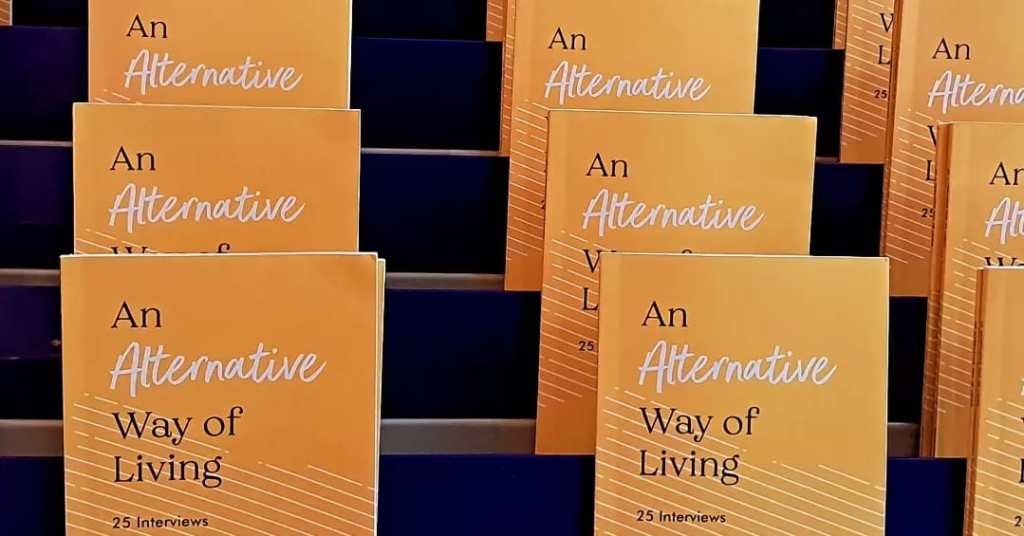
In 2018, I said goodbye to my 9-5 job. I went for a Vipassana retreat in Jaipur. Ten days of Vipassana has transformed me. As a consequence of this transformation, I realised I did not need so many things in my life. I was practicing Vipassana and gym. Because of the 10-day Vipassana meditation, my complete lifestyle changed. In my web magazine I started featuring people who practiced conscious lifestyles. And out of these interviews a published book emerged – An Alternative Way of Living: 25 Interviews.
The field of Positive Psychology talks about the importance of Positive Journalism. Do you see your work as Positive Journalism?
I wanted to document the little practices that made people feel good. I could see these practices as an alternative way of living. I wanted to focus on lifestyle practices that helped. The positive side of life is something that newspapers need to talk about. Newspapers are filled with news on criminals and scandals. Not of it makes much of a difference to the life of reader. Say there is news on a scandal in some remote part of the world how is it going to change my life or that or the reader. It is a scandal and cannot have a positive impact on my life. Now instead if I write about wearing cotton fabric it is a lifestyle practice that can fundamentally alter someone’s life. News on a criminal in Tihar Jail will not help me improve my life. People need to understand this. I met a family friend and gave him my book of interviews. I asked him to give it to his dad who is in the 70s. This friend said that his father won’t read such light stuff because was interested in serious things. Yes, knowing about the suffering and strategy of the government brings empathy and expands the mind, but so does reading a book like this.
Could you talk about the Vipassana meditation that transformed your life and set you on the journey to write this book?
I have attended 10 retreats after the first retreat. It has been six years of tremendous transformation. I can now clearly see how an alternative way of living is the direct pathway to such transformation. This is what I have explored in my book. It is the little practices that can make a huge impact. I was a big fan of milk tea. I interviewed people following veganism and saw it as an important alternative practice. I could see after the interview how we are depriving cows of milk and not giving calves their full share. I have written on cotton fabric. We resort to synthetic fabric because it is easy to maintain. But is it good for us? After Vipassana, my view of things has changed. I have a wider view and a clearer view.
How have these practices impacted your writing?
I have started to write better and with more clarity. My thoughts flow in a straight line. I have a wider view of being a human being. A lot of my stories revolve around the themes of impermanence and acceptance – these are practices from Buddhism. I wrote one story about a girl who gets a million gifts for Christmas. Initially these gifts are very exciting for her. But in time she realises the problems – like how they slow her down. I don’t subscribe to what the world asks you to think. I have an independent school of thought.
Could you talk about the ‘little practices’ covered in your book?
The book lists around 20 practices. One interviewer has been wearing natural fabric for 25 years. When you wear natural fabric the body feels better. Traditionally fabrics of India were made from natural material. Two of the interviewees are working on garbage management which is very important for a country like India where there is no understanding that garbage needs to be managed. A Bollywood actress talks about how children need to be graded not just for knowing things in textbooks but for their understanding of plants. We need these alternative practices in today’s India which is full of European brands and style aspirations. We are forgetting good practices. The idea is not to hurt oneself, others and nature around us.
When talk about not hurting do you mean Ahimsa?
Ahimsa is a strong word; it has connections with violence. By not hurting I mean not causing them pain even in little ways.
Could you talk about mindfulness in connection with conscious living?
I see mindfulness and conscious living as synonyms to each other. A lot of people associate mindfulness as being only present in the present moment, but I see it as same conscious living. Being mindful about how you are talking, how your actions are affecting the other person, being mindful about what you eat, what you wear – these are some aspects of mindfulness.
How do you define conscious living?
Living in way that does not hurt me, hurt you or hurt the nature around.
How has writing this book changed and influenced you?
I have adopted a lot of the practices I have written about. I have turned 80% vegan. My wardrobe has 85% natural fabric. I have become mindful of the fabric I am wearing. I learnt about a new practice called permaculture, so I learnt something new. I turned into a minimalist. In 2023, I didn’t buy anything. I realised had so much already. In Delhi, known for its small shops I shopped for all of Rs. 5000 for one year.
Could you talk about the book?
I have written about eating mindfully, sleeping mindfully and behaving mindfully. The book launched on July 18th. A lady told me during the launch that the book is very good and different. A friend of mine Niveditha started writing with Morning Pages, a practice documented in the book. In a sustainability event, all participants were given a copy of the book. A book like this can impact the collective consciousness.
Your future plans?
I am writing an autobiography on being on the conscious path. I am also working on a book of interviews on Vipassana practitioners and how the practice has helped them transform.
I started working as a pre-primary teacher. I worked in pre-primary for 33 years. I worked as a coordinator for the pre-primary sector. That is when I thought that storytelling is an important aspect for pre-primary sector. I contacted Kathalaya and invited Geeta Ma’am for a workshop. At that time, I thought that when I quit my job and retire, I will be a storyteller. This was the inspiration I had that day to be a storyteller.
After I quit my job, I took storytelling as a profession. That is when I called Deiva and she asked if I could do storytelling through schools. I started working on storytelling for schools through Kathalaya. I have also done the diploma in storytelling through Kathalaya.
Could you talk about the certifications in storytelling you completed at Kathalaya?
I did an online beginner’s course during Covid. Since I had decided I work as a storyteller, it worked well. After that I did my diploma at fireflies. The Kathalaya beginner’s course covered how a story should be told. With the diploma we covered the deeper nuances of storytelling – the importance of voice, voice modulation, movements, body language, and the role puppets play in storytelling. For the diploma we interviewed a few folktale tellers and made a booklet with fairytales, folktales etc. We documented all this.
Could you talk about your interest in using puppets for storytelling?
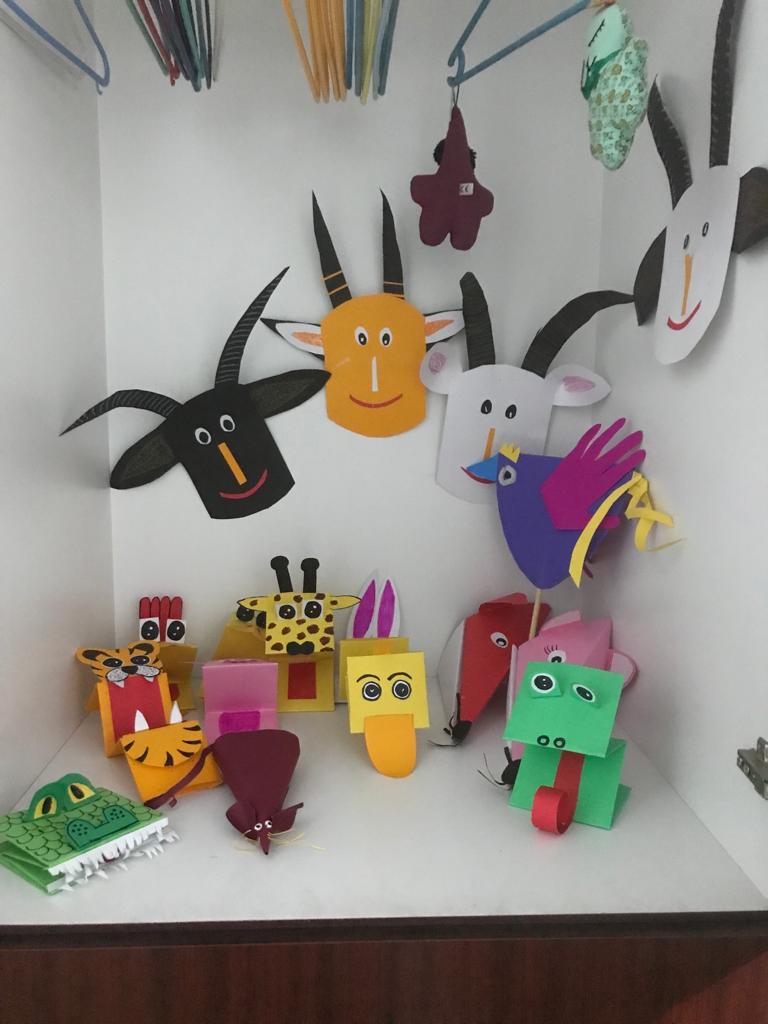
When you do the diploma in storytelling, you know who your audience is. Mine is storytelling for pre-primary children. For others it has been storytelling for adults, storytelling for senior citizens, storytelling for special children etc. Since I am interested in doing storytelling for pre-primary children or smaller children I knew that puppets will be relevant. I make my own colorful and attractive puppets. I make hand puppets and stick puppets. I have a whole box of puppets.
Could you talk about the role of sounds and voice modulation in storytelling?
When we are enacting animals, each has a characteristic sound. We use a different voice for each animal. For instance, the lion has a gruffer voice, and the mouse has a softer voice.
During storytelling sessions, voice modulations for different animals is done.
Is there a need to research ecology for storytelling?
A lot of study is needed while preparing for a storytelling session. We need to read a lot of information on nature, plants, animals, birds etc. For instance, if you are working on a story on hornbill, then you need to know if the bird migrates, if it can fly etc. You need a lot of information and facts to tell the story of an animal or bird.
Can you talk about your experience as a story narrator?
Every platform, I perform in is a different experience. Even storytelling in one school to another school is a different experience. The storytelling experience varies from when your audience has only children or when it has less children.
Could you talk about spontaneity in storytelling?
The same story can be told to a two-year-old and to a ten-year-old. You can elaborate on different points of the same story to help different audiences connect. The way you tell a story to younger children requires much more voice modulation than a story told to older children.
Could you talk about movement in storytelling?
I start my story with an icebreaker with movement. Movement helps the audience connect to the story and the teller. Through getting the audience to enact movements during the story they are able to pay better attention to the story.
How has storytelling positively impacted you?
Once I got into the profession of storytelling and stopped working in schools my perception towards life itself changed. I was able to read more. I have been meeting different types of people. My knowledge has increased. It has changed my perspective of life.
On your plans as a storyteller?
I would like to reach out to more schools, more children and do more storytelling.
The favourite story you like telling?
The story of the lion and mosquito.
Once there was a lion. The lion thought that he was the King of Jungle. He really thought that.
The lion growled.
The mosquito was trying to sleep. The lion was making so much noise that the mosquito could not sleep.
The mosquito asked the lion to be quiet.
The lion said, “I am the King of the Jungle and can do anything I want.”
The mosquito said, “I don’t think you are the King of the Jungle.”
The lion said, “I am the King of the Jungle.”
The mosquito said, “I don’t think you are the King of the Jungle.”
Then the mosquito, entered the lion’ nose.
The lion cried, “Leave me please.”
The mosquito bit the lion hard.
The lion said, “Leave me alone.”
The mosquito asked the lion, “Who is the King of the Jungle?”
The mosquito then said, “Now, I am the King of the Jungle.”
And that is how the mosquito became the King of the Jungle.
Could you talk about the use of dialogues in the story?
The more you talk in dialogues during a narration the more the children will be able to assimilate. Their language also improves. I use Kannada and associate it with English. I do storytelling at the Sharadha Mutt and I do it in Kannada and English.
Could you talk about other influences to your storytelling?
I am a trained dancer. I have been training since the age of five and have been performing till the time of marriage. This has helped in storytelling with expressions and voice modulation. I am trained in Bharatnatyam, Mohiniattam and Kathakali.
Could you talk about how Kathalaya has impacted you?
After I left school I told Geeta Maam, about joining as a storyteller and she knew what my strengths were. She knew I had been associated with schools. She suggested I do storytelling for schools for Kathalaya. We are also working on building a story curriculum.
Before my retirement, in inter office competitions, I used to write small skits. Actually my writing journey started there. Then, I was writing titbits, small stories for a Tamil magazine “Pavaiyar Malar”. Almost every month, my article used to come. After retirement, I joined some Facebook groups and started writing articles. I started participating in Story Competitions. People started recognising me slowly. After reading some of my posts, Uma Aparna, Pachyderm Tales asked me to write stories with some senior citizens.
Why did you chose to do a book on Hanuman?
From very tender age, Lord Muruga and Lord Hanuman are my favourite Gods. When I chant Hanuman Slokas, I used to be fearless and tackle my problems. One day, when I was reading Sundara Kandam Book, it struck me to write it in a simpler language to reach everyone.
Why should children be introduced to Indian culture?
Our Indian culture is one of the oldest one in the world. We have everything in our culture and traditions. With two great epics Ramayana and Mahabaratha we can teach our children how to live a successful and at the same time peaceful life too. If we follow our traditions followed by our ancestors, then we will lead a very good life. Children are future leaders. It is a must that our school system, parents and elders should show our children a correct path.
What is your favourite story from the Ramayana?
Hanuman’s meet with Ravan and burning of Lanka.
What can children learn from the story of Hanuman?
Nowadays, so many comic fictious stories are coming in book, film and series form like Spiderman, He-man, Pokeman, Shakthiman, etc. If you combine all these characters also, you cannot go near Hanuman. He is wise, showing empathy, bold and brave at the same time, quick in actions. Children can definitely keep Hanuman as their Godfather and Hero.
What sources did you refer to for the Sundarkandam?
I read Valmiki Ramayan, Kamba Ramayan and searched Google. But importantly, since my childhood days, my granny used to tell so many stories. Ramayana is one them. It inspired me a lot. I used to watch Ramayana Serial regularly in television. These are all my sources.
Anne and Sid are best friends. High school students, they study in the same class as well as live in the same colony. Every evening they catch up after school, sometimes to study together and at other times to just chit-chat about all things sundry. One evening Anne came prancing to Sid’s house and said,
“Hey Sid, do you know where I am going to, this summer vacation?”
“Where to?” asked Sid.
“In the far off land of Stratford-Upon-Avon.”
“What is that? Never heard of a place like that,” said a bewildered Sid.
“That’s a popular tourist location that receives over 2.7 million visitors every year,” informed Anne to Sid.
“That’s a humongous number! What’s so special about that place?”
“That’s the birthplace of you-know whom?”
“Whom?”
“The most famous writer of English language – William Shakespeare,” said Anne with pride in her voice.
“O Anne, we have acted in several of the plays that he wrote – Merchant of Venice and Romeo and Juliet,” recollected Sid. “And what a delight it would be to visit the house he was born in!” added Sid.
“It sure will be, Sid. I am told that the house has the fireplace area preserved where Shakespeare was born and also is conserved the window of the same room. Writers from across the world visit his house to seek inspiration,” Anne said basis what she had heard her dad talk about the iconic site.
“That sounds magical. I would like to visit the town too sometime in the future. Which country is Stratford-Upon-Avon in?” asked Sid.
“England.”
“Oh! Would be exciting to see the English lifestyle. I remember seeing a fridge magnet in Susan’s house that had a picture of Shakespeare with lines – To be or not to be. I remember asking her dad what it meant,” Sid recalled.
“What it meant, Sid?” Anne interrupted.
“Uncle explained it to me saying it that the lines are a metaphor to the perpetual conflict that adults experience – if they should keep going at life or not. There are times in life, when situations arise that make us wonder if there is light at the end of the tunnel or not. In those situations of “to be or not to be”, one must always choose to be,” recalled Anne’s young friend.
“That’s looking at the bright side of life, Sid,” Anne remarked.
“Yes, that’s what he meant,” Sid confirmed.
“I will try to bring you a similar fridge magnet from Shakespeare’s birthplace, Sid,” said Anne.
“Do so. A fridge magnet that would remind me ‘to be’?” Sid said smilingly.




 Learn Curve for Girls