Kanisha was back to school. So were her friends. The vacation was the term closure of Class IX. As the girls got together after a long two-month break, they had much to discuss. Each of the girl spoke in length about the highlights of the holidays. Kanisha’s friend Sameera had the most unique vacation.
“It was the most rigorous course of my life,” Sameera heaved a sigh.
Sameera had visited a meditation course that was designed to train the mind.
“Train the mind? O why? We have a sensible mind,” exclaimed her friend.
“What we think is a sensible mind, isn’t really so. There’s more to it,” Sameera interrupted.
Sameera started to explain what the itinerary of the course was and what it taught her.
“By the time the course finished, I felt much lighter and the clarity of how I saw things increased manifold,” said Sameera.
“Nothing of what you say makes any sense to me,” pat came a reply.
“So, here is the thing. What we think, how we feel, what we see…can be done better. If we solve an Algebra problem in half-an-hour, we could do it quicker. Say in fifteen minutes. If we feel good from within, we can feel better. If we see the sky blue in color, we could see the same blue color in high definition. For all this to happen, our brain has to be of a certain quality and …… has to be devoid of unnecessary emotions.
Meditation does that,” elucidated Sameera.
“That is what I was made to do in the course,” she added.
Sameera then elaborated on the everyday activities of the course, which included long hours of practicing meditation.
“So you say that you are smarter now?” quipped Kanisha.
“Yes. In some ways. You will see that in the monthly tests,” Sameera replied.
Just then the teacher entered the class and wondered what were the girls gossiping about.
“Ma’am, Sameera attended a meditation course during the summer vacation. She says that it helped her brain become sharper,” blurted Kanisha.
“Oh, yes. Meditation is a tool that most adults use to keep the body and mind in a good shape,” agreed the ma’am. “In fact, Siddhartha Gautama credited his enlightenment to the technique of meditation he discovered,” ma’am added.
“I thought it was merely a mental exercise; didn’t know it could be so powerful?!” exclaimed Sameera.
“That is what Siddhartha Gautama said. When he sat under the Peepal tree on the fateful day in Bodh Gaya, a town of Bihar, he followed a practice of meditation that is termed Vipassana, which means ‘to see things as they are’ in the Pali language. As the practice commenced, he started getting rid of all the experiences he had gathered ever since the beginning of his existence. After 49 days of continuous Vipassana, Siddhartha Gautama was fully empty of all what was within him, leading to enlightenment,” explained the ma’am.
“But ma’am, wasn’t the Buddha who gained enlightenment?” asked a girl.
“Buddha is anybody who has reached the ultimate version. It is not a name, it is a state of being, which our prince Siddhartha Gautama attained and is therefore addressed as the Buddha.
“I was always under the impression that Buddha was a name,” commented Kanisha.
“Me too,” added Sameera.
“Anybody can be a Buddha for that matter. Sameera, you too if you practice your meditation well and realize the highest version of yourself,” said ma’am.
“Ma’am, I wonder if the Buddha was the perfect man, why didn’t he invent something? Like a special vehicle to drive to the Moon, just like how we do to the malls?” questioned Kanisha.
“Yes. If he was the awakened one, he should have invented video calls back in that age and conquered distance,” came the sentence from another girl.
“Did he write some scriptures? If he did, I would like to lay my hands on them and get to know him and his teachings better,” yet another comment.
“Well, Siddhartha Gautama is told to have written nothing. He only offered practical lessons. And coming to answering why didn’t he invent video calls or the special car to the moon, I don’t know. I am not the Buddha, which means I do not have all the answers,” responded ma’am.
Pakhi was in Class II. Every day before Pakhi left to school, her mum asked her what she wanted to eat for lunch when she returned home. Little Pakhi always had a delicious food name to say. Some days it was the pasta, on other days it was a plateful of cupcakes. On the weekends, she wanted garlic bread while towards the beginning of the week, she said Indian naan and spicy curry.
One spring, Pakhi’s grandma was visiting her. She saw Pakhi’s mum always make Pakhi’s lunch according to Pakhi’s wish.
“Do you think it’s alright to serve Pakhi what she wants to eat,” asked the grandma.
“O why not. I love cooking food of Pakhi’s choice,” replied the mum.
“But Pakhi mostly wants yumm but unhealthy food. She isn’t getting exposed to all healthy food recipes available. Cupcakes are not always healthy. And so are so many other food options she places the order for,” advised the grandma.
Pakhi’s mum paid no heed to the grandma. She continued to ask Pakhi for her choice for lunch.
One afternoon, Pakhi came home to find a bowl of salad. “This is not what I had told mum to make. I am not going to eat this,” said a grumpy Pakhi. She looked away from the bowl and refused to eat despite much persuasion from her grandma.
Pakhi’s mum had fallen sick that morning, which led her grandma to keep salads ready for Pakhi. The little girl stayed hungry all afternoon and then all evening. Then at night, she felt terribly hungry. She came downstairs to the kitchen hoping to find something fun to eat. There was nothing except the bowl of salad that her grandma had left in the refrigerator.
A hungry Pakhi hurriedly ate all the salad from the bowl. “This doesn’t taste so bad,” murmured the little one.
The next morning while Pakhi got ready for school, her grandma kissed her bye. “What are you going to make me for lunch, grandma?” asked the little girl.
“Do you want to eat what I loved eating when I was a girl like you?” asked back grandma.
“Yes, I want to see what you ate, grandma,” nodded Pakhi.
Since then, grandma made Pakhi some healthy food option. There were raw fruits, then there were wheat pancakes, and sometime a bowl of rice with vegetables.
Once upon a time there lived a girl named Beauty. One morning her father was leaving to a big town for work. He asked Beauty’s sisters what they wanted from the town.
“Get me a gold necklace, daddy,” said the eldest sister.
“Bring me a golden dress, daddy,” asked the second sister.
It was now Beauty’s turn. “How about you bring me Salman Rushdie’s famous book ‘The Satanic Verses’, daddy. I long to read that book,” said Beauty.
The father left to town.
In the town, he carried on business all day. While leaving the town, it struck him that he needed to buy his daughters the gifts they asked for.
He first went to a jewellery store to purchase an illustrious looking necklace. His next stop was a garment store where he bought a long golden gown for his second daughter. Pleased with his buys, the father now went to the bookstore to find Beauty’s book.
“I am looking to buy the book ‘The Satanic Verses’ for my daughter, can you show me where it is placed,” the father asked the man at the counter.
“We don’t sell that book here. It is banned,” informed the man.
“Oh!” remarked a sad father.
There was a man standing a little away from them who overheard their conversation and proposed to share his copy of ‘The Satanic Verses’.
“I had bought the copy while I was in the United States. I don’t mind giving it to you for your daughter. Seems like she has a good taste in selecting the books to read,” proposed the man.
Beauty’s dad thanked him much and took his email ID.
“My daughter would surely want to personally thank you for your gesture,” he said.
When Beauty got the book, she jumped with excitement.
“O thank you, daddy for bringing me the book. But this doesn’t look like a new book. Looks like somebody has used it,” she said staring hard at the cover of the book.
“Yes, my dear. It is a pre-used book,” he said.
Beauty’s daddy then narrated the complete event that had unfolded at the book store.
“I must thank that gentleman, daddy. Glad that you brought me his email ID,”
That night Beauty started reading the book and as it grew on her, she took a break to write a thank you note to the owner of the book. Soon Beauty finished reading the banned title while parallelly keeping in touch with his new friend. They wrote to each other about the books they had read and what other titles they planned to read in the future. The conversations continued and soon they realized they were in love with each other.
With the turn of events, Beauty got married to the gentleman and lived happily ever after.
Krishna and Sudama were students at teacher Sandipani’s ashram. They were fellow classmates as well as best friends.
One morning, the teacher tasked them to collect wood pieces for bonfire, from the nearby forest. The two friends walked through the forest and got on the job. They cut the wood pieces and wrapped them in a cloth that they had carried from the ashram. It was time to go back to the teacher. As they started on their journey back, it started to pour torrentially.
“Oh, Krishna, we must take shelter somewhere. The rain is heavy and I am beginning to get drenched. I don’t want to catch a cold,” suggested Sudama.
“Sure, let’s see if there is shelter around,” agreed Krishna looking around.
The boys found a gigantic tree, such that they had never seen before. The branches were thick and the leaves so voluminous that heavy rain seemed only mere drizzle under the bushy canopy of the leaves of the tree.
Soon after the boys took refuse under the tree, Sudama felt hungry. While leaving the ashram in the morning, the teacher’s wife had given him two pouches of roasted chickpea just in case the friends got hungry. One for Sudama and another for Krishna.
The hungry Sudama fished for his pouch of chickpea in his pocket and began to eat. “Tastes heavenly,” he said. In that moment, greed arose in his mind. He decided to eat Krishna’s share as well.
“Hey, Krishna. I realize I dropped the pouch of chickpea ma’am gave me for you. I am sorry that you will have to stay hungry. But don’t you worry, we will soon get home,” Sudama lamented.
Krishna knew that Sudama was quite a foodie. There have been moments in the past when Sudama tried to steal Krishna’s share of food while at the ashram. Krishna gave an investigative look at Sudama’s pockets and knew that the other pouch was also in there.
“Hey, Sudama, are you sure you dropped the pouch. How about you rummage through the pocket carefully. I am sure you will find my pouch of food in there,” Krishna said pointing to Sudama’s pocket which had the chickpea pouch.
Sudama knew in that moment that his friend had turned clever and outspoken. It wasn’t any use trying to fool him.
Pretending to search his pockets, Sudama pulled out the pouch with chickpea and said innocently, “Oh, ya Krishna, it’s right here. So light that I didn’t realize it was even in my pocket. There you go.”
I have written about 140 books in the past 11 years. This includes stories from Epics, Puranas, Vedas, Vedanta, spiritual scriptures, Indian legends, Acharyas, Rishis et al . I have published and released about 35 books which includes a book on 100 stories of Shree Panduranga. 100 stories on Krishna, in both Tamil and English. I have written books mostly on Shree Krishna and Shree Rama. I have written a book on the complete 18 parvas of Mahabharata including meaning of Gita, Sri Vishnu Sahasranama, and Yakshaprasna.
Could talk about your writing schedule?
I write for 18 hours a day. I spend all my time reading, singing and writing. I attend meetings wherever I am invited to speak on spiritual topics . I observe most of the women folk and o ld ladies prefer Tamil books. So, most of my books are in Tamil. I don’t price my books, and I give them away for free. I have 10,000 more copies yet to be distributed. I give away books to libraries, friends, donors, children in schools and old age homes. Now, I am giving publishing rights to Pachyderm Tales and Pustaka. I know both Ms Laksmi Priya and Uma Aparna will be able to distribute the books easily.
When did you start writing?
I started writing at my 75th year. Till then, I was busy with my shipping activities, and I never had time. It was at the end of the year 2012. Now I am 86. I started writing through email. In 2012, the only technology we had was email. Through email, I circulated my daily writings and the people, who read, gave me the idea of turning it into a book.
3, 14,000 people are reading my works as per 2022 FB records. (”JK’s posts have been liked 314000 times’) I get calls from people from India and different parts of the world. I give lots of books to them when they come to see me.
What was your first book on?
My first book was for children. It was on Shree Krishna. 100 stories on the life of Shree Krishna. It was based on the stories of the 10th canto of the Srimad Bhagvatham. My book was titled, Vishwaroopavamana Kathagal, which means the stories of a cosmic person in vamana (short) form.
My first English book was ‘You, I and Krishna’ . Here, every story starts with ‘dear children’ and ends with a moral message.. The pictures are in color in art paper with 280 pages approx. I distributed many free copies of this book. Rs 3 lakhs was donated by a philanthropist in Gujrat attached to the Krishna temple in Dwaraka. 12 of my books are in English. Rest of them are in Tamil. There is great demand for books n English. You, I and Krishna was named that way because there are only three persons in English Grammer.
First person – I
Second person is you
Third person – He, she, it we, etc., but all the three persons are none but Krishna
Advaita means monism nondual reality. You and I are one and the same. Everything is nothing but one. That is what Adi Shankara taught us. Vishistadvaita was taught to us by Ramanujam. It teaches us that Jeevatma and Paramatman are though separate but joined by the surrender of the individual (SARANAGATHI) to the Supreme Reality.. Qualified monism is thus known as Vishistadvaita, which needs the presence and advice of an Acharya to surrender to HIM.
What is the essence of Indian philosophy?
In Indian philosophy, there is nothing but one god. That is the concept of Adi Shankara’s Advaita Philosophy – everything is one. In Dvaita – jeevatama is different from Paramatma. The individual soul reaches the supreme soul ultimately.
In Indian philosophy the worship of god is the main item. It is called Hindu Sanatana dharma. It not religion but a faith. Tolerance is very important in Hindu Dharma. Sanatana means something that is eternal and ever lasting. The essence of Hinduism is charity, love, discipine, faith in God (devotion) This is what the Geeta also tells us clearly.
Can you narrate to the audience your favourite story?
I am a Krishna devotee. Krishna is a God with 16 kalas, Poornaavathara, ie., HE knows, is conscious, that HE is god even when he takes shapes of a man. . Rama as the avatar of a human being appeared to do righteous things. eliminating the wicked and cruel people and helping the righteous was the goal. Parithraanaaya Sadhunaam Vinaasaaya cha dushkritam dharma samsthaabanarththam Sambhavani yuge yuge. That’s why Krishna is called the god of protection. The Hindu Trinity perform the functions of Srishti stithi and samhara or laya. Creation, protection and destruction. Whatever is created must have an end one day. We calculate our life term, age, from the time of birth we are born on earth. Everything is dated on earth. God is beyond time space.
Guna is character, it is the basis on which mind and heart work for a person. Sattva, rajo tamo guna are the three gunas. characteristics Sattva people who are those who are simple, loving, auspicious, detached from the world and its attractions, and think nothing but social good. They are selfless people who help others and live for others. They live to serve others. They are not attached to this world and are not attracted to this world. This body is given for serving others. Itam sariram paropakaram. Jana seva Janardhana Seva
What is the essence of Vedanta?
Vedanta is the end of all the vedas. In the Upanishads we find the Mahavakyas – Tat Tvam Asi, Aham Bhrahmasmi, Ayam Atma Brahma and Prajnana Brahma. which mean YOU ARE THAT, I AM BRAHMAN, THIS ATHMA IS BRAMMAN, AND CONSCIOUSNESS IS BRAHMAN.
The Brahmasutras talk about the sublime Reality, omniscient, omnipresent nameless and formless self of the world, everyone is BRAHMAN
What is Srividya?
Sri Vidya is the worship of Rajarajeswari, known as MAHARAJNI. The goddess is worshipped in three forms – Bala Tripura Sundari, young baby girl, Tripura Sundari and Rajarajeshwari. There are 6 forms of worship as established by Adi Shankara. Koumara, worship of Kartikeya; Sauravam, the worship of the Sun; Shivam, worship of Shiva; Vaishnava, the worship of Vishnu, and Shakti, the worship of the Goddess and Ganapathya, worship of Lord Ganesa .
What is the significance of the Sri Chakra?
It is a yantra. It contains all the powers. It contains the beeja akshara mantra. powerful letters. When you utter the mantra scorrectly the deity respond. There are so many rituals and festivals for Hindus. Rituals are very important in Sri Vidya Upasana. Upasana means strict adherence to the set procedure of worship.
Any parting message to the audience?
Hindus are tolerant and never believe in conversion, and there was no cruelty or hatred towards other religious practices. Only liberty and freedom is given importance. Many children other than Hindus can also benefit from our Vedhas, spiritual scriptures, epics and puranas. Knowledge is Divine. Swamy Vivekananda taught how Hindu beliefs and faith has been collectively organised and developed by our ancient Rishis, and is based on tolerance, peace, love and unity, and nonviolence (ahimsa).
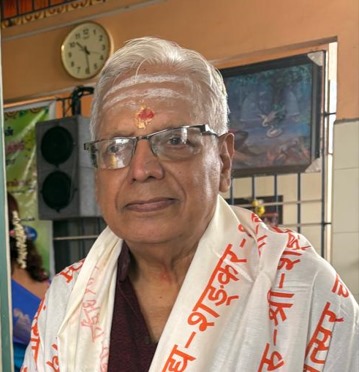
About J.K. Sivan
Born in 1939 he is now nearing 86 yrs Mr J K Sivan hails from a Tanjorean family of pious and religious scholars in Tamil, English, and Sanskrit devoted to spreading the values of our culture, tradition and spiritual development in society.
Sri J.K. Sivan has been occupying very high positions in International Shipowners organisations being an experienced Marine Insurance claims and insurance, chartering and ship management, specialist in India and abroad spanning a period of about half a century. He lives in Nanganallur now since 1994 after his overseas career.
He has been actively engaged in both social and spiritual service to society. Has been President, and Secretary of local residents welfare association and organised temple renovations. Has been Secretary of the Senior Citizens’ Forum Nanganallur.
Sri Sivan has organised many pilgrimage tours covering thousands of temple in Tamil Nadu and Southern part of India.
He has formed SREE KRISHNARPANAM SEVA SOCIETY ( which is now a family Trust since 2018 ),and ever since mid 2013 has been writing articles in English and Tamil through emails, whatsapp, face book and blogs, website, about our legends, Acharyas, epics and puranas, and other holy scriptures in the form of short stories for children . His novel way of present has ben globally well received by Hindus all over numbering lakhs of people. He has authored about 140+ books in English and Tamil , of which about 35 were published without a price tag for children. Through the above Trust Mr Sivan has organised many competitions for children women and seniors encouraging them in various activities connected promotion of spirituality in society and distributed prizes. He is recipient of many titles and virudhus including BAGAVATH SEVA RATHNA from Kanchi Mutt seer and VAISHNAVA SEVA RATHNA, from Vaishnava Conference at Annankoil.
Usha: We were just scribbling on social media. Once Uma Aparna asked us, “if we would like to write?” Today she is saying, “you have gone ahead.”
Vanaja: I have written on facebook. Now, I have got an award for a story I published with Pachyderm tales. I have got the friendship of Uma Aparna – it is a great friendship.
Usha: Writing has been a great help to us.
Vanaja: I, Ruckmani and Usha, we are publishing some books together. We will release 8 books in the next 2-3 months.
Usha : We want to read to children. We want them to read the Thirukural. We are presenting the Thirukural in story format.
Vanaja: We want to get together stories for children. We are doing it as a friendship also. We are writing about friendship also.
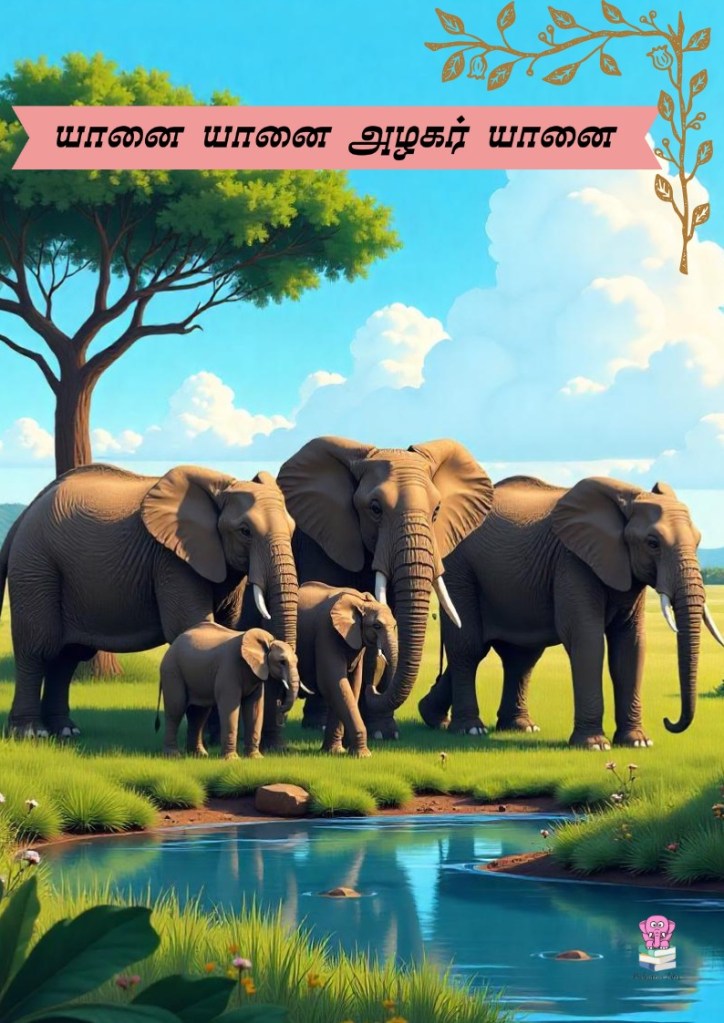
Usha: We used the Thirukural couplets to create easy content for children. We are creating nondetailed texts. We are also writing stories about elephants. Children like elephants a lot. How do elephants live? What does an elephant eat? Elephants are harmless and loved by children. To make children sleep all parents in Tamil Nadu will sing, ‘Annai Annai Ayaghar Annai.’
Usha: One of our stories goes – a small elephant saved and becomes a temple elephant. The stories of the child and the elephant as they grow up is parallelly traced.
We are documenting the stories of those who do good in society – celebrities, social workers, including Uma Aparna. We are covering stories of people in social service, education and healthcare.
People want these books. Parents want to read these books to children. Nondetailed books help children read.
Vanaja: These books are easy to carry and can be read in school. It reaches many people – school libraries, book fairs, reading for book fairs.
Usha: We are doing a book which contains writing from every continent. I wrote on Europe.
Usha: We are moving away from fiction towards children’s writing. Writing is very useful in making us feel productive.
We research and check google to ensure we no one has brought out books and content on the people we are writing about.
Rukmani: We are writing to take books to children. We want the Thirukural stories to reach small children.
Ruckmani: We want to write about how girls have come up and how they help society. We have written about their stories. We have written about Uma Aparna.
Since I wasa small child I used to read story books a lot. Because of my love for books I got the inspiration to write.
Alamelu :
As a small child, I used to read a lot of storybooks – Sujatha, Lakshmi, Indumati, Sandilyan. Uma Aparna encouraged me to write.
Kamala :
I like Tamil a lot.Kumudham, Ananda Vigadan etc. I did Katha kalashetram and was a storytelling expert. So I decided to write stories. I read Sujatha, Shree Venugopal – a spiritual writer, Tangadurai – a contemporary writer.
Bhanumati:
I have written for Bhagvada Kathaigal. Herein, I have explored the stories of Yashoda and Kannan. How, everyone likes Krishna. I have written in Nadodi kathaigal. In this collection of folktales, grama kathas, I have written on a story on Akbar and Birbal. I have contributed to the anthology – Avvaiyar Amdudha Muyvigel – narratives on the memorable and precious quotes of Tamil Poetess. Then I worked on the anthology Thukadagal which is a lot of small stories strung together. My story Odiporavan is on how a girl will suffer if her husband disappears.
Kamala:
I have written for the anthology Dasaavatar. I picked the Parasuraman avataram. This avatarn of Vishnu is an avesham avataran, where the Seer/Sage is short tempered. He serves his father Jamadagni and severs the head of his mother Renuka Devi. Then with the permission of his father he puts the head back creating two goddesses now Renuka Devi and Marimman.
Vanaja:
Our mother tongue is Tamil.
Jayanti:
The reading habit in Tamil must be inculcated. When we buy a dress for a child’s birthday. We must buy a book for the child as well.
Jayanti:
I did a PhD when I was in my 60s and teaching in a college. I am very proud of a song I wrote which was recorded with Carnatic music by a 10 year old girl and she had included my song among other songs by luminaries. My song was on teachers day and its message was –
Teachers taught us alphabets and letters
They are the ladder
They take us up in life
Brinda:
I was always interested in study. I used to read a lot of Tamil magazines. Elders in those days used to say they spoil the children’s mind, but my parents would encourage me to read. I have studied Tamil in school. My child studied in English. We must help children understand Tamil. That’s why I think its important to write, create literature and spread Tamil.
Vanaja:
I had a lot of love for Tamil. My children are in America and my great grand children want to learn Tamil. It is very important to know Tamil. All our children must know Tamil. All our stories in the anthologies are in Tamil.
Brinda:
I did BSc in mathematics. After marriage, I did an MA and Mphil. I studied the works of Vallallar the poet and Ramalingayal Adigelall, who believed in the spiritual path of bhakti.
Ruckmani:
We started learning English in the 6th standard. Tamil was from 1st standard. We think in Tamil, it comes naturally to us. I used to read a lot of books and my father also used to buy a lot of books. Kumudham, Vigadan, writing by Balakumaran, Sujatha, and Kalki’s classic Ponniyan Selyan. I used to keep writing poetry. I liked writing. Then Uma Aparna became a friend. Through the Pachyderm Tales project, we all joined the writing community. Lakshmi Priya is a great leader and thinks differently. We were all stunned by seeing what she was doing. We don’t just write the story. We would just get together as a group and decide what to write. Some of the books I have written for are Athichudi stories, Temple stories, etc. We all liked contributing to the anthologies, and I got a lot of feedback from people. My favourite contribution was for Velar Nachiyar. I took the angle of how girls were a part of the independence movement. I wrote a story about Kuili, who was the leader of the squad that helped Velan Nachiyar.
I wanted to write about girls and women who are making an outstanding contribution. I wrote about Lakshmi Priya, about Dr. Renuka helping leprosy patients.
In Tamil Nadu, the reading habits have reduced. Everybody has a story. There is often more than one story.
Brinda:
I did BSc in mathematics. Then I did my MPhil on Vallallr, Tamil saint and poet who wrote on the spiritual path or bhakti. I have published in 6 books and 4 more are on the way.
Brinda:
6 books published. 4 more on the way. I write to ensure my stories have a message on values. People must read our stories and know something.
Vanaja:
I was always intent on reading and writing as a child. I started writing 4-5 years ago. 16 books will be published.
Jayanthi:
We don’t give enough preference to Tamil. I did my PhD in Tamil. If you want to be a Tamil writer, you must study Tamil. I used to write in different types of genres. I went to Sita Lakshmi College and wanted to educate children. As a writer, my intent was to take Tamil to the schools.
Jayanthi:
My father was a writer. So, I liked writing a lot. My mother used to run a school. I used to write for Vigadan, Kalki, Kumudhan, when I was in school. I have interviewed many people in cine field. My mother started a school. When I taught children I used to teach Alzh Villiappa’s songs. His children’ s songs were very good. He was superstar of children’s literature. We liked the songs. I wanted songs for my school children. I write poems. I have written more than 80 books – biographies of many people including JK Rowling.
Brinda:
I can’t write is what I thought. I had written with Mangelmallar. I have been writing for 30 years. My name is well known among those who read Tamil Magazine – Brinda Ramani. I have written really popular articles – 30 types of rasam, 30 types of dosa etc. Being a well known writer, I was on facebook. I blog. I did these projects for Uma Aparna.
Kamala:
I like Tamil a lot. Kumudham, Ananda Vigadan, Katha kalakshetram. I am a storytelling expert. So, I decided to write stories. Kalki, Sujata, I like a lot. Shree Venugopal is spiritual writer and Pushpa Tangedurai is a contemporary writer.
Kamala:
I contributed to the anthology Dasavataram. I wrote about the Parashuraman avatar. This is an aveshan avatara, because he is short tempered. Due to bhakti to his father Jamadagni – he severs the head of his mother. This devi, whose head is then replaced is known as Mariamman, Renuka Devi, Yellamma etc.
Vanaja:
Our mother tongue is Tamil we must encourage it. Reading habit should be inculcated rigorously. Just as buy dresses for children during their birthday we must buy books too.
Jayanthi:
I have done my PhD. My happiest memory is when a 10 year old creates this song with Carnatic music base –
Flower bud
Teachers teach us alphabets and letters.
They are the ladder
They take us up
Revathi:
Working on these anthologies we learn so much about culture. Through writing literature, we are able to experience culture. We should not let go of our culture and heritage.
Praveena:
It is very important to write about culture.
Revathi:
Every mother must ensure that the child knows Tamil. We must all make an effort to learn Tamil.
Praveena:
Culture is disappearing.
Revathi:
We should get children to learn all languages. English, Hindi and Tamil. We should teach children Tamil. We should not forget Tamil.
Praveena:
I am Tamilian and proud to say this to the world. We must take the Thirukural and understands the basics there – how to lead a happy life, be content etc.
Hema :
Children today don’t know Tamil. It is to help children learn reading and writing in Tamil that I started writing. I have just started. My mission has just started.
Prabha:
We were featured in the Guinness book of records. We brought out 52 books by 62 writers.
Hema:
I got a lot of support from my daughter.
Mythali:
Tamil is disappearing. English is today the main subject. In the Tamil we speak there is a lot of English mixture. In our daily speech we use 80% English and 20% Tamil. It is important we introduce children to the Tamil world.
Revathi:
Tamil is the language of our state. It is easy to destroy but difficult to preserve your heritage, your mother tongue. I am also fluent in Hindi and do, Tamil and Hindi translations.
Prabha:
I produce a youtube channel.
Hema:
I have wanted to write a lot. I am also a storyteller.
Prabha:
I have a good team and a good publisher. I would like to thank them for supporting me with my writing.
Mythali:
I was recently introduced to Uma Aparna. I was running a Montessori school. I have lot of experience in telling stories. Uma Aparna motivated me.
Hema:
I have written stories online, infact both stories and poems online. Through this project I got a chance to write for publication.
Praveena:
I used to write poems in both English and Tamil. When I was a teacher in school I used to tell stories to students. I used to teach English through stories. I have a youtube channel where I tell stories. Uma Aparna motivated me to write stories. I have written the story of Mimmini and Kinkini – the story of two friends.
Couple of days back I was watching Agatha Disney series. My mother could not understand my fascination for the same.
Witches are not exclusive to west, but the name witch, and the costume of black is synonymous with witch. In all the pagan cultures, we can trace witches. Powerful women, knowledgable, who had deep connections with nature and living organisms, whom men could not understand, were considered abnormal, mad, lunatic, and their association with nature, their ability to cure ailments, their communication with divine, their spirituality was misconstrued as evil.
History, culture, religion and most importantly patriarchy classified women as witches; burnt them at stake.
Today, we come across numerous revisionist literature and media representation.
And it simply is impossible, as a woman to be fascinated by Witches.
For I connect them to my ancestral roots. My great grandmothers with their tattooed bodies, shriveled skins, ever punishing attitude, and most importantly their abundance of knowledge in various fields, their mad love for Art, literature, Songs and Storytelling!
“Down, down, down the road
Down the witches’ road
Down, down, down the road
Down the witches’ road
Down, down, down the road
Down the witches’ road”
Sing it out loud and proud! Sing it in the night from your terrace when you are alone under the moon. Sing it when you walk through the forest! Be a witch and be proud of being the strongest woman force on earth!
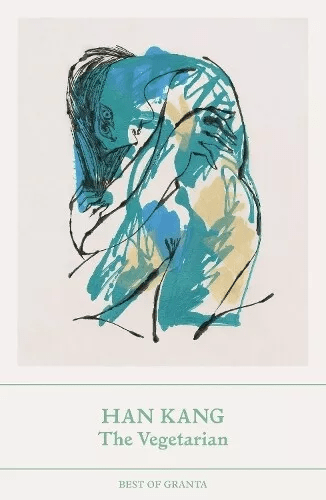
Few Years ago when I read Vegetarian by Han Kang I felt a personal connection with it. Here was a writer who equated violence against women in parallel to violence on animals. She drew similarities through her subtlety. No animal is asked permission before harming it, it works out for women as well.
Han Kang again came to my consciousness with her The White Book. I can easily say that, it was the toughest book I have read, yet the book wrung my soul in such a tranquil way.
I feel that madness can be caused only by tranquility. The book, the colour, the texture, the font everything was serene. Yet the book overpowered me.
Then two years back, vegetarian came to my consciousness again. This time through a publication house that I have never heard of. This publication did not even have a proper website then, it shocked me to see someone read, then pursue and buy rights for it. That was not it. It was the title of the book that stunned me. In Tamil, the word used generally to represent Vegetarianism is சைவம். This is the common word that we hear around in restaurants, or even generally at households.
As a vegetarian whole my life, my perception of vegetarianism was singular and simple. I simply thought that I would never eat meat. I should rather say, that it was passed on by family and traditions.
At the same time, I am an artist, I travel a lot, I have friends from all walks of life and I know not to disrespect food. Hence when someone offers me, or sometimes forces me to share meal with them.
I have learnt to decline politely without hurting anyone’s feelings.
I have come across questions, “So why don’t you try once?” My answer would simply be a smile.
If someone convinces me, I would ask them if they will eat every kind of animal meat. No everyone has a choice and preference. “And I would say, being a vegetarian is my choice.”
Slowly, my vegetarianism ceased being a simple tradition that was passed on by family. And it became a choice.
But the moment I set foot inside Tamil Nadu, my knowledge and readings became vast and I realised that caste and class dictate what you eat.
This whole concept of choice and preference shows that I belong to a privileged class where I have choice.
I had an opportunity to see Selvaraghavan’s ‘Ayirathil Oruvan’ with a meat eating friend of mine. I asked her why would they show a revolting and graphic imagery of someone wanting to eat rat meat. She was offended. She shared that during colonisation when there was man made shortage of food. The farmers who grew rice had no choice but to catch the field mouse and eat the same.
Life is a learning curve. And the learning is perpetual. Categorising vegetarianism in Tamil as merely, a translation is heresy.
The translator, (whom I had the privilege of talking to him yesterday) has not merely translated the words and contexts. But he has made sure that he has left his own values and belief systems inside his translation.
I think, that is why the title is not simply ‘சைவம்’ the most obvious word, yet associated with religion, caste and class. Instead he had used the word, ‘மரக்கறி’ a word that I don’t remember hearing at all. Then he clarified, that Tamils in Malaysia, Singapore and Srilanka use this word in their common parlance.
I was taken aback. I remembered searching and eating ‘மரக்கறி’ in Malaysia. I also remembered that the small eatery served me the food that was kept aside for the owner’s daughter to eat.
If you haven’t read Han Kang yet, if you can read Tamil, then the starting point would be ‘மரக்கறி’
A poignant tale of feminism, choice and most importantly being one with nature and then becoming the nature.
I have always fallen for narratives of madness. Particularly mad woman tales and I remember a situation in the novel, where she would go and stand by a tree when it is pouring. It reminded me of my own madness and exploration of nature. For some reason it also brought back to me Surfacing of Margaret Atwood!
Can we think of our regional languages as our heritage and soft power. Can the oldest living language in the world, Tamil, be thought of as world heritage. Learn Curve for Girls examines Tamil as our living heritage in this conversation with Dr R Lakshmi Priya, Tamil Translator and well-known Tamil publisher.
Can you tell us how the Tamil language is a world heritage?
Tamil is a most ancient language. It is called as Sem Mozhi and is listed as a classical language in 2004. Before Tamil got this status, only Greek and Latin were considered as classical languages. After the Sem Mozhi status many youngsters became interested in Tamil.
Tamil is believed to be the oldest living language in the world, some 5000 years old. Like Chinese and English, Tamil is also one of the largest spoken languages. Tamil is world heritage. Tamil is our heritage, having been passed down from one generation to the next.
How do languages grow? Can you explain this with context to Tamil?
For a language to grow, people should use the language. English keeps growing, its vocabulary keeps expanding. Tamil is a fluid language. It does not have a rigid structure. When the use of computers spread Tamil developed its own vocabulary of computer and internet based words. This Tamil is called Kanini Tamil. The Tamil which consists of a unique vocabulary of scientific terms is called Arivial Tamil and that which has a unique vocabulary of mathematical terms is called Kanidam Tamil.
Languages should have a fluid structures. They will not grow if you don’t invent words and if you don’t allow others to include words. Tamil is ever energetic and ever youthful. If you take the English word dating, even for that we have a word in Tamil.
Imagine if we don’t invent words for new gen talk. The language will not have words and we have to borrow from other languages.
Can you tell us a little about Tamil grammar and Tamil Literature?
Tamil developed its own grammar 3000 years ago in a book called Tolkappiyam written by Tolkappiyar. It is not very complex. It can be used by anyone to learn Tamil. There is, for instance, no striling and puling.
We have five great epics in Sanskrit. We also have five minor epics. That is ten epics in total. We also have another 8 books that are important in Tamil. We have our own version of the Ramayana – the Kamban Ramayana.
Can you talk about the international appeal of Tamil?
Tamil has always attracted people from different, places, civilizations and religions. They have imbibed the culture and started writing in the language.
The first writing in the language were Shaivite and Vaishnavite, soon Tamil attracted Christian writers, Muslim writers and Jain writers. One famous Tamil writer from a few centuries ago, Veeramamunivar is an Italian Jesuit priest. He learnt Tamil and even changed his name. GU Pope is another very famous name in Tamil Nadu. He translated the Thirukural from Tamil to English. He came to South India in 1839. There are thousands of such people, foreigners who have learnt the language and written in it.
Can you talk about the close relationship between Tamil language and Tamil culture?
Tamil language does not exist without Tamil history, art, architecture, Bharatnatyam, temple architecture, and Carnatic music. Everything connects with the larger language.
In temples in Tamil Nadu, you can find engravings written in Tamil words.
So many people are fascinated by one aspect of Tamil culture – be it food, history, architecture, language and through this lens they understand all of Tamil culture.
For us it is not Tamil Mozhi, it is Tamil Marabh, it is not Tamil language, it is Tamil culture. Tamil language does not exist in isolation. Tamil culture is very parochial – games we play, products we use, all this shapes the language we speak.
To give an illustration of how Tamil culture and Tamil language are linked – in Tamil culture it is understood that every guest must be served water, this makes Tamil culture very respectful, the language too is thus shaped. The Tamil language has inviting words like Vango Vango, Vargo Vargo – inviting words, respectful words.
The Tamil culture resonates in every part of the language – you should not say No, (Vendan), you should say Porum (enough). The language is structured around the culture.
The Tamil culture preserves itself. If we are asked to speak some language other than Tamil, we resist it. We have fought here for our language, even court communication is in Tamil. We don’t communicate in English or Hindi. We insist on this. We don’t want our children to forget Tamil that is why we insist on this.
How can the study of regional languages like Tamil become a part of India’s soft power?
We are talking about multiculturalism. We are saying glocalisation is important. We are reviving older traditions. There is no one western ideology guiding us. There is no one single ideology we all follow. Understanding regional language, regional culture is very important in this context.
Could you talk about intellectual theory in Tamil and if it already had equivalents to contemporary western theory like post modernism etc.?
Postmodernism is incredulous towards the meta narrative. It is questioning the metanarrative and all institutions. We can date post modernism to around 1988. In Tamil, we had similar thinking that originated, before, during and after this date. We have formed our own mini narratives. In Tamil, we have our own philosophers, writers and authors, who have formed their own mini narratives.
Mahakavi Subramaniyam Bharati questions the metanarrative. Periyar has questioned institutions long before post modernism came into existence. We have this statement in Tamil, “If we are not able to provide a morsel of food for one person, let the whole world cease to exist.” This quotation in Tamil predates Marxism. We are also a very maternal society. The Tamil language has produced many women poets and authors, like Aviyar and Avudel Ammal. All this predates feminism as a movement.
We Tamilians are proud of our intelligence – we are more inclined towards education than anything else.
In Tamil literature given to us before 1000 years, questions like ‘what is education?’, ‘what is moral value’, ‘what is truth’ have been raised and answered.
There are today millions of writers in the Tamil language. In every house there is a scholar and a writer.
Can you discuss the relationship between language and land?
There is a deep and intimate relationship between the land of the Tamils and our language. In Tamil language there are five divisions of Tamil land – Kurunji (mountain and mountainous terrain), Mullai (forest and forest regions), Maradam (agricultural land), Neidhal (sea and sea related regions), and Palai (desert and desert related regions). There are deities for each of the regions, distinct food and distinct poetic language.
Can you cite any examples of Tamil literature as being accessible to an international audience?
The Thirukural does not have any cultural representation in it. Anyone in the world can read it and understand it in relationship to them.
Can you talk about the Tamil Siddhar culture with specific reference to their representations in the Tamil language?
For us the word Siddhar means an intellectual. Siddhars were cultural intellectuals, intellectuals in astronomy, geniuses in mathematics and science. Tamil is one culture which has an ancient tradition where humans had dialogues with god. Agastyar was famous Siddhar who has asked god many questions. Interesting stories abound in Tamil about conversations between god and humans.
The story of Lord Murugan and the poet and siddhar Avvaiyar is a good instance. As the story goes, Lord Murugan feels that the poetess Avvaiyar has become egoistic and he wants to test her usage of the Tamil language. He also wants to play with her taking a child form. He comes to Earth where Avvaiyar is walking near a cranberry tree. She feels like eating some berries. She sees the small child and asks him to shake the tree and procure for her some berries. He asks her, “do you want hot fruit or cold fruit.” She is not able to understand the meaning here. Lord Murugan nonetheless shakes the tree and cranberries drop down. Avvaiyar bends down and picks them up. Because the fruits are coated in dust she blows on them as if they were hot fruit. Then finally she understands the child’s meaning and his word play.
In the Tamil culture, the understanding is that the concept of god and human are interchangeable. The common understanding is that anyone can become a god if they are knowledgeable.
There is this story of the Tamil poet Nakkeran that is very interesting. Once a King announced a writing contest. Lord Shiva himself participates in this contest. Nakkeran sees an error in Lord Shiva’s poem and gets angry. Lord Shiva says, “Was the grammar wrong or the structure, or is it how I have formed the words, what could be possibly wrong with my poem?”
In rage Lord Shiva says, “I will burn you up with my third eye,”
Nakkeran says, “Even if you do it will not correct the error in the poem.”
Lord Shiva turns him to ashes. Then in compassion brings him back to life.
This story is illustration of the sort of passion and debate that the Tamil language sparked in humans and in the Gods.
Can you talk about the need for cultural exchange in different languages?
The Tamil culture and language believes in cultural exchange. Getting ideas and concepts in other languages has made Tamil what it is. Our poet Subramaniam Bharati was proficient in six languages. He has famously said, “If you can go a different country, learn the language, understand it and make it your own.”
Can you talk about your own experience in Tamil translations and as a publisher of Tamil books?
I have added to the vast pool of people translating to and from Tamil. I have translated Sputnik Sweetheart by Haruki Murakami into Tamil. The book will be out soon.
I do believe everyone has a story to tell. I have so far published 320 Tamil language books. This includes books by child authors, books by women, geriatric writing (with writers aged 65 and 85).


 Learn Curve for Girls