Tag: india

  • Knowledge quests and investigations into Indian feminism – Interview with Dr. Sushumna Kannan

    Could you talk about your career journey?

    My career began when I started my masters in Cultural Studies. I did English Literature in my bachelors. Studying English literature was a launch into the questions of selfhood. When I was younger, I had read Hindu Philosophy. English Literature felt like it could be a way of enquiring into ourselves. There is a joy in studying the social sciences and humanities and focussing on culture.

    The kinds of questions cultural studies answered didn’t satisfy me.

    As I was doing my PhD, it occurred to me that cultural studies answered the how question (how things are done?) rather than the why question (why they occur in the first place?) I wanted the why question answered. Knowledge quests are in a very fundamental way asking about the why question. I started getting answer to the Why question through Hindu studies. I was studying Akka Mahadevi. I was studying an array of religious studies.

    I read over 200 books in feminism. I do identify as a feminist. I have read a lot from the discipline of religious studies. In the United States, I did a lot of religious studies research. It is an interesting engagement. I love some scholars and don’t love some of them.

    Could you talk about your reading?

    The academic reading is read in order understand ideas, draw comparisons, etc. Culture Studies reading helps gain a different impression of history and culture. It is a different experience. Reading fiction is an altogether different experience. It allows to experience in images, in full colour and sensory details. I have read 200 odd novels. It has been a joyous experience. I have read English literature, Kannada and regional books in translation. Amit Chowdary is one of my favourite writers and ‘Strange and Sublime Address’ is one of my favourite books. I love the way he writes. Shashi Deshpande and Arundhati Roy are two of my favourite writers. The impulse to write a novel or a poem next follows me.

    Could you talk about history writing from India?

    Until 1970s, history writing in India was conducted bias free. Since the 1970s, very left leaning ideologies have taken over history writing in India. There are two very different things – one looks white and one looks black.

    Could you talk about women’s history writing in India?

    Women’s history in India can’t be understood unless we understand StreeDharma. In a Jain scripture we get glimpses of women performing rituals and yagnas. The Upanishads are known for the Brahmavadinis – independent women who are independent scholars. In the Upanishads we get small glimpses of how women lived. Who were the foreigners who altered us? Hindu warrior code was clear that you should not fight a woman. The warrior code of the other side seems barbaric now and they did fight women. Streedharma, which looks very regressive, was set up in these circumstances. Women are restricted to their home. Uma Bharati, Andal – the stories of these women give us a glimpse of lives of women in ancient India.

    There are two tasks that hindered the history writing process in India – extreme tolerance for the project and extreme hatred for the project.

    Hindu Dharma did offer women compensations. If women due to family commitments could not participate in spirituality – equalities and substitutes were offered. Hindu dharma did offer that. That is kind of feminist.

    What about the unique place of Goddesses in Indian history?

    Celebrating Goddesses in a country where women can’t still be what they want to be in society fully, is showing futility. Women in India should be like Goddesses in real life. We retain the ancient goddess tradition in India. We once had women who were brahmavadinis – that is the goal.

    Could you talk about the Dus Mahavidyas in this context?

    If you tap into these energies – you will never be disappointed. For me however, this is an academic endeavour and an active research process that gives the answers.

    Could you talk about your research topic and Bhakti in particular?

    Bhakti opened a way for women out of StreeDharma. To pursue knowledge is a bhakti search in medieval India. Wherever there were hostile external circumstances some women became bhaktas – living within and living detached. They lived in society but in a detached manner. Times can be very difficult in an unsafe society and society still feels unsafe. That needs to change.

    Akka Mahadevi is addressing a deep quest within. As far as time immemorial in India there has been a quest for the self, a philosophical quest. She is a part of this ancient tradition. It has been there for men and women. The quest for the self within remains in India. The interesting this about Akka Mahadevi is that she does not deny StreeDharma and recommends it for women in general. Akka Mahadevi was a part of the Veerashaivaite movement. Her Ista devta was Shiva as Mallikarjuna. Veerashaivism had a tantric understanding of Shiva and Shakti. Here we can clearly see the connection between tantra and bhakti. Scholarship tends to look at literary aspects of bhakti writing without understanding their experiences.
  • Learning from stories – Interview with Suhani Dewra

    Story knowledge systems of India

    Could you talk about how and in what form you encountered the stories of India?

    My maternal grandfather used to tell stories at night during vacations. The school curriculum included stories in both Hindi and English. Starting from classes 2nd and 3rd, the English teacher would narrate stories to us. She would narrate it like a storytelling performance with voice modulation. I used to like listening to her so much. I used to read also – Cinderella, Rapunzel, Puss in the Boots. I especially liked folktales.

    Could talk about how listening and stories as a child had influenced you?

    Indic Stories influenced me tremendously, as also did stories like Snow White. They all had an imprint on me. In the 9th standard there was a speech from the Bhagvat Geeta, a speech given by Krishna to Arjuna before the war. The speech goes, “If you lose your mental composure, you will lose completely.” In my adult life, I always went back to this Bhagvat Geeta speech when I needed some clarification or guidance. I was deeply influenced by the Ramayana. Lord Rama is an obedient son, so I wanted to be obedient like him.

    “In Celebration of Being Alive,” the Dr. Christiaan Barnard story taught me about the lesson of celebrating life.

    They make me thoughtful and in my adult life, the stories I have heard as a child, have played on my subconscious mind.

    The stories existed before there was writing on paper or TV. Indian stories are numerous. I watch the Ramayana every time there is new version.

    What can children learn from our stories?

    Much can be learnt from stories. There is a deep focus on family life in Indian stories. The Ramayana is all about standing for your blood.

    How are Indian stories different from western ones?

    The landscape is very different. Snow-white is played out on a vastly different climate zone. Cinderella too. The landscapes itself create a deep difference in the storytelling styles. Culture gets transferred through stories – any culture. If you look at Krishna stories – they advocate community living. In all Indic stories there is a great emphasis on community living.

    In Indian stories you get a good sense of the grandeur of Indian lifestyles.

    Any message on Indic stories?

    In India, people take the stories as sacred and very seriously. They could just let stories be stories.

  • The culture of India through the stories – Interview with Preeti Yadav – Part 2

    Story Knowledge Systems of Mothers and Grandmothers of India

    How does Indian culture get transmitted through its stories?

    Indian Culture through its stories makes a distinction between the good and bad. These stories give a strong foundation to children. These stories encapsulate the values we pass on to the younger generation. These stories are an introduction for every child to the world of morality. Storytelling strengthens our culture in a sure way. Stories teach us about righting wrongs. The Ramayana makes an important point about respecting women. Stories can make the point much clear.

    Can you talk about Indian stories in the context of world stories?

    Other cultures will have their folklore and folk stories. The aim behind such storytelling in all societies is to create a good society. Other cultures will have their stories where the broad guidelines to have a peaceful and content life are defined. Indian cultural stories are as relevant today as they were in the past. In the Mahabharata, we when we read it, we can see the stories are still happening today. The learnings from the epic can be still implemented in today’s climate and scenario. When we look at the stories around us and hear stories of disrespecting of women, we can see that Mahabharata is as relevant today as it was earlier.

    The basic moral stories can relevant even today. The story where the crow puts in stones to get a level water teaches us still about patience and logical thinking.

    Could you talk about Indian tales?

    I read the Panchatantra in the 1st and 2nd standard. These stories cover basic values. Akbar and Birbal stories show how intelligent and quick thinking can solve any problem in a witty way. In our culture, mythological stories become the very foundation of our culture.

    Stories come into play at a very young age. We hear them from our parents and it comes before we go to school and before we learn to read. It is our first introduction to the world.

  • Celebrating Goan Culture through books – Interview with Rajeshwari Iyer

    Living in Goa for the past 43 years, 72 years old Rajeswari Iyer, is a freelance journalist.  She has to her credit many articles, features stories , interviews published in leading English dailies. A few popular Tamil magazines featured her articles in Tamil too. 

    Rajeswari is one among the 8 senior citizen authors who have written two stories each in 15 books over a span of just one year published by Pachyderm Tales . These authors including Rajeswari were recognized and awarded by All India Book of Records. 

    Her 16th book, Ragamalika is a compilation of all her stories from the 15 books written in Tamil of which ‘Musings from my balcony’ is the English version.  Rajeswari is the only woman writer from Goa to receive lifetime achievement award and medal and a certificate from All India Book of records.  She is also a recipient of best innovative story writer from Pachyderm Tales.

    Could you talk about your writing background?

    My journalism background was many decades back. For ten years, from 1990 – 2000, I have been writing feature stories, interviews including celebrity interviews of people who are well known in their field. I wrote the middle of 400-500 words for a Goan newspaper. Goa Today has featured me. I was a businesswoman. Writing was a passion. I did special features. I wrote for Deccan Herald, Bangalore and Deccan Chronicle Hyderabad.
    I joined a Tamil writing group. I refreshed my Tamil. We were writing in the same Tamil group when Uma spotted me. I joined the Ashtalaksmi group of Pachyderm Tales.

    You have written about the Kumbi dance of Goa. Could you talk about this art form?

    The Kunbis or Gawdas are one of the ‘Adivasi’ communities of Goa, an indigenous tribal community engaged in the farming sector. Due to the Portuguese influence, the Kunbi dance is performed by the women folk to the beats of local instruments like dhol, tashe and ghumot which are played by the men. The beat is a mix of local and western. In spite of the fast pace, the women sway with grace and elegance. The attire of the Kunbi women is the red chequered cotton saree which is now popularly called the Kunbi saree. This  six-yard Adivasi saree is locally referred to as the ‘Kapod’. As the women work in the fields, for their comfort and convenience they tie the saree at the waist with pleats, stretching just below the knees. What would normally be the pallu is drawn across the chest and back over the right shoulder to form a knot locally called a ‘dethali’.  Traditionally, no blouse was worn with this sari.

    Could you talk about the Chikal Kalo festival of Goa?

    There is a temple dedicated to Lord Krishna and Devaki in a town called Marcel in Goa. It is called Devaki Krishna Temple.  In Garbha Griha (sanctum sanctorum) we see that Devaki is in a standing position holding the infant Lord Krishna known as Balakrishna, in her arms.

    Devaki also requested Lord Krishna to grant herself that privilege of Krishna’s childhood antics. Lord Krishna obliged, and he came to earth along with Devaki to fulfil her wish. They chose an Island called “Sudan” in Goa. The Portuguese changed the name of Sudan Island to Chorao Island.  Goans hid the idol of Devaki and Bala Krishna near a waterbody called Mayem Lake. The mud festival or the Chikal Kalo festival demonstrates the divine play of Balakrishna for his mother Devaki.

    Could you talk about the legends associated with Govapuri?

    According to ancient Indian mythology is said that Goa was reclaimed from the sea. It is believed that Sixth Avatar of Vishnu Sage, Parshuram created the Sahyadri range and struck an arrow into the western seas. The arrow is said to have sent the seas rolling back to create Gomantak or Goa. Govapuri, also known as Gopakapattana, was a prosperous port city in ancient Goa. It was the capital of the Kadamba dynasty for 300 years. The Sanskrit name for Goa is “Govapuri.” The name “Govapuri” is derived from the combination of two Sanskrit words: “Go” meaning “cow” and “Puri” meaning “town” or “city.” In ancient times, Goa was known for its cattle and agriculture, hence the association with cows in its Sanskrit name.

    Could you talk about Goan “susegad” lifestyle

    Goan “susegad” lifestyle. ‘Susegad’ is a concept associated with Goan culture. It is derived from the Portuguese word ‘sossegado’ (peace). It is often about living life in a relaxed, calm, peaceful, and laid-back manner. In short, enjoying life to the fullest.

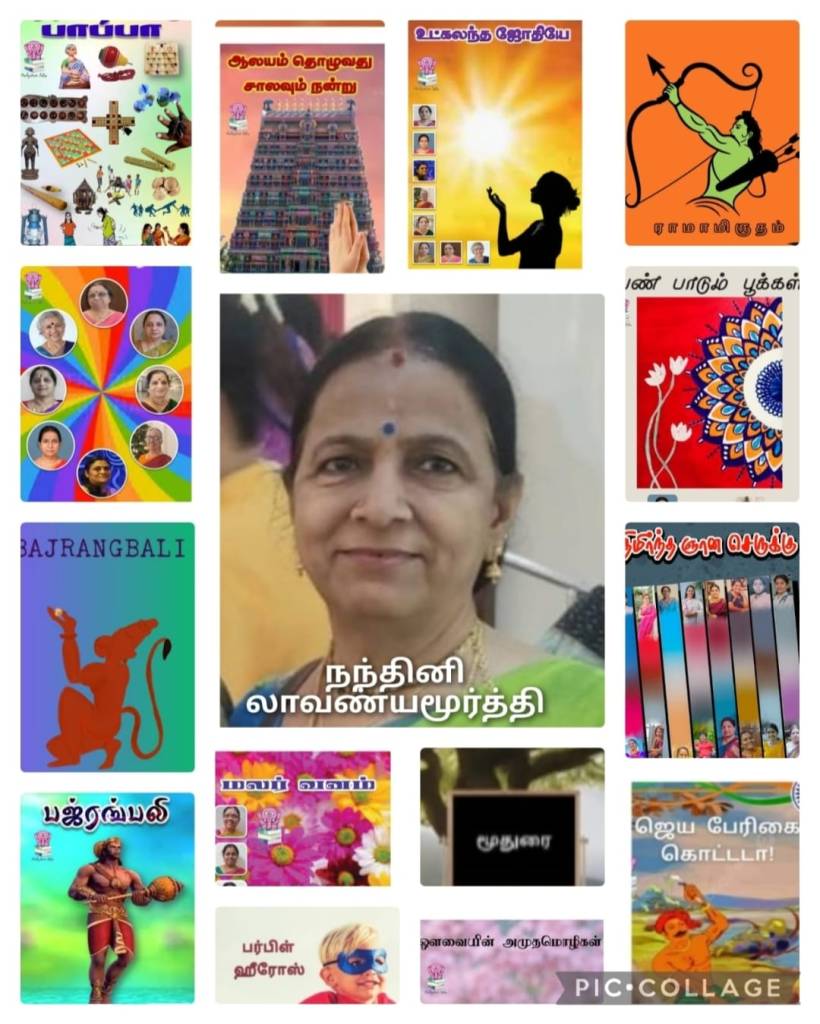
  • Interview with Nandhini Lavanyamurthy

    Your writing journey?

    Before my retirement, in inter office competitions,  I used to write small skits. Actually my writing journey started there. Then, I was writing titbits, small stories  for a Tamil magazine “Pavaiyar Malar”. Almost every month, my article used to come.  After retirement, I joined some Facebook groups and started writing articles. I started participating in Story Competitions. People started recognising me slowly.  After reading some of my posts, Uma Aparna, Pachyderm Tales asked me to write stories with some senior citizens. 

    Why did you chose to do a book on Hanuman?

    From very tender age, Lord Muruga and Lord Hanuman are my favourite Gods. When I chant Hanuman Slokas, I used to be fearless and tackle my problems. One day, when I was reading Sundara Kandam Book, it struck me to write it in a simpler language to reach everyone.

    Why should children be introduced to Indian culture?

    Our Indian culture is one of the oldest one in the world.  We have everything in our  culture and traditions. With two great epics Ramayana and Mahabaratha we can teach our children how to live a successful and at the same time peaceful life too. If we follow our traditions followed by our ancestors, then we will lead a very good life. Children are future leaders.  It is a must that our school system, parents and elders should show our children a correct path.

    What is your favourite story from the Ramayana?

    Hanuman’s meet with Ravan and burning of Lanka.

    What can children learn from the story of Hanuman?

    Nowadays, so many comic fictious stories are coming in book, film and series form like Spiderman, He-man, Pokeman, Shakthiman, etc. If you combine all these characters also, you cannot go near Hanuman. He is wise, showing empathy, bold and brave at the same time, quick in actions. Children can definitely keep Hanuman as their Godfather and Hero.

    What sources did you refer to for the Sundarkandam?

    I read Valmiki Ramayan, Kamba Ramayan and searched Google. But importantly, since my childhood days, my granny used to tell so many stories. Ramayana is one them.  It inspired me a lot. I used to watch Ramayana Serial regularly in television.  These are all my sources.

  • Arundhati visits her aunt  

    Suhani Dewra

    Arundhati undertook a sudden flight to her aunt’s house. Her uncle had passed away a natural death of cardiac arrest. He was 75 and was being treated at the hospital for some days before he breathed his last. Arundhati wanted to be near her aunt. While on her flight, memories of younger days when her aunt used to look after Arundhati conjured up in her mind. She made and packed her lunch for school, checked on her college admission itinerary, and in general her well-being.

    When Arundhati reached the house, her aunt who was in the mourning period was delighted to see her niece. A little shedding of tears happened, of course.

    The house was full of relatives and visitors. The mourning period was scheduled for ten days. Every day, a new set of visitors came to meet Arundhati’s aunt and her children who were now parents themselves. Arundhati’s aunt in general was a woman made of sterner stuff. Never in her life has she been inactive. Whether it was her health issues or any emotions set back, this was a woman who never stopped caring for others. So remained she, even after the loss of her beloved husband.

    “Take my bottle,” she said Arundhati when Arundhati woke up at midnight feeling thirsty. “Do you want to sleep in the room your cousins are?” suggested her aunt feeling Arundhati may want to share the room with people her age. “That’s alright, I will go out to meet Preeti. She must be tired after a long journey,” she murmured when somebody commented that how her daughter-in-law was outside in the living room when she should have directly stepped into the aunt’s room the first thing she arrived. “Tell the cook to pack the night’s dinner for you. You may not want to cook after you reach home,” she suggested a visiting relative who was now returning home.

    Towards the end of ten days, the aunt’s daughter got upset with her mother’s behavior. “Mother, stop this behavior. Just stay in the room and mourn. What are people going to think? That you are not sad about the loss?” she said.

    Arundhati overheard her cousin say this. She wondered, do we have to mourn for the sake of people? Do we have to display suffering to validate suffering?

    These thoughts consumed her for some days.

    On the other side, every day the menu comprised food that the deceased liked eating. Most of them were gourmet food. Women dressed in embellished clothing. “Carry some bright and bling clothes. This is how people dress up in any gathering, be it mourning or wedding. Else people think that you don’t have good clothes,” had said Arundhati’s mother while she was packing her luggage.  At night, a lot of members of the house gathered to chit chat, some about the worldly affairs, others about what was on in somebody’s else’s life.  

    It wasn’t a lifestyle that raised eyebrows. The other family members could carry on with their lives. Only Arundhati’s aunt, being the widowed wife, was expected a certain conduct. Not sure if those around her expected her to be so, or it were only her children and daughter in laws who feared gossip in the colony.  

    While such thoughts were floating in Arundhati’s mind, it occurred to her that when a famous movie actor’s ailing father had died, the son threw a lavish party to celebrate his deceased father’s full life. There was orchestra, there were drinks, and there were lots of guests. Just like a celebration. And that actor’s mother was alive who Arundhati assumed had also participated in the celebration of a life well lived.

    “There are various systems of living. One system of living chooses for the woman to mourn the dead, while another system allows her to celebrate the life that lived,” thought she.

    Back home, Arundhati discussed the details of her stay in her aunt’s house with her once colleague and now friend Surela.

    “But one can’t always grieve. Even if one is mourning, there are moments when light shines through. That is human nature,” Surela reasoned.

    “True, but much is expected of women. A man’s calmness is considered his strength, a women’s is taken as her nonchalance. Can the display of grief measure the amount of love one felt and feels for another person?”

    Neither of them had an answer to this question.

  • Krishna and Sudama in the forest

    Suhani Dewra

    Krishna and Sudama were students at teacher Sandipani’s ashram. They were fellow classmates as well as best friends.

    One morning, the teacher tasked them to collect wood pieces for bonfire, from the nearby forest. The two friends walked through the forest and got on the job. They cut the wood pieces and wrapped them in a cloth that they had carried from the ashram. It was time to go back to the teacher. As they started on their journey back, it started to pour torrentially.

    “Oh, Krishna, we must take shelter somewhere. The rain is heavy and I am beginning to get drenched. I don’t want to catch a cold,” suggested Sudama.

    “Sure, let’s see if there is shelter around,” agreed Krishna looking around.

    The boys found a gigantic tree, such that they had never seen before. The branches were thick and the leaves so voluminous that heavy rain seemed only mere drizzle under the bushy canopy of the leaves of the tree.

    Soon after the boys took refuse under the tree, Sudama felt hungry. While leaving the ashram in the morning, the teacher’s wife had given him two pouches of roasted chickpea just in case the friends got hungry. One for Sudama and another for Krishna.

    The hungry Sudama fished for his pouch of chickpea in his pocket and began to eat. “Tastes heavenly,” he said. In that moment, greed arose in his mind. He decided to eat Krishna’s share as well.

    “Hey, Krishna. I realize I dropped the pouch of chickpea ma’am gave me for you. I am sorry that you will have to stay hungry. But don’t you worry, we will soon get home,” Sudama lamented.

    Krishna knew that Sudama was quite a foodie. There have been moments in the past when Sudama tried to steal Krishna’s share of food while at the ashram. Krishna gave an investigative look at Sudama’s pockets and knew that the other pouch was also in there.

    “Hey, Sudama, are you sure you dropped the pouch. How about you rummage through the pocket carefully. I am sure you will find my pouch of food in there,” Krishna said pointing to Sudama’s pocket which had the chickpea pouch.

    Sudama knew in that moment that his friend had turned clever and outspoken. It wasn’t any use trying to fool him.

    Pretending to search his pockets, Sudama pulled out the pouch with chickpea and said innocently, “Oh, ya Krishna, it’s right here. So light that I didn’t realize it was even in my pocket. There you go.”

  • Interview with prolific Tamil and English writer JK Sivan

    How many books have you written?

    I have written about 140 books in the past 11 years. This includes stories from Epics, Puranas, Vedas, Vedanta, spiritual scriptures, Indian legends, Acharyas, Rishis et al . I have published and released about 35 books which includes a book on 100 stories of Shree Panduranga. 100 stories on Krishna, in both Tamil and English. I have written books mostly on Shree Krishna and Shree Rama. I have written a book on the complete 18 parvas of Mahabharata including meaning of Gita, Sri Vishnu Sahasranama, and Yakshaprasna.

    Could talk about your writing schedule?

    I write for 18 hours a day. I spend all my time reading, singing and writing. I attend meetings wherever I am invited to speak on spiritual topics . I observe most of the women folk and o ld ladies prefer Tamil books. So, most of my books are in Tamil. I don’t price my books, and I give them away for free. I have 10,000 more copies yet to be distributed. I give away books to libraries, friends, donors, children in schools and old age homes. Now, I am giving publishing rights to Pachyderm Tales and Pustaka. I know both Ms Laksmi Priya and Uma Aparna will be able to distribute the books easily.

    When did you start writing?

    I started writing at my 75th year. Till then, I was busy with my shipping activities, and I never had time. It was at the end of the year 2012. Now I am 86. I started writing through email. In 2012, the only technology we had was email. Through email, I circulated my daily writings and the people, who read, gave me the idea of turning it into a book.

    3, 14,000 people are reading my works as per 2022 FB records. (”JK’s posts have been liked 314000 times’) I get calls from people from India and different parts of the world. I give lots of books to them when they come to see me.

    What was your first book on?

    My first book was for children. It was on Shree Krishna. 100 stories on the life of Shree Krishna. It was based on the stories of the 10th canto of the Srimad Bhagvatham. My book was titled, Vishwaroopavamana Kathagal, which means the stories of a cosmic person in vamana (short) form.

    My first English book was ‘You, I and Krishna’ . Here, every story starts with ‘dear children’ and ends with a moral message.. The pictures are in color in art paper with 280 pages approx. I distributed many free copies of this book. Rs 3 lakhs was donated by a philanthropist in Gujrat attached to the Krishna temple in Dwaraka. 12 of my books are in English. Rest of them are in Tamil. There is great demand for books n English. You, I and Krishna was named that way because there are only three persons in English Grammer.

    First person – I

    Second person is you

    Third person – He, she, it we, etc., but all the three persons are none but Krishna

    Advaita means monism nondual reality. You and I are one and the same. Everything is nothing but one. That is what Adi Shankara taught us. Vishistadvaita was taught to us by Ramanujam. It teaches us that Jeevatma and Paramatman are though separate but joined by the surrender of the individual (SARANAGATHI) to the Supreme Reality.. Qualified monism is thus known as Vishistadvaita, which needs the presence and advice of an Acharya to surrender to HIM.

    What is the essence of Indian philosophy?

    In Indian philosophy, there is nothing but one god. That is the concept of Adi Shankara’s Advaita Philosophy – everything is one. In Dvaita – jeevatama is different from Paramatma. The individual soul reaches the supreme soul ultimately.

    In Indian philosophy the worship of god is the main item. It is called Hindu Sanatana dharma. It not religion but a faith. Tolerance is very important in Hindu Dharma. Sanatana means something that is eternal and ever lasting. The essence of Hinduism is charity, love, discipine, faith in God (devotion) This is what the Geeta also tells us clearly.

    Can you narrate to the audience your favourite story?


    I am a Krishna devotee. Krishna is a God with 16 kalas, Poornaavathara, ie., HE knows, is conscious, that HE is god even when he takes shapes of a man. . Rama as the avatar of a human being appeared to do righteous things. eliminating the wicked and cruel people and helping the righteous was the goal. Parithraanaaya Sadhunaam Vinaasaaya cha dushkritam dharma samsthaabanarththam Sambhavani yuge yuge. That’s why Krishna is called the god of protection. The Hindu Trinity perform the functions of Srishti stithi and samhara or laya. Creation, protection and destruction. Whatever is created must have an end one day. We calculate our life term, age, from the time of birth we are born on earth. Everything is dated on earth. God is beyond time space.

    Guna is character, it is the basis on which mind and heart work for a person. Sattva, rajo tamo guna are the three gunas. characteristics Sattva people who are those who are simple, loving, auspicious, detached from the world and its attractions, and think nothing but social good. They are selfless people who help others and live for others. They live to serve others. They are not attached to this world and are not attracted to this world. This body is given for serving others. Itam sariram paropakaram. Jana seva Janardhana Seva

    What is the essence of Vedanta?


    Vedanta is the end of all the vedas. In the Upanishads we find the Mahavakyas –
    Tat Tvam Asi, Aham Bhrahmasmi, Ayam Atma Brahma and Prajnana Brahma. which mean YOU ARE THAT, I AM BRAHMAN, THIS ATHMA IS BRAMMAN, AND CONSCIOUSNESS IS BRAHMAN.

    The Brahmasutras talk about the sublime Reality, omniscient, omnipresent nameless and formless self of the world, everyone is BRAHMAN

    What is Srividya?

    Sri Vidya is the worship of Rajarajeswari, known as MAHARAJNI. The goddess is worshipped in three forms – Bala Tripura Sundari, young baby girl, Tripura Sundari and Rajarajeshwari. There are 6 forms of worship as established by Adi Shankara. Koumara, worship of Kartikeya; Sauravam, the worship of the Sun; Shivam, worship of Shiva; Vaishnava, the worship of Vishnu, and Shakti, the worship of the Goddess and Ganapathya, worship of Lord Ganesa .

    What is the significance of the Sri Chakra?

    It is a yantra. It contains all the powers. It contains the beeja akshara mantra. powerful letters. When you utter the mantra scorrectly the deity respond. There are so many rituals and festivals for Hindus. Rituals are very important in Sri Vidya Upasana. Upasana means strict adherence to the set procedure of worship.

    Any parting message to the audience?

    Hindus are tolerant and never believe in conversion, and there was no cruelty or hatred towards other religious practices. Only liberty and freedom is given importance. Many children other than Hindus can also benefit from our Vedhas, spiritual scriptures, epics and puranas. Knowledge is Divine. Swamy Vivekananda taught how Hindu beliefs and faith has been collectively organised and developed by our ancient Rishis, and is based on tolerance, peace, love and unity, and nonviolence (ahimsa).

    About J.K. Sivan

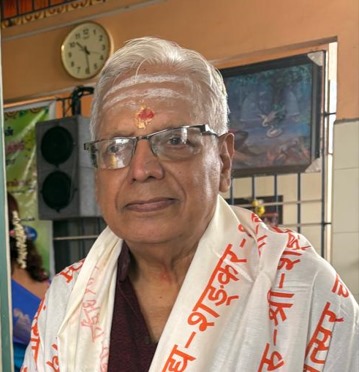
    Born in  1939  he  is now nearing  86 yrs  Mr  J K Sivan  hails from a  Tanjorean family of pious and religious scholars  in Tamil, English, and Sanskrit devoted to spreading the values of our culture, tradition and spiritual development in society.

    Sri J.K. Sivan has been occupying very high positions in International Shipowners organisations  being an experienced Marine Insurance claims and insurance, chartering and ship management,  specialist  in India and abroad spanning a period of about half a century.  He lives in Nanganallur now since 1994 after his overseas career.

    He has been actively engaged in  both social and spiritual service to society. Has been President, and Secretary  of  local residents welfare association and organised temple renovations. Has been Secretary of the  Senior Citizens’ Forum Nanganallur.

    Sri Sivan has organised many  pilgrimage tours covering thousands of temple in Tamil Nadu and Southern part of India.

    He has formed  SREE KRISHNARPANAM SEVA SOCIETY  ( which is now a  family Trust since 2018 ),and ever since  mid 2013  has been  writing articles in  English and Tamil through emails, whatsapp, face book and blogs, website,  about our legends, Acharyas, epics  and puranas, and other holy scriptures in the form of short stories for children . His novel way of present has ben  globally well received by Hindus all over numbering lakhs of people.  He has authored about  140+ books  in English and Tamil , of which about  35 were published without a price tag  for children. Through the above Trust Mr Sivan has organised  many  competitions for  children women and seniors  encouraging them in various  activities connected  promotion of spirituality in society and  distributed prizes. He is  recipient of many titles and virudhus including   BAGAVATH SEVA RATHNA from  Kanchi Mutt seer and VAISHNAVA SEVA RATHNA, from Vaishnava Conference at Annankoil.  

  • A Pachyderm Tales writing roundtable

    Bhanumati:

    Since I wasa small child I used to read story books a lot. Because of my love for books I got the inspiration to write.

    Alamelu :

    As a small child, I used to read a lot of storybooks – Sujatha, Lakshmi, Indumati, Sandilyan. Uma Aparna encouraged me to write.

    Kamala :

    I like Tamil a lot.Kumudham, Ananda Vigadan etc. I did Katha kalashetram and was a storytelling expert. So I decided to write stories. I read Sujatha, Shree Venugopal – a spiritual writer, Tangadurai – a contemporary writer.

    Bhanumati:

    I have written for Bhagvada Kathaigal. Herein, I have explored the stories of Yashoda and Kannan. How, everyone likes Krishna. I have written in Nadodi kathaigal. In this collection of folktales, grama kathas, I have written on a story on Akbar and Birbal. I have contributed to the anthology – Avvaiyar Amdudha Muyvigel – narratives on the memorable and precious quotes of Tamil Poetess. Then I worked on the anthology Thukadagal which is a lot of small stories strung together. My story Odiporavan is on how a girl will suffer if her husband disappears.

    Kamala:

    I have written for the anthology Dasaavatar. I picked the Parasuraman avataram. This avatarn of Vishnu is an avesham avataran, where the Seer/Sage is short tempered. He serves his father Jamadagni and severs the head of his mother Renuka Devi. Then with the permission of his father  he puts the head back creating two goddesses now Renuka Devi and Marimman.

    Vanaja:

    Our mother tongue is Tamil.

    Jayanti:

    The reading habit in Tamil must be inculcated. When we buy a dress for a child’s birthday. We must buy a book for the child as well.

    Jayanti:

    I did a PhD when I was in my 60s and teaching in a college. I am very proud of a song I wrote which was recorded with Carnatic music by a 10 year old girl and she had included my song among other songs by luminaries. My song was on teachers day and its message was –

    Teachers taught us alphabets and letters

    They are the ladder

    They take us up in life

    Brinda:

    I was always interested in study. I used to read a lot of Tamil magazines. Elders in those days used to say they spoil the children’s mind, but my parents would encourage me to read.  I have studied Tamil in school. My child studied in English. We must help children understand Tamil. That’s why I think its important to write, create literature and spread Tamil.

    Vanaja:

    I had a lot of love for Tamil. My children are in America and my great grand children want to learn Tamil. It is very important to know Tamil. All our children must know Tamil. All our stories in the anthologies are in Tamil.

    Brinda:

    I did BSc in mathematics. After marriage, I did an MA and Mphil. I studied the works of Vallallar the poet and Ramalingayal Adigelall, who believed in the spiritual path of bhakti.

    Ruckmani:

    We started learning English in the 6th standard. Tamil was from 1st standard. We think in Tamil, it comes naturally to us. I used to read a lot of books and my father also used to buy a lot of books. Kumudham, Vigadan, writing by Balakumaran, Sujatha, and Kalki’s classic Ponniyan Selyan. I used to keep writing poetry. I liked writing. Then Uma Aparna became a friend. Through the Pachyderm Tales project, we all joined the writing community. Lakshmi Priya is a great leader and thinks differently. We were all stunned by seeing what she was doing. We don’t just write the story. We would just get together as a group and decide what to write. Some of the books I have written for are Athichudi stories, Temple stories, etc. We all liked contributing to the anthologies, and I got a lot of feedback from people. My favourite contribution was for Velar Nachiyar. I took the angle of how girls were a part of the independence movement. I wrote a story about Kuili, who was the leader of the squad that helped Velan Nachiyar.

    I wanted to write about girls and women who are making an outstanding contribution. I wrote about Lakshmi Priya, about Dr. Renuka helping leprosy patients.

    In Tamil Nadu, the reading habits have reduced. Everybody has a story. There is often more than one story.

    Brinda:

    I did BSc in mathematics. Then I did my MPhil on Vallallr, Tamil saint and poet who wrote on the spiritual path or bhakti. I have published in 6 books and 4 more are on the way.

    Brinda:

    6 books published. 4 more on the way. I write to ensure my stories have a message on values. People must read our stories and know something.

    Vanaja:

    I was always intent on reading and writing as a child. I started writing 4-5 years ago. 16 books will be published.

    Jayanthi:

    We don’t give enough preference to Tamil. I did my PhD in Tamil. If you want to be a Tamil writer, you must study Tamil. I used to write in different types of genres. I went to Sita Lakshmi College and wanted to educate children. As a writer, my intent was to take Tamil to the schools.

    Jayanthi:

    My father was a writer. So, I liked writing a lot. My mother used to run a school. I used to write for Vigadan, Kalki, Kumudhan, when I was in school. I have interviewed many people in cine field. My mother started a school. When I taught children I used to teach Alzh Villiappa’s songs. His children’ s songs were very good. He was superstar of children’s literature. We liked the songs. I wanted songs for my school children. I write poems. I have written more than 80 books – biographies of  many people including JK Rowling.

    Brinda:

    I can’t write is what I thought. I had written with Mangelmallar. I have been writing for 30 years. My name is well known among those who read Tamil Magazine – Brinda Ramani. I have written really popular articles – 30 types of rasam, 30 types of dosa etc. Being a well known writer, I was on facebook. I blog. I did these projects for Uma Aparna.

    Kamala:

    I like Tamil a lot. Kumudham, Ananda Vigadan, Katha kalakshetram. I am a storytelling expert. So, I decided to write stories. Kalki, Sujata, I like a lot. Shree Venugopal is spiritual writer and Pushpa Tangedurai is a contemporary writer.

    Kamala:

    I contributed to the anthology Dasavataram. I wrote about the Parashuraman avatar. This is an aveshan avatara, because he is short tempered. Due to bhakti to his father Jamadagni – he severs the head of his mother. This devi, whose head is then replaced is known as Mariamman, Renuka Devi, Yellamma etc.

    Vanaja:

    Our mother tongue is Tamil we must encourage it. Reading habit should be inculcated rigorously. Just as buy dresses for children during their birthday we must buy books too.

    Jayanthi:

    I have done my PhD. My happiest memory is when a 10 year old creates this song with Carnatic music base –

    Flower bud

    Teachers teach us alphabets and letters.

    They are the ladder

    They take us up

    Revathi:

    Working on these anthologies we learn so much about culture. Through writing literature, we are able to experience culture. We should not let go of our culture and heritage.

    Praveena:

    It is very important to write about culture.

    Revathi:

    Every mother must ensure that the child knows Tamil. We must all make an effort to learn Tamil.

    Praveena:

    Culture is disappearing.

    Revathi:  

    We should get children to learn all languages. English, Hindi and Tamil. We should teach children Tamil. We should not forget Tamil.

    Praveena:

    I am Tamilian and proud to say this to the world. We must take the Thirukural and understands the basics there – how to lead a happy life, be content etc.

    Hema :

    Children today don’t know Tamil. It is to help children learn reading and writing in Tamil that I started writing. I have just started. My mission has just started.

    Prabha:

    We were featured in the Guinness book of records. We brought out 52 books by 62 writers.

    Hema:

    I got a lot of support from my daughter.

    Mythali:  

    Tamil is disappearing. English is today the main subject. In the Tamil we speak there is a lot of English mixture. In our daily speech we use 80% English and 20% Tamil. It is important we introduce children to the Tamil world.

    Revathi:

    Tamil is the language of our state. It is easy to destroy but difficult to preserve your heritage, your mother tongue. I am also fluent in Hindi and do, Tamil and Hindi translations.

    Prabha:

    I produce a youtube channel.

    Hema:

    I have wanted to write a lot. I am also a storyteller.

    Prabha:

    I have a good team and a good publisher. I would like to thank them for supporting me with my writing.

    Mythali:

    I was recently introduced to Uma Aparna. I was running a Montessori school. I have lot of experience in telling stories. Uma Aparna motivated me.

    Hema:

     I have written stories online, infact both stories and poems online. Through this project I got a chance to write for publication.

    Praveena:

      I used to write poems in both English and Tamil. When I was a teacher in school I used to tell stories to students. I used to teach English through stories. I have a youtube channel where I tell stories. Uma Aparna motivated me to write stories. I have written the story of Mimmini and Kinkini – the story of two friends.

  • Tamil – The world’s oldest living language as heritage – Interview with Dr. R Lakshmi Priya

    Can we think of our regional languages as our heritage and soft power. Can the oldest living language in the world, Tamil, be thought of as world heritage. Learn Curve for Girls examines Tamil as our living heritage in this conversation with Dr R Lakshmi Priya, Tamil Translator and well-known Tamil publisher.

    Can you tell us how the Tamil language is a world heritage?

    Tamil is a most ancient language. It is called as Sem Mozhi and is listed as a classical language in 2004. Before Tamil got this status, only Greek and Latin were considered as classical languages. After the Sem Mozhi status many youngsters became interested in Tamil.

    Tamil is believed to be the oldest living language in the world, some 5000 years old. Like Chinese and English, Tamil is also one of the largest spoken languages. Tamil is world heritage. Tamil is our heritage, having been passed down from one generation to the next.

    How do languages grow? Can you explain this with context to Tamil?

    For a language to grow, people should use the language. English keeps growing, its vocabulary keeps expanding. Tamil is a fluid language. It does not have a rigid structure. When the use of computers spread Tamil developed its own vocabulary of computer and internet based words. This Tamil is called Kanini Tamil. The Tamil which consists of a unique vocabulary of scientific terms is called Arivial Tamil and that which has a unique vocabulary of mathematical terms is called Kanidam Tamil.

    Languages should have a fluid structures. They will not grow if you don’t invent words and if you don’t allow others to include words. Tamil is ever energetic and ever youthful. If you take the English word dating, even for that we have a word in Tamil.

    Imagine if we don’t invent words for new gen talk. The language will not have words and we have to borrow from other languages.

    Can you tell us a little about Tamil grammar and Tamil Literature?

    Tamil developed its own grammar 3000 years ago in a book called Tolkappiyam written by Tolkappiyar. It is not very complex. It can be used by anyone to learn Tamil. There is, for instance, no striling and puling.

    We have five great epics in Sanskrit. We also have five minor epics. That is ten epics in total. We also have another 8 books that are important in Tamil. We have our own version of the Ramayana – the Kamban Ramayana.

    Can you talk about the international appeal of Tamil?

    Tamil has always attracted people from different, places, civilizations and religions. They have imbibed the culture and started writing in the language.

    The first writing in the language were Shaivite and Vaishnavite, soon Tamil attracted Christian writers, Muslim writers and Jain writers. One famous Tamil writer from a few centuries ago, Veeramamunivar is an Italian Jesuit priest. He learnt Tamil and even changed his name. GU Pope is another very famous name in Tamil Nadu. He translated the Thirukural from Tamil to English. He came to South India in 1839. There are thousands of such people, foreigners who have learnt the language and written in it.

    Can you talk about the close relationship between Tamil language and Tamil culture?

    Tamil language does not exist without Tamil history, art, architecture, Bharatnatyam, temple architecture, and Carnatic music. Everything connects with the larger language.

    In temples in Tamil Nadu, you can find engravings written in Tamil words.

    So many people are fascinated by one aspect of Tamil culture – be it food, history, architecture, language and through this lens they understand all of Tamil culture.

    For us it is not Tamil Mozhi, it is Tamil Marabh, it is not Tamil language, it is Tamil culture. Tamil language does not exist in isolation. Tamil culture is very parochial – games we play, products we use, all this shapes the language we speak.

    To give an illustration of how Tamil culture and Tamil language are linked – in Tamil culture it is understood that every guest must be served water, this makes Tamil culture very respectful, the language too is thus shaped. The Tamil language has inviting words like Vango Vango, Vargo Vargo – inviting words, respectful words.

    The Tamil culture resonates in every part of the language – you should not say No, (Vendan), you should say Porum (enough). The language is structured around the culture.

    The Tamil culture preserves itself. If we are asked to speak some language other than Tamil, we resist it. We have fought here for our language, even court communication is in Tamil. We don’t communicate in English or Hindi. We insist on this. We don’t want our children to forget Tamil that is why we insist on this.

    How can the study of regional languages like Tamil become a part of India’s soft power?

    We are talking about multiculturalism. We are saying glocalisation is important. We are reviving older traditions. There is no one western ideology guiding us. There is no one single ideology we all follow. Understanding regional language, regional culture is very important in this context.

    Could you talk about intellectual theory in Tamil and if it already had equivalents to contemporary western theory like post modernism etc.?

    Postmodernism is incredulous towards the meta narrative. It is questioning the metanarrative and all institutions. We can date post modernism to around 1988. In Tamil, we had similar thinking that originated, before, during and after this date. We have formed our own mini narratives. In Tamil, we have our own philosophers, writers and authors, who have formed their own mini narratives.

    Mahakavi Subramaniyam Bharati questions the metanarrative. Periyar has questioned institutions long before post modernism came into existence. We have this statement in Tamil, “If we are not able to provide a morsel of food for one person, let the whole world cease to exist.” This quotation in Tamil predates Marxism. We are also a very maternal society. The Tamil language has produced many women poets and authors, like Aviyar and Avudel Ammal. All this predates feminism as a movement.

    We Tamilians are proud of our intelligence – we are more inclined towards education than anything else.

    In Tamil literature given to us before 1000 years, questions like ‘what is education?’, ‘what is moral value’, ‘what is truth’ have been raised and answered.

    There are today millions of writers in the Tamil language. In every house there is a scholar and a writer.

    Can you discuss the relationship between language and land?

    There is a deep and intimate relationship between the land of the Tamils and our language. In Tamil language there are five divisions of Tamil land – Kurunji (mountain and mountainous terrain), Mullai (forest and forest regions), Maradam (agricultural land), Neidhal (sea and sea related regions), and Palai (desert and desert related regions). There are deities for each of the regions, distinct food and distinct poetic language.

    Can you cite any examples of Tamil literature as being accessible to an international audience?

    The Thirukural does not have any cultural representation in it. Anyone in the world can read it and understand it in relationship to them.

    Can you talk about the Tamil Siddhar culture with specific reference to their representations in the Tamil language?

    For us the word Siddhar means an intellectual. Siddhars were cultural intellectuals, intellectuals in astronomy, geniuses in mathematics and science. Tamil is one culture which has an ancient tradition where humans had dialogues with god. Agastyar was famous Siddhar who has asked god many questions. Interesting stories abound in Tamil about conversations between god and humans.

    The story of Lord Murugan and the poet and siddhar Avvaiyar is a good instance. As the story goes, Lord Murugan feels that the poetess Avvaiyar has become egoistic and he wants to test her usage of the Tamil language. He also wants to play with her taking a child form. He comes to Earth where Avvaiyar is walking near a cranberry tree. She feels like eating some berries. She sees the small child and asks him to shake the tree and procure for her some berries. He asks her, “do you want hot fruit or cold fruit.” She is not able to understand the meaning here. Lord Murugan nonetheless shakes the tree and cranberries drop down. Avvaiyar bends down and picks them up. Because the fruits are coated in dust she blows on them as if they were hot fruit. Then finally she understands the child’s meaning and his word play.

    In the Tamil culture, the understanding is that the concept of god and human are interchangeable. The common understanding is that anyone can become a god if they are knowledgeable.

    There is this story of the Tamil poet Nakkeran that is very interesting. Once a King announced a writing contest. Lord Shiva himself participates in this contest. Nakkeran sees an error in Lord Shiva’s poem and gets angry. Lord Shiva says, “Was the grammar wrong or the structure, or is it how I have formed the words, what could be possibly wrong with my poem?”

    In rage Lord Shiva says, “I will burn you up with my third eye,”

    Nakkeran says, “Even if you do it will not correct the error in the poem.”

    Lord Shiva turns him to ashes. Then in compassion brings him back to life.

    This story is illustration of the sort of passion and debate that the  Tamil language sparked in humans and in the Gods.

    Can you talk about the need for cultural exchange in different  languages?

    The Tamil culture and language believes in cultural exchange. Getting ideas and concepts in other languages has made Tamil what it is. Our poet Subramaniam Bharati was proficient in six languages. He has famously said, “If you can go a different country, learn the language, understand it and make it your own.”

    Can you talk about your own experience in Tamil translations and as a publisher of Tamil books?

    I have added to the vast pool of people translating to and from Tamil. I have translated Sputnik Sweetheart by Haruki Murakami into Tamil. The book will be out soon.

    I do believe everyone has a story to tell. I have so far published 320 Tamil language books. This includes books by child authors, books by women, geriatric writing (with writers aged 65 and 85).