Could you talk about how and in what form you encountered the stories of India?
My maternal grandfather used to tell stories at night during vacations. The school curriculum included stories in both Hindi and English. Starting from classes 2nd and 3rd, the English teacher would narrate stories to us. She would narrate it like a storytelling performance with voice modulation. I used to like listening to her so much. I used to read also – Cinderella, Rapunzel, Puss in the Boots. I especially liked folktales.
Could talk about how listening and stories as a child had influenced you?
Indic Stories influenced me tremendously, as also did stories like Snow White. They all had an imprint on me. In the 9th standard there was a speech from the Bhagvat Geeta, a speech given by Krishna to Arjuna before the war. The speech goes, “If you lose your mental composure, you will lose completely.” In my adult life, I always went back to this Bhagvat Geeta speech when I needed some clarification or guidance. I was deeply influenced by the Ramayana. Lord Rama is an obedient son, so I wanted to be obedient like him.
“In Celebration of Being Alive,” the Dr. Christiaan Barnard story taught me about the lesson of celebrating life.
They make me thoughtful and in my adult life, the stories I have heard as a child, have played on my subconscious mind.
The stories existed before there was writing on paper or TV. Indian stories are numerous. I watch the Ramayana every time there is new version.
What can children learn from our stories?
Much can be learnt from stories. There is a deep focus on family life in Indian stories. The Ramayana is all about standing for your blood.
How are Indian stories different from western ones?
The landscape is very different. Snow-white is played out on a vastly different climate zone. Cinderella too. The landscapes itself create a deep difference in the storytelling styles. Culture gets transferred through stories – any culture. If you look at Krishna stories – they advocate community living. In all Indic stories there is a great emphasis on community living.
In Indian stories you get a good sense of the grandeur of Indian lifestyles.
Any message on Indic stories?
In India, people take the stories as sacred and very seriously. They could just let stories be stories.
My background in education is a Masters in English Literature. Before that I did a Bachelors in Nutrition. Since 2000, I have been in the field of English Language Teaching. I have been teaching English in different schools. And I started using stories and storytelling for English Language Teaching. My background to storytelling is that I am trained in Bharatnatyam, Kuchipudi and in Rabinder Sangeet. I have worked in the All India Radio. I was a part of an oration club in Secunderabad. I learnt the flute and the violin. My parents put me in Chinmaya Mission at an early age and here I learnt to chant the Bhagvat Geeta. There was an environment and culture of stories, music and dance here. Formally I started telling stories to my students in 2000.
I grew up living in 13 states in the country. Everyone in my family speaks 4 to 5 languages, extended family included. I have had a multilingual and multicultural upbringing.
On your journey as a storyteller?
I loved telling stories. In 2000, as an English teacher I realised that narrating stories was very useful for schools and children. I had done stories before in the All India Radio. I had recorded Alice in Wonderland as a series there. But this was chosen by my boss. But in 2000, I chose to tell stories in the classroom because I thought it was beneficial. Children could relate to the stories better, be more enthusiastic about the language, talk in English and turn in homework. In 2005, I studied teaching English in the English and Foreign Languages University. I could connect the dots back. I could see what I was doing with storytelling in the classroom was working. And I could connect the dots forward. What I did at EFLU I could use as a teller and in the classroom.
Another milestone was, in 2010 I started singing songs in my stories. In 2011, I got a project for Dasaavatram for children of NRI. I sat with my Kuchipudi teacher and composed the story in English and also with Sanskrit and in other Indian languages. The performance included narrating the story with music and dance – a style I continued since then.
In 2017, I founded the Story Arts Foundation as a trust to work with the Government and NGOs. Starting 2016, I started travelling internationally for my work to do stories from the Indian culture and perform them for a global audience. My focus has been on stories found in the Indian culture.
Your favourite story?
This was one that my father told me. He was my first storyteller at home. He would often narrate the story of Yellaam Nanmaikku. There was King and he had a trusted minister and he would keep saying Yellaam Nanmaikku Yellaam Nanmaikku. The king would find this irritating some times to hear Yellaam Nanmaikku – everything was good. One day the King ate a lot of Brinjal and got a little ill. Physicians were called in. And still all the Minister could say was ‘Yellaam Nanmaikku’. The King was furious and threw the Minster in jail. Still all the Minister could say was ‘Yellaam Nanmaikku’. The next day the King and his troop went on a trip to the jungle. A thorn pierced the King’s hand and he ended up with a bandage. Meanwhile, without the minister, the King and his band got lost in the jungle. They reach a place where there are jungle dwellers who are going to make a sacrifice. The King realised he was going to be sacrificed. The drum rolls started for the sacrificial ceremony. But the sacrificers soon realised that the King was an imperfect sacrifice as his hand was bandaged. The king was released and he and his troop reach the palace safely and realised that Yellaam Nanmaikku, all was good. The King had his minster released. The Minster was still in a cheerful state of mind. The King asked how come the Minister said Yellaam Nanmaikku to being thrown in jail. The minster said, ‘They didn’t sacrifice you because your hand was bandaged but if I had joint the troop and they would seen I have no bandage and sacrificed me. The King agreed – Yellaam Nanmaikku.
I had heard this story from my father and narrated it frequently to my children. Once when I was disappointed with something my younger son said Yellaam Nanmaikku. So, the story came back to me. My father, me, my children and from my child to me – that’s how the story travelled.
Your favourite Indian story collection?
Stories from the folklore of India and our Itihasa Puranas. I feel deeply connected to stories of our land. It has something to do with my style of narration – which is very Indian. I like narrating stories from the Ramayana for children. For myself, i like reading the Upanishadic stories.
Any world geographies, whose stories you enjoy?
I enjoy listening to all narratives – Norwegian stories, African Stories, Australian Aboriginal stories. I find that stories from Africa have a lot of music and are extremely lyrical. They have a special quality of language and orality in them. When I had been invited by the University of South Africa to visit six schools in the municipality I realised that reciting African poetry was a part of the African culture and tradition. This was apparent as child after child recited African poetry in a particular manner. They have a tradition of oral poetry recitation. Even if you don’t understand the language, you will feel the power of the cadence.
How would describe your connection to storytelling?
Just like some people like cooking and specifically cooking for others. Storytelling for me is like that. I like to cook a story and share it with others. With storytelling, we sit down, share a story and listen to it together.
You use a lot of rare musical instruments in your narrations, could you talk about these?
I look for instruments whenever I travel. They are not new in my life. I started playing a palm sized piano when I was 10 years old. I learnt the flute for one year. I learnt musical instruments at Bal Vihar and Bal Vikas, the majeeram, harmonium, cynabal are all used in Indian bhajans. I have a very interesting musical collection. Many of my musical instruments are from distant and far off places. This bird made from clay is hollow inside. You have to fill this water inside. With the water, the bird will make a chirping sound. I got the Xutuli from Assam.
From the Haridasus, who are Harikatha performers in the state of Andra Pradesh, i got this musical instrument the Alandu. My friend came from Australia and was attending a Haridasu performance and got this for me from them. These are not available commercially in shops.
I got the Dapu from Malayasia, it is made from monitor lizard skin. I soundscape my stories. I am a storyteller and not a musician. While narrating stories my focus is on the storytelling not a musical or dance performance.
I used a rattle in the Banyan and the Sparrow story. Rattles are common for children and are available everywhere. My focus is in getting the right music for the storytelling. I have the damaru. It is played with the rope, not the hand or the stick. I got this Shaker from Pondicherry. It is made of dried seeds. All cultures have such musical instruments. I got cymbals from Dharmashala with typical Tibetan patterns embossed on them. From Bengal, I got the Duitara – which has two strings. Baul storytellers use this instrument. I got this from Baul singers when I was attending a children’s writing residency in Bholpur, Shantineketan. In Nepal I got a meditation bowl that has a nice resonance. In Kolkata, I got the ocean drum, which creates sounds of water. From Northeast Thailand, I got the flute. I was visiting a music department of University where I had been invited. The flute has to be rotated to create the sound – a sense of sadness or happiness depending on what you want for the story.
I am an electrical engineer. I was with Konika films. I had great growth in that company. They made camera films. I am a Kannadiga. I was managing aftersales. I was in many managerial roles and managed multiple projects. I worked on System Integration. I worked on seamless management of audio-visual facilities. I was in the managerial area for 24 years – business development, client servicing and everyday operations.
Your storytelling pathway?
I had no clue about what storytelling was. I was highly involved in presentations to clients. I was otherwise not someone who would read books. Storytellers are usually from literature background. I took a storytelling course. Storytelling gave a lot of exposure. Other people are an integral part of the storytelling experience. Storytelling opens the heart. Storytelling is deep engagement with children on a daily basis. My feeling is that I didn’t chose storytelling. Storytelling chose me. I did learn a lot with Geeta Maam. She is a great person to learn from. She opened the heart of storytelling for me. The Kathalaya storytelling diploma was a deep dive into storytelling. The diploma internalised storytelling for me and skilled me with different techniques in storytelling. I learnt to use different practices for storytelling. I started preschools in Mumbai. I run eight centres, all in Mumbai, where I teach storytelling. I am part of two international schools where I do storytelling as a part of the curriculum. I teach parents storytelling for their children. I find that storytelling is a skill that helps me breathe. We are all storytellers.
Can you talk about storytelling for the classroom?
Once I turned into a storyteller, I have an eye and ear out to absorb details that can help create great stories. I made my own curriculum for storytelling for early childhood development.
Deepa Balakrishnan has been an award-winning journalist in Bengaluru for nearly two decades. In that short stint, she has had the privilege of covering a host of subjects from politics and rocket science to tsunamis and riots. She has spent most of her professional life as a broadcast journalist, though she also wrote for newspapers and websites. She is also an author, having published two books for children based on real-life news experiences. Her journey, authoring, started when she ended her long days at work to return home and her then-four-year-old wanted bedtime stories. She then started storifying her some of the real-life events she had covered, and found that the little one loved those. While on a career break, she published some of these stories to reach more children.
On your career as a journalist and writer?
I wanted to be a journalist since I was 15-16. I took journalism courses all through college. It was not for the glamour or the fame or the money, since there was not much money in journalism. But I wanted to be involved in societal change. It was a thing of identity. I would think of the utopian world. I wanted to contribute to a utopian world. I started my journalism journey in a publication – beats I covered were education, science and urban governance. I had so much to write about. Then I had the TV interview. I was asked, “Do you write for the news per week? What kind of deadlines do write to? Can you do one story or two per day? I was at that time doing 11 stories.” But TV is different. It may be one story, but you are still doing one story per day are the challenges can be navigating traffic, getting the right sound admist the noise etc. So, I was not putting up 11 stories in given day. One thing about journalism in any form is that the goals are the same. We are telling stories. I was at home and telling my son a story. My son loved it so much that he heard it again and again for a week. What I wanted to do was tell news stories in a way in which children could understand. As a journalist you tell a story that everyone in a village can understand, the whole nation can understand. I would tell my kid stories and that’s how the storytelling started.
Could you talk about your children’s books? How did they come about?
One was a story about a news event that had happened in Brazil. A sealion that had got lost in city traffic – I made a story out of it. The other story was about stone quarrying, illegal stone quarrying at that. We went to do the shoot in the forest and we took a video of the quarrying. The impact it had on villages. In the book, I wanted to talk about what we are doing to protect our forests. So many trees, so many animals – how does this quarrying impact them. A year after the incident there were so many news reports of animals leaving the forest and getting lost in villages. A leopard that comes from the protected forest area and enters the village is in the news. As a result of telling such stories we can get our children to read the news. How do you get your child hooked to reading the news? My son opens the physical newspaper and reads it.
Could you talk about the importance of truth and authenticity in your work?
All these are lived experiences. Authenticity is very important in any story. There is no room for plagiarism. You are here and the stories are about what you see. Journalism is all about how anyone anywhere can understand what you have to say. Even a younger child can relate to these things. Questions to ask are – whether I am making a difference to society? Whatever I am writing – whether I am making a difference in terms of awareness?
Is this not pioneering work, in terms of presenting the news as children’s books?
Maybe. That is hard to say. As journalists, we are all storytellers. There are lot of children’s writers these days doing the same thing. Sudha Murthy banks on her own childhood experiences. She writes about what she has known. She is a storyteller who draws from her lived experiences.
Could you talk about your experience of storytelling – in Print Journalism, Broadcast Journalism, and as children’s writer – the entire expanse of storytelling?
Storytelling is what we do as journalists. How it changed and remained the same across mediums. The story should have people and anecdotes, case studies and experiences. Once we were doing a documentary on The Chandrayan and spent 23 days on it – shooting and editing. It was the experiences people shared with us that made the story real. We were talking to one of the scientists behind the exhibition. He was from Pollachi and never left his district till he finished his collage. The story of a scientist from a small town can be a source of a lot of personal inspiration. To a news story, the personal experiences make all the difference.
I started working as a pre-primary teacher. I worked in pre-primary for 33 years. I worked as a coordinator for the pre-primary sector. That is when I thought that storytelling is an important aspect for pre-primary sector. I contacted Kathalaya and invited Geeta Ma’am for a workshop. At that time, I thought that when I quit my job and retire, I will be a storyteller. This was the inspiration I had that day to be a storyteller.
After I quit my job, I took storytelling as a profession. That is when I called Deiva and she asked if I could do storytelling through schools. I started working on storytelling for schools through Kathalaya. I have also done the diploma in storytelling through Kathalaya.
Could you talk about the certifications in storytelling you completed at Kathalaya?
I did an online beginner’s course during Covid. Since I had decided I work as a storyteller, it worked well. After that I did my diploma at fireflies. The Kathalaya beginner’s course covered how a story should be told. With the diploma we covered the deeper nuances of storytelling – the importance of voice, voice modulation, movements, body language, and the role puppets play in storytelling. For the diploma we interviewed a few folktale tellers and made a booklet with fairytales, folktales etc. We documented all this.
Could you talk about your interest in using puppets for storytelling?
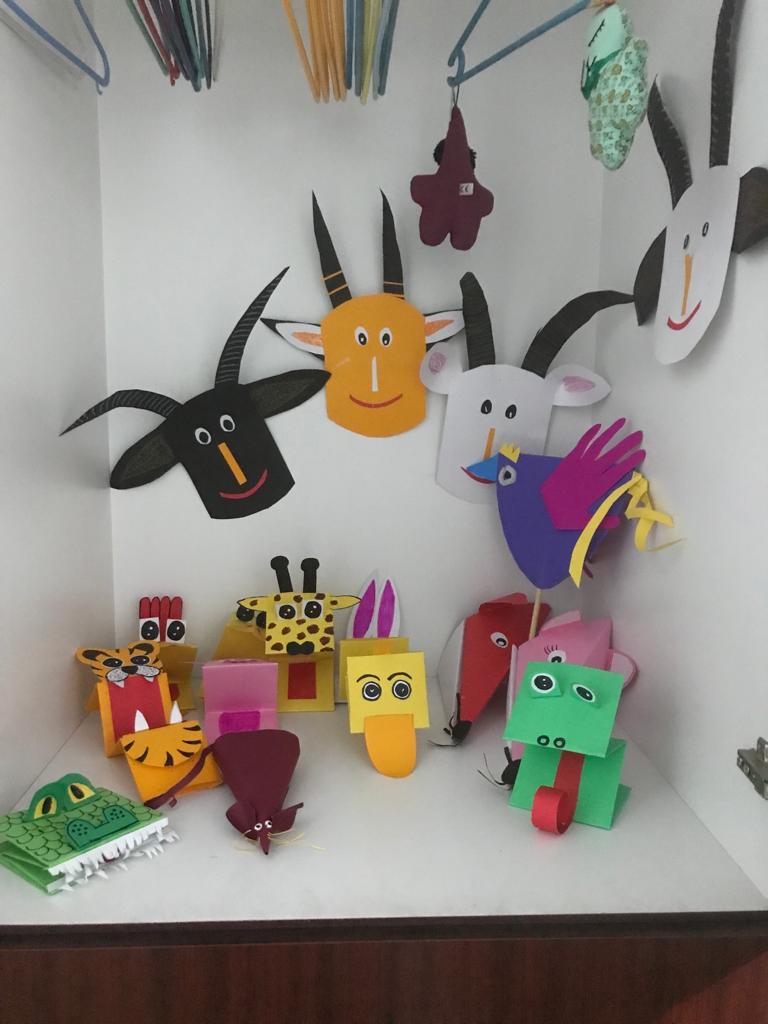
When you do the diploma in storytelling, you know who your audience is. Mine is storytelling for pre-primary children. For others it has been storytelling for adults, storytelling for senior citizens, storytelling for special children etc. Since I am interested in doing storytelling for pre-primary children or smaller children I knew that puppets will be relevant. I make my own colorful and attractive puppets. I make hand puppets and stick puppets. I have a whole box of puppets.
Could you talk about the role of sounds and voice modulation in storytelling?
When we are enacting animals, each has a characteristic sound. We use a different voice for each animal. For instance, the lion has a gruffer voice, and the mouse has a softer voice.
During storytelling sessions, voice modulations for different animals is done.
Is there a need to research ecology for storytelling?
A lot of study is needed while preparing for a storytelling session. We need to read a lot of information on nature, plants, animals, birds etc. For instance, if you are working on a story on hornbill, then you need to know if the bird migrates, if it can fly etc. You need a lot of information and facts to tell the story of an animal or bird.
Can you talk about your experience as a story narrator?
Every platform, I perform in is a different experience. Even storytelling in one school to another school is a different experience. The storytelling experience varies from when your audience has only children or when it has less children.
Could you talk about spontaneity in storytelling?
The same story can be told to a two-year-old and to a ten-year-old. You can elaborate on different points of the same story to help different audiences connect. The way you tell a story to younger children requires much more voice modulation than a story told to older children.
Could you talk about movement in storytelling?
I start my story with an icebreaker with movement. Movement helps the audience connect to the story and the teller. Through getting the audience to enact movements during the story they are able to pay better attention to the story.
How has storytelling positively impacted you?
Once I got into the profession of storytelling and stopped working in schools my perception towards life itself changed. I was able to read more. I have been meeting different types of people. My knowledge has increased. It has changed my perspective of life.
On your plans as a storyteller?
I would like to reach out to more schools, more children and do more storytelling.
The favourite story you like telling?
The story of the lion and mosquito.
Once there was a lion. The lion thought that he was the King of Jungle. He really thought that.
The lion growled.
The mosquito was trying to sleep. The lion was making so much noise that the mosquito could not sleep.
The mosquito asked the lion to be quiet.
The lion said, “I am the King of the Jungle and can do anything I want.”
The mosquito said, “I don’t think you are the King of the Jungle.”
The lion said, “I am the King of the Jungle.”
The mosquito said, “I don’t think you are the King of the Jungle.”
Then the mosquito, entered the lion’ nose.
The lion cried, “Leave me please.”
The mosquito bit the lion hard.
The lion said, “Leave me alone.”
The mosquito asked the lion, “Who is the King of the Jungle?”
The mosquito then said, “Now, I am the King of the Jungle.”
And that is how the mosquito became the King of the Jungle.
Could you talk about the use of dialogues in the story?
The more you talk in dialogues during a narration the more the children will be able to assimilate. Their language also improves. I use Kannada and associate it with English. I do storytelling at the Sharadha Mutt and I do it in Kannada and English.
Could you talk about other influences to your storytelling?
I am a trained dancer. I have been training since the age of five and have been performing till the time of marriage. This has helped in storytelling with expressions and voice modulation. I am trained in Bharatnatyam, Mohiniattam and Kathakali.
Could you talk about how Kathalaya has impacted you?
After I left school I told Geeta Maam, about joining as a storyteller and she knew what my strengths were. She knew I had been associated with schools. She suggested I do storytelling for schools for Kathalaya. We are also working on building a story curriculum.
Your experiences as the Founder of the Storytelling Movement in India and in many parts internationally too?
This is my feeling and thought that there is nothing new in what I am doing. It is like reinventing the wheel. Storytelling is as ancient as human time itself. We have always said at Kathalaya that the world is made up of stories not just atoms. Right from the time the first atom appeared, stories appeared. Human beings are social animals from the very beginning, sitting around the fire, where they shared food and along with the food stories. We must thank fire. All around the world, people have been moving in 18th and 19th centuries with the beginning of industrialization from small towns and villages to big cities. Historically in India, approximately from 1945 to 1990 there was nothing happening with storytelling – all due to nuclear families, the search of jobs, the moving away from traditional roots, Macaulayan education, there was no time to listen to stories! There were no grandmothers being heard as they narrated stories, no time for community gatherings. The only way children listened to a story was by reading them. Originally in India, we had listening, retelling of stories along with a discussion on them – that was the guruvul. All this got converted to reading and writing. When I was growing up, it was a mixture of tales that is a mixture of heard and read stories – my parents were from the old times from villages in Tanjore and Nagercoil – I both listened to stories and read them. There was both the oriental input and the western input. Curiosity is very important for learning, for growing up, if you didn’t wonder, if you are not curious you can’t learn. Stories became a diet and this diet was very nourishing for my soul. I became a teacher and a librarian – wherein I found that 45 minutes was all that was allotted to each class, it was all very divided. I figured out that the best way to teach concepts was through a story. I didn’t know I was starting a movement, it was like climbing a ladder quickly – teachers called, NGOs called – storytelling was tool that could be used everywhere. Teachers called to get help with concepts, NGOs on how to use stories for special education and for teaching the deaf mute. This waterbody of stories had many tributaries. And at that time, there was no competition as people did not know ‘what was storytelling?’. People didn’t challenge us much because they thought storytelling was not a ‘real business’. I wanted to give storytelling a genuine pedestal by professionalising it. I wanted it to have goodwill. It was the right time and the right thing happened – to be able to do all this without obstacles and to be able to build the whole universe of storytelling. I was one of the facilitators to make storytelling happen.
You used the symbol of the fire, could you elaborate on this key Indian metaphor?
What we call learning is rooted in our civilisation and its fondness for storytelling. Gypsies had it. So, it bards. This culture of learning through stories. If you look at the ancient Egyptian, Chinese and Indian civilisation, they were very ahead of modern western education and societies. Much of the learning was integrated with healing and therapy based. Of the therapy based traditions, India has strong storytelling roots. One of the earliest art based civilisations was the Indus valley or Harappan Civilisation. So many things we were doing ahead of its time. Our rishis were true seers and had the power of foresight. The Chinese, Egyptian, Mesopotamian, civilisations were all gifted with seers. The seers in the Indian civilisation were the rishis. These Rishis foresaw the universal values, that is the basis of all storytelling. They also heard sounds from the cosmos, its vibratory patterns, these were converted to chants.
The elements – eternal and universal, have a way of syncing up with and helping human beings. In times of old, people wandered around and sat around trees waiting for ideas. One day, while sitting under a tree, early man heard a voice – this voice informed him that by bringing out the fire from the stone he will prosper. In those days early man used to eat raw meat. Once early man became a settler, he heard the sound from the stone and fire came out. Now he could cook his food.
There are these stories of Nachiketus in the Upanishads, who as a littleboy, who questioned whatever his father offered as sacrifice. His father, when a cow became old, would offer that as the danam. As a consequence of an altercation with his father, Nachiketus goes looking for Yama. The god of Death, Yama, is fascinated by the questions the boy has for him. Yama tells the boy the secrets of death and gives fire the name the Nachiketa Yagna. This is also known as the agni vidya. It is through the vidyas that people learn and the vidyas had stories behind them. Fire helped man settle down. Fire and flames were powerful in that they let man know that everything can’t be conquered. Water and fire became very important. Pranayama is done for wind. That’s why in human life the elements are so important. The rishis could perceive the elements – they could see the tree in the seed.
How would you describe the potency of storytelling as a form?
The power of storytelling lies in that you sit near a person, when you listen to a story. The west has been very good with documentation. In storytelling, everything had to be told from the heart. It has to be felt and told. It comes from the heart. There had not been too much reasoning. Storytelling as a form looked like it was a very rote process and retentions helped. Because of retentions it helped in rethinking the story. Today, the same thing is converted to a digital form. When you see an animation the effect is not the same as person telling the story. In a telling, the energy of the person reaches the student.
In India the tradition we have come into is that the purpose of living was to live in service of others for the rishis. In the world this can be seen as well – In Egypt’s desert areas there were learned fakirs and Sufi ascetics, in China there was Confucious and then there was influence of the Buddha. They were role models and seers for who life had to be lived.
On storytelling in Adivasi communities?
In the Adivasi communication they have a lot more oral traditions, lots of music and a lot of folklore. They will sing the story so beautifully. Santali tribals don’t have a written script. They still tell stories to impart knowledge to children, stories to impart knowledge to children – the stories of the first Diwali, the story of how a woman married a peacock, the story of why the lizard’s tail keep growing back. There is humour in the stories, music and songs. In Mangalore, there is a story for why two types of fish are not cooked together.
Could you talk about your experiences in setting up storytelling internationally?
I was asked to build a culture of storytelling. In Sweden, they had their culture and their teachers. They wanted to bring storytelling as a concept of learning. Before this storytelling was for performance and entertainment. They did not know that storytelling could be integrated with the classroom to set up a cultural curriculum. I helped them integrate storytelling with lifeskills and values. I trained them in the art of communication through storytelling. In Scotland, Sweden, Brazil – storytelling was all about building the bridge.



 Learn Curve for Girls