Book Review: Walking Out, Speaking up – Feminist Street Theatre in India by Deepti Priya Mehrotra
A book on theatre and dissent, Walking Out Speaking up – Feminist Street Theatre in India by Deepti Priya Mehrotra is a book which is at once academic and rooted in social reality. Walking Out Speaking up – Feminist Street Theatre in India is a book made of fragments, fragmented as our lives are by dowry and social lies. The fragments comprising this book are quotes from interviews, extracts from plays in Hindi and English, photo documentation, news excerpts, feminist activism as a lived experience etc.
The book is a study and a very very meticulous study of the methods and formulations of the street theatre in North India that started with a wish to stop dowry deaths and other crimes against women. Om Swaha is a play on a dowry death, made personal and immediate through the commitment and agency of the method of street theatre.
Ehsas, a feeling and a street play, can be sensed so clearly and evocatively through the means of this book. The book almost takes us through a video journey of brilliantly apt images that bring Ehsas to life.
Images stark and real, images of death and murder, images colourful and on the dangerous invocations of fire in India today that would have made our ancestors from the prehistoric era who discovered the many positive uses of fire shudder, images of that which can be understood and images of that which has to be explained – images of feminist street theatre in India.
Feminist street theatre in India is an important part of the woman’s movement in India. Delineating the structure of the same is this book, a ready manual of intense writing which is at once self-aware and socially conscious. Feminist Street Theatre in India is both a subject of deliberations and actions.
Feminist Street Theatre can be understood as a grassroots movement lead by scholars and academics – central to our understanding of how to respond and react to that which is the content of our daily newspapers.
Feminist Street Theatre in India is a collective and movement lead by the chance and often lifechanging meetings of actors, feminists, activists, directors, scriptwriters, theatre coordinators over the outrageous and enraging contents of daily news. News – short and impersonal, hardly evocative and image based but full of reality as we never want to know it forms the basis of feminist street theatre in India.
News and journalism if the backbone of a society and culture, then theatre especially feminist street theatre is its secret mystical kundalini or serpent power – magical and powerful at once.
Watch the news and experience its horror and discover solutions for the realities it photographs and who better to help in this than feminist street theatre – a magical portal of learning and democratic processes?
Because of street theatre, and related activism, which I got introduced to when I was 17-18, I didn’t follow the set career path I could have, like being in full-time teaching or journalism. I did not want to join set institutions.
Writing has been my mainstay in terms of meaningful work. I write in English and Hindi, and have written a number of books. In 2003 I wrote a book on single mothers – Home Truths: Stories of Single Mothers. These are narratives of women who have a child or children outside the structures of patriarchy – adoptive mothers, divorced women, widowed women, women who never married etc. The inspiration came for this from myself being a single mother — I brought up my daughter on my own, and the book came out of my own experience, because I needed to know such stories, to help me and other women also. There are these common beliefs that I wanted to challenge, such as ‘Divorce leads to broken homes.’ There’s a space that opens up – the freedom that comes from being single, taking the decisions. We are different, which need not be a problem.
I was able to interview many other single mothers in this research project. I had won a MacArthur Foundation grant to do this 2 year research project. The book was published by Penguin. I wrote the Hindi book also – Ekal Maa: Maut bhi tum se haari hai (Single Mothers—You triumph even over death).
My next book was on Nautanki – a folk theatre form, very popular in India for 100 years till the 1960s-70s. It was an operatic theatre form with music, dance, dialogue, stories, and initially done only by men. I wrote the book on Gulab Bai who was reputed to be the first woman actor in Nautanki. I did the book Gulab Bai: the queen of Nautanki Theatre. Gulab Bai was from the Bedia caste–a dalit caste. They were on the margins of respectable society, completely on the periphery. Gulab Bai was awarded the Padma Shri, for her singing. These women were actors, singers, directors, experts in everything they did. This book was also published by Penguin. It is a biography of Gulab Bai, as well as a social history of the Nautanki genre.
My third book was different – it was on Peace Activist Irom Sharmila. The story of her life and the story of Manipur. There have been women’s struggles in Manipur, as a part of anti-colonial struggles. These women’s wars of the 20th century were known as Nupilan – Nupi being the word for women in Manipuri. Well known for struggles, this is the community of women Irom Sharmila came from. She was protesting state extra-judicial killings by armed forces. Under the Armed Forces Special Powers Act, rapes and killings took place which were state-sponsored violence. In 2004, elderly women protested the rape of a 34 year old woman. The elderly women protested and disrobed in public, expressing their rage. In these contexts, Irom Sharmila was protesting. She went on a hunger strike, demanding the withdrawal of the Armed Forces Special Powers Act. Irom Sharmila was sent to jail and force-fed through a nasal tube. I met her both in jail and in the hospital. This is a book about Irom Sharmila and the Manipuri people’s struggle for peace. I have also written the book in Hindi and it has also been published.
I have written on Jaggi Devi, a Dalit freedom fighter who was born in 1918. I met her in the 1980s and she died in the 1990s.
I was also writing for magazines, journals and newspapers. Thereafter, I wrote a book called Her Stories: Indian Women down the ages – Thinkers, Writers, Rebels, Queens. Some of them are women we know while some are known only in their local areas. It covers a span of 3000 years. It is interesting to retell the stories of women, to write with historical authenticity without the limitations of biased historical writing.
I have also been a teacher. I completed a PhD in political science, a BA in Economics, and an MA in Philosophy, all from Delhi University. When I was around 40, I began teaching in Lady Shri Ram College in DU. Though I did not take it up full-time job, sometimes I had up to 18 classes a week. I taught in the Education department and the Journalism department. I provided Social Sciences inputs into these two departments, both of which are career focussed – education and journalism. I brought in my life experiences to connect with young people. I taught briefly in the Tata Institute of Social Sciences, Mumbai. And in Dayalbagh Educational Institute, a university in Agra. There I designed several courses in the Social Science Faculty and taught across B.A., M.A and research scholars. It was a different cohort of students there, very different from Delhi or Mumbai. They all had to wear a staid white uniform, in college!
Apart from this, I took up a number of consultancies. I was a consultant on social issues for UN agencies, Action Aid, National Foundation of India, Aga Khan Foundation etc. This too was an interesting career for me. I went to remote parts of the country, to evaluate, document or advise them on projects.
Could you talk about the biases in history writing especially in writing women’s histories?
All the books I wrote were concerned with social organisation and patriarchy. All are concerned with gender. I grew up as a very quiet and frightened child. My own experiences and feelings, very personal, made me sensitive to biases in society. One has to have an eye for this. I could see an opening in street theatre. In the theatre workshops we would talk about our experiences – about sexual harassment, our mother’s pain, our overworked mothers. My mother would wake up at 3:00 every morning, to cook, then go to work. She was so creative, but she burnt herself out. I learnt storytelling from my mother.
When I look at books and search for women in history, women are just not there in the books. There are queens in books – but these queens were seldom in power. What we read about women in royal households, are daughters, wives and royal mothers. When we read these accounts we don’t see the agency and possibilities of women. The history writers often don’t know about these aspects of women’s lives and don’t mention important things, like the overwork. We talk in terms of ‘father of science’, ‘father of sociology’ – but women pioneers in the same areas were ignored. Women in history books are stereotyped nonentities. Androcentric biases exist in every discipline, and feminist scholars are countering this. The figure of women in history books must be made more full and perceptible with information about their identity, thoughts, public and personal life, strengths and frailties.
My joy has been to stand in the way of patriarchies, challenge their stereotypes, and to look and see the hidden aspects, the invisible histories, what has been happening with human beings, with society, all around. There have been so many voices in history and so many versions, histories and her-stories. Even very powerful women had to fight many different types of social systems. There were the Begums of Bhopal who were excellent administrators, and very concerned about girls’ education. The Buddhist nuns of the 6th century composed the first ever women’s poetry known in the world. The stories of these women are available in Buddhist literature, as little more than sketches. When I thought of this book – ‘Her Stories: Indian Women Down the Ages…’, it was to re-imagine women’s lives by standing in their shoes, as it were. In 56 short chapters, I retold stories of many women, each more interesting than the other. I wanted to write about women with their own voice and their own energy.
Even the women mystics revered in India – Andal, Karaikkal Ammaiyar, Meerbai… — their stories need to be brought to life through feminist perspectives. On Meerabai there is this familiar story that she merged with the idol of Krishna. But there’s also an another story, of how the king sent a group of Brahmins to drag her back to Chittorgarh, because she was bringing bad repute to the Rajput kingdom. She was to be carried forcefully, but instead of submitting to this fate, she chose to end her life, by walking into the sea. This story honours her resistance, her her agency. We can rewrite these stories, based on oral histories, fragments of documents, similar to stories we ourselves have seen, understood. We have to ask these questions of women in history – ‘What was her life like?’ ‘What was her story?’ ‘What did she want?’ ‘What did she do?’
There is so much to learn, beyond biases of gender, caste, class etc. Nangeli was a Dalit woman who cut off one breast as a form of protest, because she had to pay tribute to the upper castes, in Travancore. They would not let the Dalit women wear upper body clothing. News of her protest spread, and the rules finally had to change.
Could you talk about your work in Feminist Street Theatre?
The street theatre book I wanted to do since years, the motivation came from my involvement in feminist street theatre during 1980s-90s. Feminist street theatre involved – such a transformation, such an energy – I wanted to communicate the memory, the emotions, the solidarity and the joy of friendships.
The theatre was held in public spaces. We were women-predominant groups with performances of plays like Om Swaha. The plays were anti-dowry and anti-domestic violence. These were important plays. Street theatre performance was in streets, markets, parks, resettlement colonies, in colleges and homes. slum. Actors were across class, college students, working-class women, and we made friends – close friends.
Theatre workshops were the basis of creating most of the plays. There was a common political urgency, a need to communicate certain messages. The plays were collectively produced, sometimes there was no written script.
We were working on our fraught systems – working on how patriarchal institutions, like marriage, are moulded. Plays like Om Swaha expressed these concerns and more. We were fighting for certain ways of thinking. We were fighting for a freer life. We were doing all this in Ehsaas. This play showed gender socialisation, sexual harassment, household roles, all in a very familiar manner. We were a women students’ group. We were footloose, independent-minded young women, wearing colourful clothes, ordinary salwar-kurtas. Audiences asked questions during post-performance discussions, about social change, and a lot of ground was covered. We performed in many places in Delhi, Lucknow, Aligarh and in Bhopal at a big theatre festival. We were an involved group. We believed in the power of street theatre. We refused to accept unequal social systems and would talk about everything – difficult lives, personal choices, lack of respect for women.
Street theatre performances could be viewed by all. They were performed as forms of protest and agitation. It was agitprop without the propaganda (prop). It was quality theatre, with wonderful directors like Rati Bartholomew, Maya Rao, Anuradha Kapoor, Tripurari Sharma, Madhushree Dutta, Jyoti Mhapsekar. Actors were mostly amateurs. The whole essence of the women’s movement was enacted through street theatre. We just connected organically to each other as a part of the street theatre experience.
In Om Swaha Kanchan asks the audience, “What should I do?” She was being badly abused by her husband and in-laws. Should she continue to adjust, or should she leave? It was based on a real story. People in the audience said – Kanchan should leave rather than suffer and die. The play brought about a change in their mindset.
The movement faded after the 1990s due to many reasons. It is hard to find today feminist street theatre groups of that sort. It was then a women-led and women-predominant group. Women actors often find it difficult to continue, given their multiple responsibilities, at work, at home.
It was my keen desire to document feminist street theatre as it existed in India of the 80s. I wanted to write the histories of feminist street theatre, to answer questions like – “Why did the women create feminist street theatre?”, “Who were the women in feminist street theatre?”
If I had not been able to do the book, probably such a book would never have been written. In 2014, I started writing the book. It took time to get scripts, photos, conduct interviews, and get inputs of people involved in the plays. Half of the work involved sourcing the plays, reading, translating, selecting excerpts, doing interviews, making transcripts. The other half was writing, analysis, putting it all together. I was also working on other things. The book took ten years to complete.
Working on the street theatre built many types of skills – of speaking, listening, interacting with large audiences. People went on to work as teachers, lawyers, human rights activists, writers and journalists. There is a continuous teaching and learning in street theatre. We articulated feelings, issues, because we could do it collectively. It built us as individuals and we could continue to work in activism and education in many ways after the theatre.
The streets of India were not crowded with traffic then. We did plays in parks, outside police stations, at protests, in houses — courtyards (angans). There were many public venues where we performed. Later the streets changed, and also performances are banned in many public venues. There was globalisation, there was rise of social media — all that impacted the street theatre.
The project of the book was to hear and record different voices and campaigns that constituted feminist street theatre in India. The women’s movement was strong and there was a lot of street theatre by women, I have been able to cover some of it, in Delhi, Maharashtra, Bengal, Chhatisgarh, UP etc but of course not all of it. Plays took up issues of violence, also communal violence.
Street theatre is done in places where people congregate. We would go anywhere and perform, we would find the audiences. We would create a circle, and the audience would sit or stand all around. There was eye contact with the audience. We would just let people gather, and participate. There was no backstage, it was all very spontaneous.
It was all very focussed on bringing about change in the minds of the audience. So many possibilities arose. Sometimes the plays were done in small gatherings. The plays were very engaging with a lot of symbols and images. Plays were open-ended, with a lot of urgency and issues. The street theatre was full of the power of feminism. There was a great deal of singing, popular songs like – “Babul ki duayein leti jaa” as well as specially created songs.
Most people in the audience would stay and watch the whole play. Therein lay the power of this performance art form.
Could you talk about the possible revival of the feminist street theatre tradition?
It is hard to find street theatre now in the traffic filled streets of Delhi. But in UP, in Bundelkhand women’s groups still create and perform plays. In rural areas, street theatre of this kind remains a possibility. Vanangana, the women’s organisation in Bundelkhand, makes plays based on real events, like we did. It is a very powerful way of talking about and understanding issues, leading to participation and social change.
In urban areas, feminist street theatre can never come back to what it was – there is too much traffic, policing of areas, a clamping down on street performances and protests. All this means revival of that particular form of street theatre is not possible. But feminists are engaged in many experiments, in theatre, art, music, and cultural activism continues to be an important way to raise issues.
My background in education is a Masters in English Literature. Before that I did a Bachelors in Nutrition. Since 2000, I have been in the field of English Language Teaching. I have been teaching English in different schools. And I started using stories and storytelling for English Language Teaching. My background to storytelling is that I am trained in Bharatnatyam, Kuchipudi and in Rabinder Sangeet. I have worked in the All India Radio. I was a part of an oration club in Secunderabad. I learnt the flute and the violin. My parents put me in Chinmaya Mission at an early age and here I learnt to chant the Bhagvat Geeta. There was an environment and culture of stories, music and dance here. Formally I started telling stories to my students in 2000.
I grew up living in 13 states in the country. Everyone in my family speaks 4 to 5 languages, extended family included. I have had a multilingual and multicultural upbringing.
On your journey as a storyteller?
I loved telling stories. In 2000, as an English teacher I realised that narrating stories was very useful for schools and children. I had done stories before in the All India Radio. I had recorded Alice in Wonderland as a series there. But this was chosen by my boss. But in 2000, I chose to tell stories in the classroom because I thought it was beneficial. Children could relate to the stories better, be more enthusiastic about the language, talk in English and turn in homework. In 2005, I studied teaching English in the English and Foreign Languages University. I could connect the dots back. I could see what I was doing with storytelling in the classroom was working. And I could connect the dots forward. What I did at EFLU I could use as a teller and in the classroom.
Another milestone was, in 2010 I started singing songs in my stories. In 2011, I got a project for Dasaavatram for children of NRI. I sat with my Kuchipudi teacher and composed the story in English and also with Sanskrit and in other Indian languages. The performance included narrating the story with music and dance – a style I continued since then.
In 2017, I founded the Story Arts Foundation as a trust to work with the Government and NGOs. Starting 2016, I started travelling internationally for my work to do stories from the Indian culture and perform them for a global audience. My focus has been on stories found in the Indian culture.
Your favourite story?
This was one that my father told me. He was my first storyteller at home. He would often narrate the story of Yellaam Nanmaikku. There was King and he had a trusted minister and he would keep saying Yellaam Nanmaikku Yellaam Nanmaikku. The king would find this irritating some times to hear Yellaam Nanmaikku – everything was good. One day the King ate a lot of Brinjal and got a little ill. Physicians were called in. And still all the Minister could say was ‘Yellaam Nanmaikku’. The King was furious and threw the Minster in jail. Still all the Minister could say was ‘Yellaam Nanmaikku’. The next day the King and his troop went on a trip to the jungle. A thorn pierced the King’s hand and he ended up with a bandage. Meanwhile, without the minister, the King and his band got lost in the jungle. They reach a place where there are jungle dwellers who are going to make a sacrifice. The King realised he was going to be sacrificed. The drum rolls started for the sacrificial ceremony. But the sacrificers soon realised that the King was an imperfect sacrifice as his hand was bandaged. The king was released and he and his troop reach the palace safely and realised that Yellaam Nanmaikku, all was good. The King had his minster released. The Minster was still in a cheerful state of mind. The King asked how come the Minister said Yellaam Nanmaikku to being thrown in jail. The minster said, ‘They didn’t sacrifice you because your hand was bandaged but if I had joint the troop and they would seen I have no bandage and sacrificed me. The King agreed – Yellaam Nanmaikku.
I had heard this story from my father and narrated it frequently to my children. Once when I was disappointed with something my younger son said Yellaam Nanmaikku. So, the story came back to me. My father, me, my children and from my child to me – that’s how the story travelled.
Your favourite Indian story collection?
Stories from the folklore of India and our Itihasa Puranas. I feel deeply connected to stories of our land. It has something to do with my style of narration – which is very Indian. I like narrating stories from the Ramayana for children. For myself, i like reading the Upanishadic stories.
Any world geographies, whose stories you enjoy?
I enjoy listening to all narratives – Norwegian stories, African Stories, Australian Aboriginal stories. I find that stories from Africa have a lot of music and are extremely lyrical. They have a special quality of language and orality in them. When I had been invited by the University of South Africa to visit six schools in the municipality I realised that reciting African poetry was a part of the African culture and tradition. This was apparent as child after child recited African poetry in a particular manner. They have a tradition of oral poetry recitation. Even if you don’t understand the language, you will feel the power of the cadence.
How would describe your connection to storytelling?
Just like some people like cooking and specifically cooking for others. Storytelling for me is like that. I like to cook a story and share it with others. With storytelling, we sit down, share a story and listen to it together.
You use a lot of rare musical instruments in your narrations, could you talk about these?
I look for instruments whenever I travel. They are not new in my life. I started playing a palm sized piano when I was 10 years old. I learnt the flute for one year. I learnt musical instruments at Bal Vihar and Bal Vikas, the majeeram, harmonium, cynabal are all used in Indian bhajans. I have a very interesting musical collection. Many of my musical instruments are from distant and far off places. This bird made from clay is hollow inside. You have to fill this water inside. With the water, the bird will make a chirping sound. I got the Xutuli from Assam.
From the Haridasus, who are Harikatha performers in the state of Andra Pradesh, i got this musical instrument the Alandu. My friend came from Australia and was attending a Haridasu performance and got this for me from them. These are not available commercially in shops.
I got the Dapu from Malayasia, it is made from monitor lizard skin. I soundscape my stories. I am a storyteller and not a musician. While narrating stories my focus is on the storytelling not a musical or dance performance.
I used a rattle in the Banyan and the Sparrow story. Rattles are common for children and are available everywhere. My focus is in getting the right music for the storytelling. I have the damaru. It is played with the rope, not the hand or the stick. I got this Shaker from Pondicherry. It is made of dried seeds. All cultures have such musical instruments. I got cymbals from Dharmashala with typical Tibetan patterns embossed on them. From Bengal, I got the Duitara – which has two strings. Baul storytellers use this instrument. I got this from Baul singers when I was attending a children’s writing residency in Bholpur, Shantineketan. In Nepal I got a meditation bowl that has a nice resonance. In Kolkata, I got the ocean drum, which creates sounds of water. From Northeast Thailand, I got the flute. I was visiting a music department of University where I had been invited. The flute has to be rotated to create the sound – a sense of sadness or happiness depending on what you want for the story.
I am an electrical engineer. I was with Konika films. I had great growth in that company. They made camera films. I am a Kannadiga. I was managing aftersales. I was in many managerial roles and managed multiple projects. I worked on System Integration. I worked on seamless management of audio-visual facilities. I was in the managerial area for 24 years – business development, client servicing and everyday operations.
Your storytelling pathway?
I had no clue about what storytelling was. I was highly involved in presentations to clients. I was otherwise not someone who would read books. Storytellers are usually from literature background. I took a storytelling course. Storytelling gave a lot of exposure. Other people are an integral part of the storytelling experience. Storytelling opens the heart. Storytelling is deep engagement with children on a daily basis. My feeling is that I didn’t chose storytelling. Storytelling chose me. I did learn a lot with Geeta Maam. She is a great person to learn from. She opened the heart of storytelling for me. The Kathalaya storytelling diploma was a deep dive into storytelling. The diploma internalised storytelling for me and skilled me with different techniques in storytelling. I learnt to use different practices for storytelling. I started preschools in Mumbai. I run eight centres, all in Mumbai, where I teach storytelling. I am part of two international schools where I do storytelling as a part of the curriculum. I teach parents storytelling for their children. I find that storytelling is a skill that helps me breathe. We are all storytellers.
Can you talk about storytelling for the classroom?
Once I turned into a storyteller, I have an eye and ear out to absorb details that can help create great stories. I made my own curriculum for storytelling for early childhood development.
Deepa Balakrishnan has been an award-winning journalist in Bengaluru for nearly two decades. In that short stint, she has had the privilege of covering a host of subjects from politics and rocket science to tsunamis and riots. She has spent most of her professional life as a broadcast journalist, though she also wrote for newspapers and websites. She is also an author, having published two books for children based on real-life news experiences. Her journey, authoring, started when she ended her long days at work to return home and her then-four-year-old wanted bedtime stories. She then started storifying her some of the real-life events she had covered, and found that the little one loved those. While on a career break, she published some of these stories to reach more children.
On your career as a journalist and writer?
I wanted to be a journalist since I was 15-16. I took journalism courses all through college. It was not for the glamour or the fame or the money, since there was not much money in journalism. But I wanted to be involved in societal change. It was a thing of identity. I would think of the utopian world. I wanted to contribute to a utopian world. I started my journalism journey in a publication – beats I covered were education, science and urban governance. I had so much to write about. Then I had the TV interview. I was asked, “Do you write for the news per week? What kind of deadlines do write to? Can you do one story or two per day? I was at that time doing 11 stories.” But TV is different. It may be one story, but you are still doing one story per day are the challenges can be navigating traffic, getting the right sound admist the noise etc. So, I was not putting up 11 stories in given day. One thing about journalism in any form is that the goals are the same. We are telling stories. I was at home and telling my son a story. My son loved it so much that he heard it again and again for a week. What I wanted to do was tell news stories in a way in which children could understand. As a journalist you tell a story that everyone in a village can understand, the whole nation can understand. I would tell my kid stories and that’s how the storytelling started.
Could you talk about your children’s books? How did they come about?
One was a story about a news event that had happened in Brazil. A sealion that had got lost in city traffic – I made a story out of it. The other story was about stone quarrying, illegal stone quarrying at that. We went to do the shoot in the forest and we took a video of the quarrying. The impact it had on villages. In the book, I wanted to talk about what we are doing to protect our forests. So many trees, so many animals – how does this quarrying impact them. A year after the incident there were so many news reports of animals leaving the forest and getting lost in villages. A leopard that comes from the protected forest area and enters the village is in the news. As a result of telling such stories we can get our children to read the news. How do you get your child hooked to reading the news? My son opens the physical newspaper and reads it.
Could you talk about the importance of truth and authenticity in your work?
All these are lived experiences. Authenticity is very important in any story. There is no room for plagiarism. You are here and the stories are about what you see. Journalism is all about how anyone anywhere can understand what you have to say. Even a younger child can relate to these things. Questions to ask are – whether I am making a difference to society? Whatever I am writing – whether I am making a difference in terms of awareness?
Is this not pioneering work, in terms of presenting the news as children’s books?
Maybe. That is hard to say. As journalists, we are all storytellers. There are lot of children’s writers these days doing the same thing. Sudha Murthy banks on her own childhood experiences. She writes about what she has known. She is a storyteller who draws from her lived experiences.
Could you talk about your experience of storytelling – in Print Journalism, Broadcast Journalism, and as children’s writer – the entire expanse of storytelling?
Storytelling is what we do as journalists. How it changed and remained the same across mediums. The story should have people and anecdotes, case studies and experiences. Once we were doing a documentary on The Chandrayan and spent 23 days on it – shooting and editing. It was the experiences people shared with us that made the story real. We were talking to one of the scientists behind the exhibition. He was from Pollachi and never left his district till he finished his collage. The story of a scientist from a small town can be a source of a lot of personal inspiration. To a news story, the personal experiences make all the difference.
I have done an MBA full time and then did an MA in English Literature by distance mode. I was more into science or physics. So, the MBA appealed to my analytical side. I could not adjust in the corporate world and I did the MA in English and a career in literature looked appealing to me. I started sending my writing to people. I gathered a lot of feedback. I worked with Artoonsinn and Writer’s Workout. Now I am a published writer.
What genres do you prefer?
I read a lot of mysteries. I try writing mysteries. I enjoy writing horror. I like writing the strange pace of events in horror. I like the supernatural and the paranormal. I enjoy magic realism too. This collection Forests and Fairies was a collection for children and is middle grade stories.
Your writing has a lot of references to the world of folklore and fairy tales, could you talk about this?
I have a soft corner for fairies. I look for inspiration in the Panchatantra Tales and Jataka Tales. I like weaving stories around forests. We all as children read the folk tales and fairytales and this becomes a part of you since its a part of our childhood. Many of my stories find inspiration in fairytales and folklore. I used really like the Little Mermaid as a child, though it was a sad story. I think my love for fairies goes to barbie movies. Mariposa and barbies became an inspiration for my fairy worlds. I associate the barbie movies and also fairies with a sense of safety. You can rely on fairies when things go wrong. The fairies try to help you and even you can’t see them.
Your journey of writing Forests and Faeries?
I have been writing the different stories in this collection for children over four to five years. The writing was done for different publications. But the editing was what took attention. When we decided to publish the collection, I had a chance to read a lot of middle grade fiction and children’s books. In this book, there are a lot of pagan people and people who are close to nature. The stories retain a sense of globalness. The stories can be retold in any other context – African or South American.
Could you talk about your interest in sustainability?
Forests have been central to my writing. I create spaces with the presence of trees, animals, calmness, a brook on the side etc. It makes me carefree. Another location I like setting my story is in the ruins of a temple. In Shared Roots I had set my story in the ruins of a temple.
Could you talk about motifs in your writing?
I see forests as a safe place. I see them as a non-venomous space. These forests are home, and they are where I believe magic happens. Forests have everything I ask for as a home. Another motif in my writing is Faeries – the little helpers, guardian angels, giving us help and hope. We all need help and hope. We are always stepping on shadows. Fairies give us hope. As a writer, I also have characters in the story who read books and like books. This is a given.
Could you talk about your idea of magic?
Being a Hindu, magic is a part of our lives. The Ramayana, the Mahabharata with Sita Haran or War Scenes. There are different types of arrows, causing rain, using fire. The ties are close by. As a child you read a lot of folktales and fairytales – it becomes a part of who you are. I see magic as a kind of help when you need it. When you need help and get it – it is form of magic. It comes in varied forms. It depends on how much magic we want to believe in. The flower turning into fruit – there is magic in science. As a child, I believed in magic.
Could you talk about writing as a dialogue?
When I write the first draft. I write for myself. I don’t think of the reader. Then there is dialogue with me and what I have read so far. When I start editing that’s when I have a dialogue with the audience. Some of the stories had to be edited to make them suitable for children. The story Perfect Paradise has a hopeful ending for instance.
Usha: We were just scribbling on social media. Once Uma Aparna asked us, “if we would like to write?” Today she is saying, “you have gone ahead.”
Vanaja: I have written on facebook. Now, I have got an award for a story I published with Pachyderm tales. I have got the friendship of Uma Aparna – it is a great friendship.
Usha: Writing has been a great help to us.
Vanaja: I, Ruckmani and Usha, we are publishing some books together. We will release 8 books in the next 2-3 months.
Usha : We want to read to children. We want them to read the Thirukural. We are presenting the Thirukural in story format.
Vanaja: We want to get together stories for children. We are doing it as a friendship also. We are writing about friendship also.
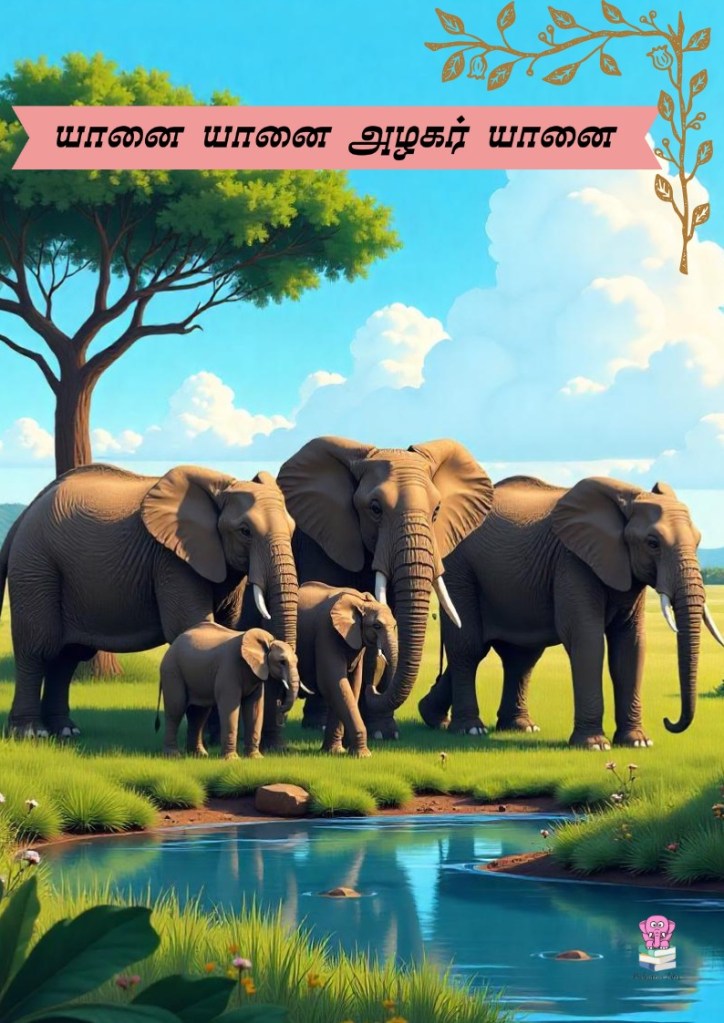
Usha: We used the Thirukural couplets to create easy content for children. We are creating nondetailed texts. We are also writing stories about elephants. Children like elephants a lot. How do elephants live? What does an elephant eat? Elephants are harmless and loved by children. To make children sleep all parents in Tamil Nadu will sing, ‘Annai Annai Ayaghar Annai.’
Usha: One of our stories goes – a small elephant saved and becomes a temple elephant. The stories of the child and the elephant as they grow up is parallelly traced.
We are documenting the stories of those who do good in society – celebrities, social workers, including Uma Aparna. We are covering stories of people in social service, education and healthcare.
People want these books. Parents want to read these books to children. Nondetailed books help children read.
Vanaja: These books are easy to carry and can be read in school. It reaches many people – school libraries, book fairs, reading for book fairs.
Usha: We are doing a book which contains writing from every continent. I wrote on Europe.
Usha: We are moving away from fiction towards children’s writing. Writing is very useful in making us feel productive.
We research and check google to ensure we no one has brought out books and content on the people we are writing about.
Rukmani: We are writing to take books to children. We want the Thirukural stories to reach small children.
Ruckmani: We want to write about how girls have come up and how they help society. We have written about their stories. We have written about Uma Aparna.
Since I wasa small child I used to read story books a lot. Because of my love for books I got the inspiration to write.
Alamelu :
As a small child, I used to read a lot of storybooks – Sujatha, Lakshmi, Indumati, Sandilyan. Uma Aparna encouraged me to write.
Kamala :
I like Tamil a lot.Kumudham, Ananda Vigadan etc. I did Katha kalashetram and was a storytelling expert. So I decided to write stories. I read Sujatha, Shree Venugopal – a spiritual writer, Tangadurai – a contemporary writer.
Bhanumati:
I have written for Bhagvada Kathaigal. Herein, I have explored the stories of Yashoda and Kannan. How, everyone likes Krishna. I have written in Nadodi kathaigal. In this collection of folktales, grama kathas, I have written on a story on Akbar and Birbal. I have contributed to the anthology – Avvaiyar Amdudha Muyvigel – narratives on the memorable and precious quotes of Tamil Poetess. Then I worked on the anthology Thukadagal which is a lot of small stories strung together. My story Odiporavan is on how a girl will suffer if her husband disappears.
Kamala:
I have written for the anthology Dasaavatar. I picked the Parasuraman avataram. This avatarn of Vishnu is an avesham avataran, where the Seer/Sage is short tempered. He serves his father Jamadagni and severs the head of his mother Renuka Devi. Then with the permission of his father he puts the head back creating two goddesses now Renuka Devi and Marimman.
Vanaja:
Our mother tongue is Tamil.
Jayanti:
The reading habit in Tamil must be inculcated. When we buy a dress for a child’s birthday. We must buy a book for the child as well.
Jayanti:
I did a PhD when I was in my 60s and teaching in a college. I am very proud of a song I wrote which was recorded with Carnatic music by a 10 year old girl and she had included my song among other songs by luminaries. My song was on teachers day and its message was –
Teachers taught us alphabets and letters
They are the ladder
They take us up in life
Brinda:
I was always interested in study. I used to read a lot of Tamil magazines. Elders in those days used to say they spoil the children’s mind, but my parents would encourage me to read. I have studied Tamil in school. My child studied in English. We must help children understand Tamil. That’s why I think its important to write, create literature and spread Tamil.
Vanaja:
I had a lot of love for Tamil. My children are in America and my great grand children want to learn Tamil. It is very important to know Tamil. All our children must know Tamil. All our stories in the anthologies are in Tamil.
Brinda:
I did BSc in mathematics. After marriage, I did an MA and Mphil. I studied the works of Vallallar the poet and Ramalingayal Adigelall, who believed in the spiritual path of bhakti.
Ruckmani:
We started learning English in the 6th standard. Tamil was from 1st standard. We think in Tamil, it comes naturally to us. I used to read a lot of books and my father also used to buy a lot of books. Kumudham, Vigadan, writing by Balakumaran, Sujatha, and Kalki’s classic Ponniyan Selyan. I used to keep writing poetry. I liked writing. Then Uma Aparna became a friend. Through the Pachyderm Tales project, we all joined the writing community. Lakshmi Priya is a great leader and thinks differently. We were all stunned by seeing what she was doing. We don’t just write the story. We would just get together as a group and decide what to write. Some of the books I have written for are Athichudi stories, Temple stories, etc. We all liked contributing to the anthologies, and I got a lot of feedback from people. My favourite contribution was for Velar Nachiyar. I took the angle of how girls were a part of the independence movement. I wrote a story about Kuili, who was the leader of the squad that helped Velan Nachiyar.
I wanted to write about girls and women who are making an outstanding contribution. I wrote about Lakshmi Priya, about Dr. Renuka helping leprosy patients.
In Tamil Nadu, the reading habits have reduced. Everybody has a story. There is often more than one story.
Brinda:
I did BSc in mathematics. Then I did my MPhil on Vallallr, Tamil saint and poet who wrote on the spiritual path or bhakti. I have published in 6 books and 4 more are on the way.
Brinda:
6 books published. 4 more on the way. I write to ensure my stories have a message on values. People must read our stories and know something.
Vanaja:
I was always intent on reading and writing as a child. I started writing 4-5 years ago. 16 books will be published.
Jayanthi:
We don’t give enough preference to Tamil. I did my PhD in Tamil. If you want to be a Tamil writer, you must study Tamil. I used to write in different types of genres. I went to Sita Lakshmi College and wanted to educate children. As a writer, my intent was to take Tamil to the schools.
Jayanthi:
My father was a writer. So, I liked writing a lot. My mother used to run a school. I used to write for Vigadan, Kalki, Kumudhan, when I was in school. I have interviewed many people in cine field. My mother started a school. When I taught children I used to teach Alzh Villiappa’s songs. His children’ s songs were very good. He was superstar of children’s literature. We liked the songs. I wanted songs for my school children. I write poems. I have written more than 80 books – biographies of many people including JK Rowling.
Brinda:
I can’t write is what I thought. I had written with Mangelmallar. I have been writing for 30 years. My name is well known among those who read Tamil Magazine – Brinda Ramani. I have written really popular articles – 30 types of rasam, 30 types of dosa etc. Being a well known writer, I was on facebook. I blog. I did these projects for Uma Aparna.
Kamala:
I like Tamil a lot. Kumudham, Ananda Vigadan, Katha kalakshetram. I am a storytelling expert. So, I decided to write stories. Kalki, Sujata, I like a lot. Shree Venugopal is spiritual writer and Pushpa Tangedurai is a contemporary writer.
Kamala:
I contributed to the anthology Dasavataram. I wrote about the Parashuraman avatar. This is an aveshan avatara, because he is short tempered. Due to bhakti to his father Jamadagni – he severs the head of his mother. This devi, whose head is then replaced is known as Mariamman, Renuka Devi, Yellamma etc.
Vanaja:
Our mother tongue is Tamil we must encourage it. Reading habit should be inculcated rigorously. Just as buy dresses for children during their birthday we must buy books too.
Jayanthi:
I have done my PhD. My happiest memory is when a 10 year old creates this song with Carnatic music base –
Flower bud
Teachers teach us alphabets and letters.
They are the ladder
They take us up
Revathi:
Working on these anthologies we learn so much about culture. Through writing literature, we are able to experience culture. We should not let go of our culture and heritage.
Praveena:
It is very important to write about culture.
Revathi:
Every mother must ensure that the child knows Tamil. We must all make an effort to learn Tamil.
Praveena:
Culture is disappearing.
Revathi:
We should get children to learn all languages. English, Hindi and Tamil. We should teach children Tamil. We should not forget Tamil.
Praveena:
I am Tamilian and proud to say this to the world. We must take the Thirukural and understands the basics there – how to lead a happy life, be content etc.
Hema :
Children today don’t know Tamil. It is to help children learn reading and writing in Tamil that I started writing. I have just started. My mission has just started.
Prabha:
We were featured in the Guinness book of records. We brought out 52 books by 62 writers.
Hema:
I got a lot of support from my daughter.
Mythali:
Tamil is disappearing. English is today the main subject. In the Tamil we speak there is a lot of English mixture. In our daily speech we use 80% English and 20% Tamil. It is important we introduce children to the Tamil world.
Revathi:
Tamil is the language of our state. It is easy to destroy but difficult to preserve your heritage, your mother tongue. I am also fluent in Hindi and do, Tamil and Hindi translations.
Prabha:
I produce a youtube channel.
Hema:
I have wanted to write a lot. I am also a storyteller.
Prabha:
I have a good team and a good publisher. I would like to thank them for supporting me with my writing.
Mythali:
I was recently introduced to Uma Aparna. I was running a Montessori school. I have lot of experience in telling stories. Uma Aparna motivated me.
Hema:
I have written stories online, infact both stories and poems online. Through this project I got a chance to write for publication.
Praveena:
I used to write poems in both English and Tamil. When I was a teacher in school I used to tell stories to students. I used to teach English through stories. I have a youtube channel where I tell stories. Uma Aparna motivated me to write stories. I have written the story of Mimmini and Kinkini – the story of two friends.



 Learn Curve for Girls